Horizontal and vertical integration (bakery example)
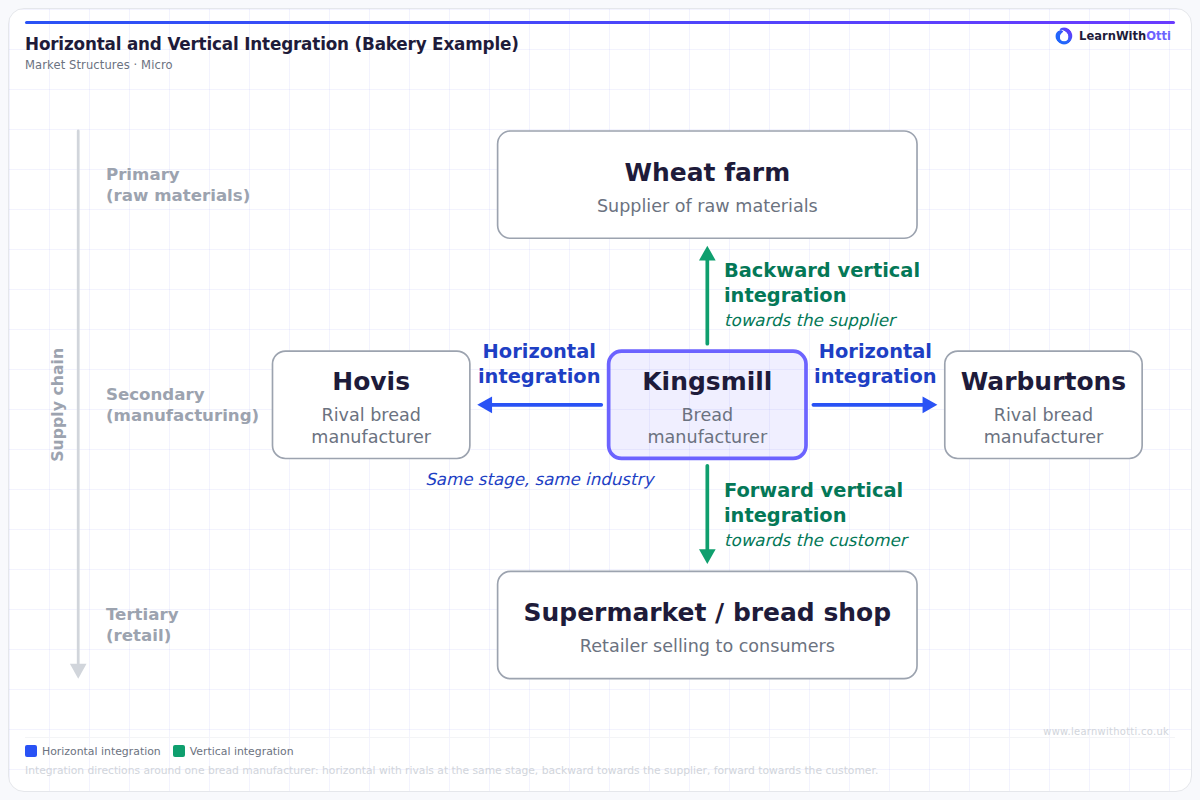
Box-and-arrow diagram of the directions of integration around one bread manufacturer: horizontal integration with rival bread manufacturers at the same stage, backward vertical integration towards the wheat supplier and forward vertical integration towards the retailer, set against the primary, secondary and tertiary stages of the supply chain.
Printable preview
Download a static PNG of this diagram to print or include in revision notes.
Download PNGWhat this diagram shows
This diagram places one bread manufacturer, Kingsmill, at the centre of the bread supply chain and shows the three directions it could grow by integration. Moving outwards along its own row, it could join with a rival bread manufacturer such as Hovis or Warburtons: that is horizontal integration, two firms at the same stage of production in the same industry. Moving up the chain, it could join with a supplier of its raw materials, such as a wheat farm: that is backward vertical integration. Moving down the chain, it could join with a retailer that sells bread to consumers, such as a supermarket or bread shop: that is forward vertical integration. The faint labels on the left show the stages of production: primary (raw materials), secondary (manufacturing) and tertiary (retail). A real example of the horizontal case: ABF, which owns Kingsmill, agreed to buy Hovis, and the Competition and Markets Authority cleared the deal in June 2026 after a phase 2 investigation.
Key points
- Horizontal integration joins firms at the same stage of production in the same industry, such as two bread manufacturers.
- Backward vertical integration joins a firm with a supplier earlier in the supply chain, such as a bread manufacturer and a wheat farm.
- Forward vertical integration joins a firm with a business later in the supply chain, closer to the consumer, such as a bread manufacturer and a retailer.
- The supply chain runs from primary (raw materials) through secondary (manufacturing) to tertiary (retail), and vertical integration moves a firm up or down it.
- Horizontal integration can bring economies of scale and a larger market share, but it reduces the number of competitors, which is why competition authorities such as the CMA review large mergers.
- Vertical integration can secure supplies or sales outlets and cut transaction costs, but it can also be used to deny rivals access to inputs or customers.
Exam tip
When you use this diagram, name the direction and give a reason in the same breath: backward vertical integration secures the supply of a key input such as wheat, forward vertical integration secures access to customers, and horizontal integration joins two firms at the same stage to gain economies of scale and market share. Then say what it means for competition, because a horizontal merger between rivals removes a competitor from the market.
Common mistakes
The most common mistake is mixing up backward and forward vertical integration. Backward means towards the supplier (earlier in the supply chain), forward means towards the customer (later in the supply chain). Another is calling any merger horizontal: two firms are only horizontally integrated if they are at the same stage of production in the same industry. A third is assuming integration always benefits consumers; the same merger can cut costs and also reduce competition.
Ask Otti about this diagram
Our AI tutor can walk you through every curve, explain exam technique, and quiz you on it.