Asymmetric Information
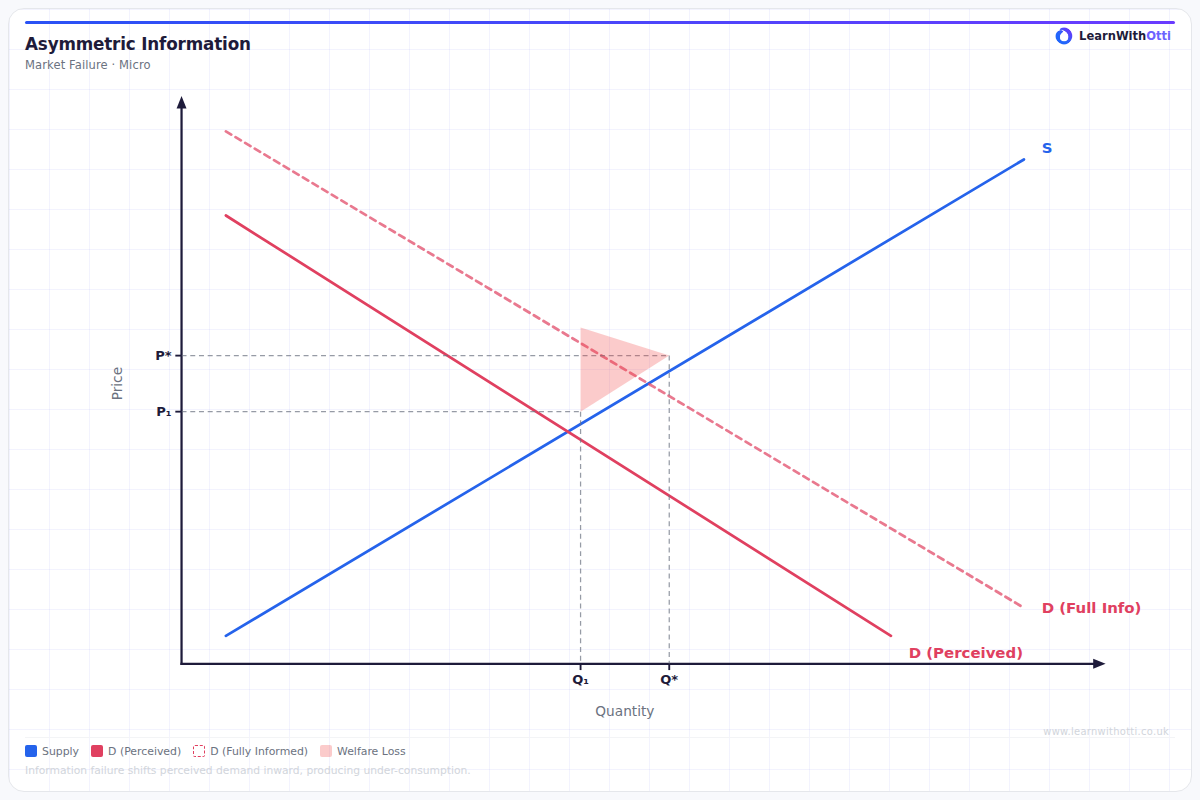
Diagram illustrating market failure due to asymmetric information (moral hazard and adverse selection), showing how information gaps lead to under- or over-provision of goods.
Printable preview
Download a static PNG of this diagram to print or include in revision notes.
Download PNGWhat this diagram shows
Asymmetric information occurs when one party in a transaction has more or better information than the other party, leading to market failure. This diagram typically shows how information gaps create inefficient outcomes, such as in insurance markets where buyers know more about their risk levels than sellers. The result is often market breakdown, reduced trade, or the exclusion of low-risk participants from the market. Understanding this concept is crucial for explaining why perfectly competitive market assumptions often fail in real-world scenarios.
Key points
- Asymmetric information creates market failure when buyers and sellers have unequal access to relevant information
- Adverse selection occurs before contracts are made - high-risk buyers are more likely to purchase insurance, driving up prices
- Moral hazard happens after contracts are signed - people change behaviour because they're protected from consequences
- Common examples include insurance markets, second-hand car sales (lemons problem), and labour markets
- Solutions include signalling, screening, regulation, and government intervention to improve information flows
Exam tip
Students often confuse asymmetric information with externalities - remember that asymmetric information is a cause of market failure, not an externality itself. Examiners are impressed when you clearly distinguish between adverse selection (pre-contract information problems) and moral hazard (post-contract behaviour changes).
Common mistakes
Students frequently mix up adverse selection and moral hazard, incorrectly identifying which occurs before or after the contract. They also wrongly classify asymmetric information as a type of externality rather than recognising it as a separate cause of market failure.
Exam board notes
All major exam boards treat this diagram identically, focusing on the same key concepts of adverse selection and moral hazard. Some boards may emphasise different real-world examples, but the underlying economic principles and diagram interpretation remain consistent across AQA, Edexcel, OCR and CIE.
Related diagrams
Ask Otti about this diagram
Our AI tutor can walk you through every curve, explain exam technique, and quiz you on it.