Public Goods and the Free Rider Problem
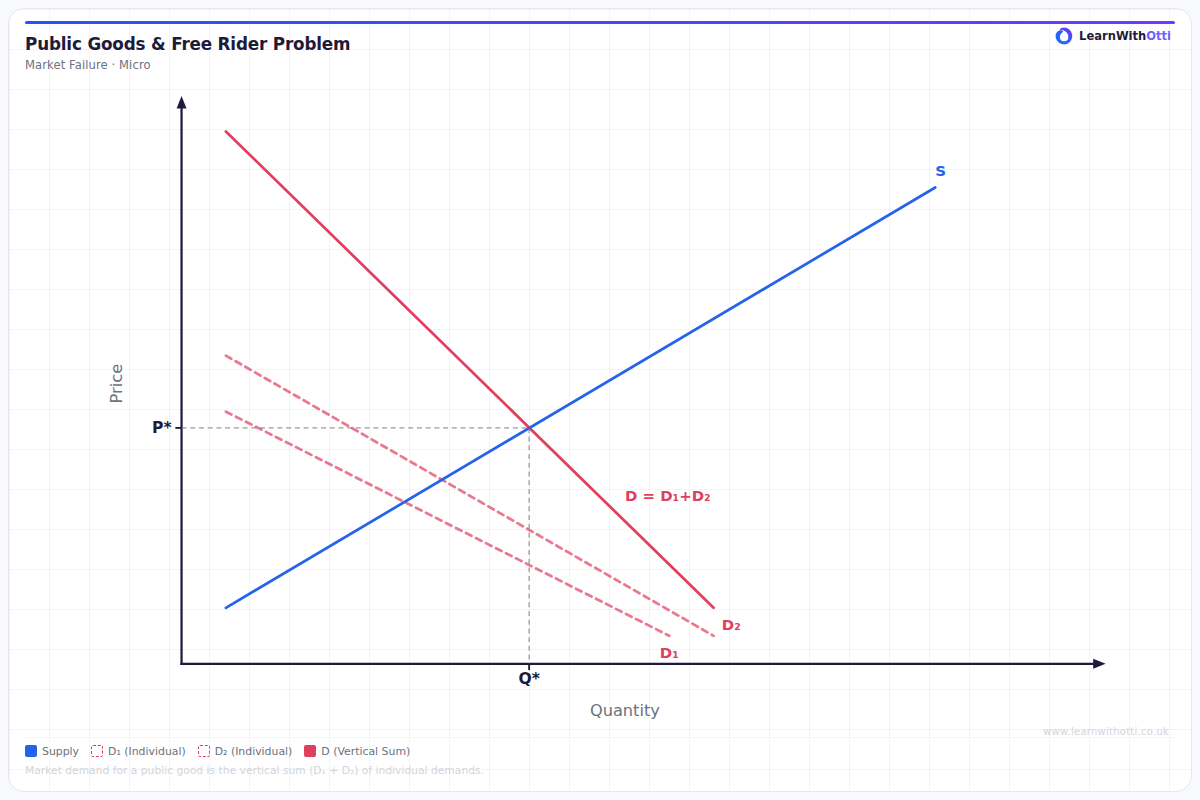
Diagram illustrating the free rider problem for non-excludable, non-rival public goods, showing why the market fails to provide them and justifying government provision.
Printable preview
Download a static PNG of this diagram to print or include in revision notes.
Download PNGWhat this diagram shows
This diagram illustrates how public goods create market failure because they possess two key characteristics: non-excludability (you can't prevent people from consuming them) and non-rivalry (one person's consumption doesn't reduce availability for others). The free rider problem occurs because rational consumers have no incentive to pay for public goods when they can benefit without paying, knowing others cannot be excluded. This leads to under-provision or complete market failure, as private firms cannot generate sufficient revenue to cover costs. The diagram typically shows how the socially optimal level of provision exceeds what the free market would provide.
Key points
- Public goods have two defining characteristics: non-excludability and non-rivalry in consumption
- Free riders are rational consumers who benefit from public goods without paying, as exclusion is impossible
- Private markets under-provide or fail to provide public goods because firms cannot capture sufficient revenue
- The free rider problem creates a gap between socially optimal provision and market provision
- Government intervention through taxation and direct provision is needed to achieve allocative efficiency
Exam tip
Students often confuse public goods with merit goods - remember that public goods are NON-EXCLUDABLE and NON-RIVALROUS, while merit goods can be provided privately but are under-consumed. Examiners are impressed when you clearly explain WHY rational consumers free-ride and link this to market failure requiring government intervention.
Common mistakes
Students frequently mix up public goods with merit goods, incorrectly including healthcare or education as pure public goods when these can be provided privately. They also fail to explain WHY people free-ride, missing the crucial point that it's rational behaviour given the non-excludable nature of public goods.
Exam board notes
All major exam boards treat this diagram identically, emphasizing the twin characteristics of public goods and the resulting free rider problem. Some boards like AQA may place slightly more emphasis on real-world examples and government solutions in their mark schemes.
Related diagrams
Ask Otti about this diagram
Our AI tutor can walk you through every curve, explain exam technique, and quiz you on it.