Choice Architecture and Nudge Theory
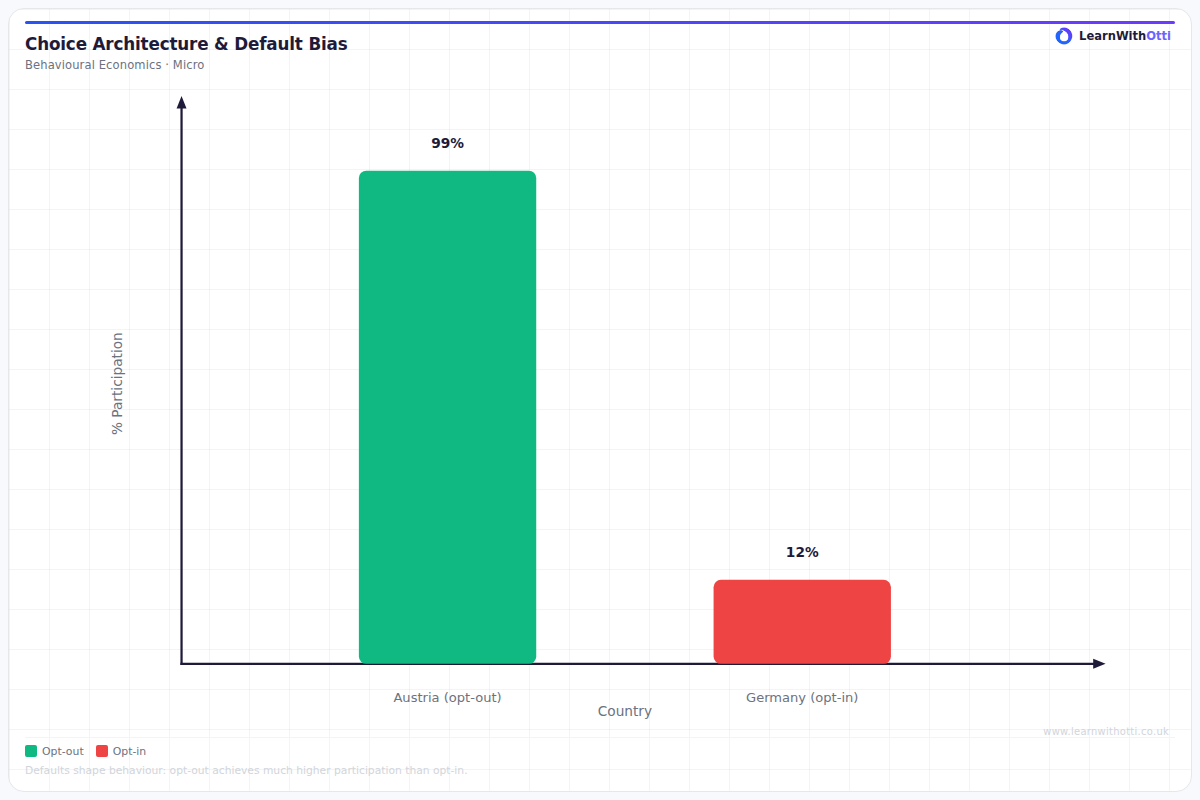
Diagram illustrating behavioural economics interventions such as default options, framing, and nudges that shift consumer choices without restricting freedom.
Printable preview
Download a static PNG of this diagram to print or include in revision notes.
Download PNGWhat this diagram shows
This diagram illustrates how choice architecture and nudge theory can address negative externalities by influencing behaviour without restricting freedom. Unlike traditional government intervention (taxes, regulations), nudges work by redesigning how choices are presented to encourage socially optimal decisions. For example, making healthy food more visible in canteens or setting organ donation as an opt-out rather than opt-in system. This approach recognises that people don't always make rational decisions and can be 'nudged' towards better outcomes for both themselves and society.
Key points
- Choice architecture involves designing the context in which people make decisions to guide them towards better outcomes
- Nudges preserve individual freedom of choice while encouraging socially beneficial behaviour
- This approach addresses negative externalities by changing behaviour at source rather than through punishment
- Examples include default settings (opt-out organ donation), social norms messaging, and strategic placement of choices
- Nudge theory recognises that people are not always rational decision-makers and can be influenced by how choices are framed
Exam tip
Examiners are impressed when students can clearly distinguish between 'nudging' and traditional government intervention - nudges preserve choice while reducing negative externalities. Always explain how choice architecture addresses market failure without restricting freedom, as this shows sophisticated understanding of behavioural economics.
Common mistakes
Students often confuse nudges with traditional government intervention, failing to emphasise that nudges maintain freedom of choice. Many also struggle to explain how nudges specifically address externalities rather than just changing any behaviour.
Exam board notes
AQA and Edexcel place stronger emphasis on practical applications and policy examples of nudge theory. OCR focuses more on the theoretical foundations and links to behavioural economics concepts, while all boards expect students to evaluate the effectiveness of nudges versus traditional interventions.
Related diagrams
Ask Otti about this diagram
Our AI tutor can walk you through every curve, explain exam technique, and quiz you on it.