Equilibrium Shifts: Demand and Supply Both Shift Right
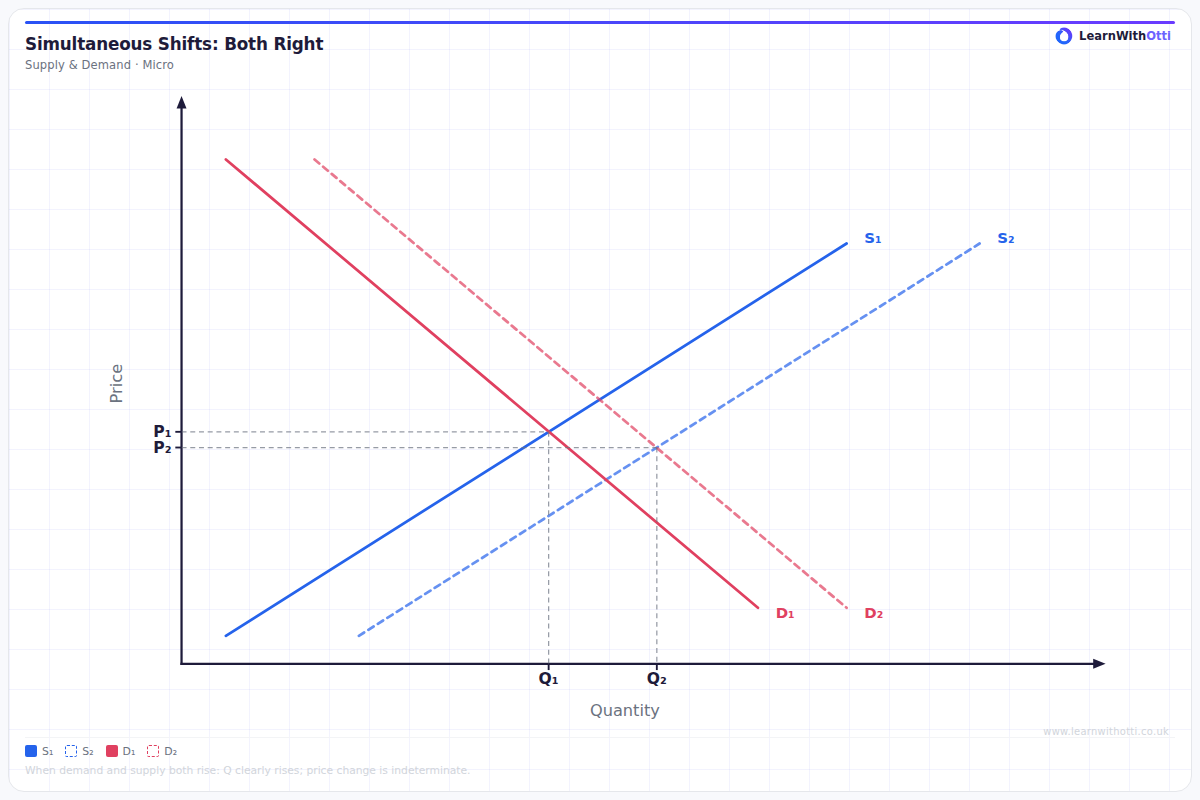
Shows demand and supply both shifting right. Equilibrium quantity rises, because both an increase in demand and an increase in supply raise the quantity traded. The effect on price is indeterminate: the demand shift pushes price up and the supply shift pushes it down, so the direction depends on which shift is larger.
Printable preview
Download a static PNG of this diagram to print or include in revision notes.
Download PNGWhat this diagram shows
Shows demand and supply both shifting right. Equilibrium quantity rises, because both an increase in demand and an increase in supply raise the quantity traded. The effect on price is indeterminate: the demand shift pushes price up and the supply shift pushes it down, so the direction depends on which shift is larger.
Key points
- Both curves shift right: demand from D1 to D2 and supply from S1 to S2.
- Equilibrium quantity definitely rises. An increase in demand and an increase in supply both raise the quantity traded.
- The effect on price is indeterminate. The demand shift pushes price up and the supply shift pushes it down.
- Which way price moves depends on which shift is larger. If the two shifts are equal, price is unchanged.
- State which variable is determinate and which is not, rather than guessing at the ambiguous one.
Exam tip
State the determinate outcome first: quantity rises. Then explain that the price change depends on the relative size of the two shifts, rather than asserting a direction you cannot justify from the diagram.
Common mistakes
The commonest error is claiming the quantity effect is indeterminate. With both curves shifting right, quantity definitely rises; it is the price effect that cannot be determined. Students also assert a direction for price without justification, when the correct answer is that it depends on which shift is larger, and some describe the shifts as "upward", which obscures the fact that both are increases.
Related diagrams
Ask Otti about this diagram
Our AI tutor can walk you through every curve, explain exam technique, and quiz you on it.