Buffer Stock Scheme
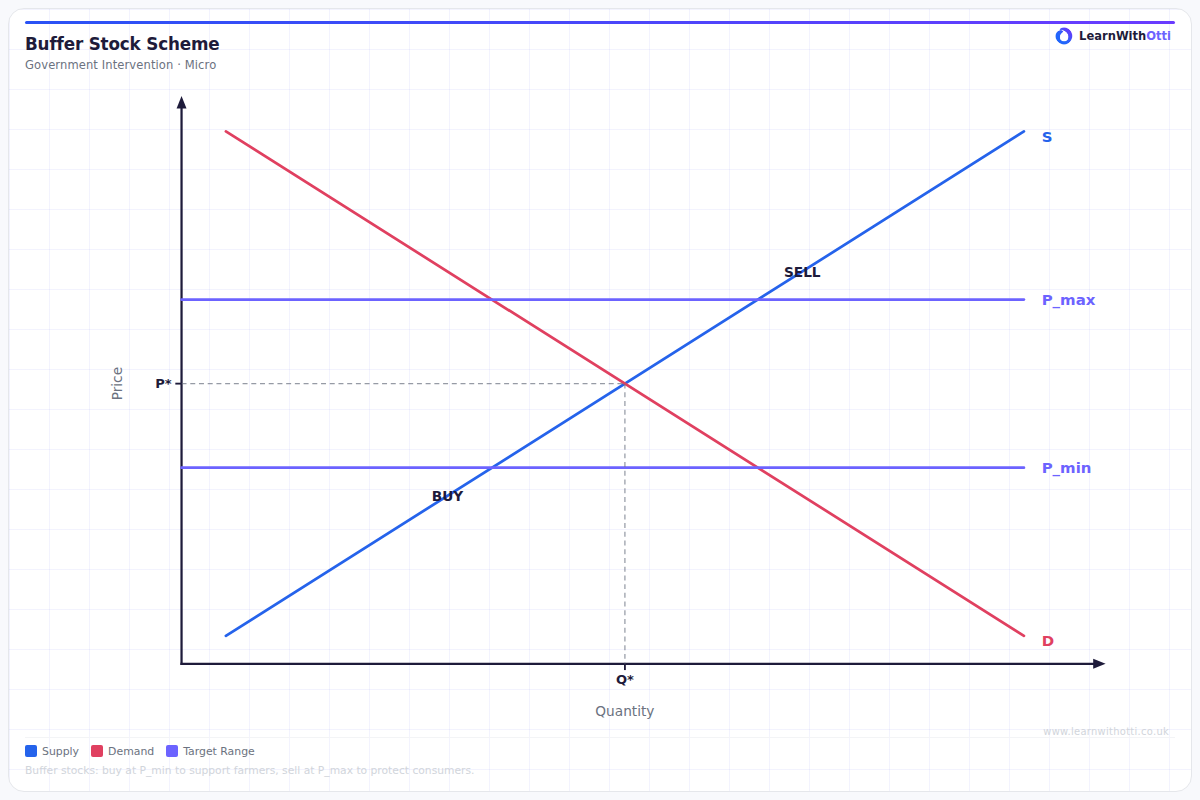
Diagram showing a buffer stock scheme where a government agency buys when prices fall below a floor and sells when prices rise above a ceiling to stabilise commodity prices.
Printable preview
Download a static PNG of this diagram to print or include in revision notes.
Download PNGWhat this diagram shows
A buffer stock scheme shows how governments intervene to stabilize commodity prices by setting a price floor and ceiling, with a buffer stock authority buying and selling to maintain prices within this range. When market prices fall below the floor price, the authority purchases excess supply to push prices back up, and when prices rise above the ceiling, it releases stocks to increase supply and reduce prices. This intervention aims to reduce price volatility in commodity markets, protecting both producers from extremely low prices and consumers from price spikes. It's particularly important for agricultural products and raw materials where supply can be highly variable due to factors like weather conditions.
Key points
- The scheme creates a price corridor with a maximum (ceiling) and minimum (floor) price that the authority will defend
- When market price falls below the floor, the buffer stock authority becomes a buyer, purchasing excess supply to raise prices
- When market price rises above the ceiling, the authority sells from its accumulated stocks to increase supply and lower prices
- The scheme requires significant financial resources to purchase stocks and storage facilities to hold commodities
- Success depends on setting appropriate price levels and having sufficient funding - schemes can fail if price bands are unrealistic or resources are inadequate
Exam tip
Examiners are impressed when students clearly explain the stabilization mechanism - how the buffer stock authority buys when prices fall below the floor and sells when prices rise above the ceiling. Students often fail to explain WHY this intervention is needed, so always mention the problem of volatile commodity prices affecting producer incomes and consumer costs.
Common mistakes
Students often confuse which way the authority intervenes - remember they buy when prices are LOW (below floor) and sell when prices are HIGH (above ceiling). Many also forget to mention the substantial costs involved in running such schemes, including storage costs and the risk of stock deterioration.
Exam board notes
All major exam boards treat this diagram identically, though OCR tends to emphasize the evaluation of buffer stock schemes more heavily, particularly discussing why many international commodity agreements using buffer stocks have failed in practice.
Related diagrams
Ask Otti about this diagram
Our AI tutor can walk you through every curve, explain exam technique, and quiz you on it.