Circular Flow of Income (Basic)
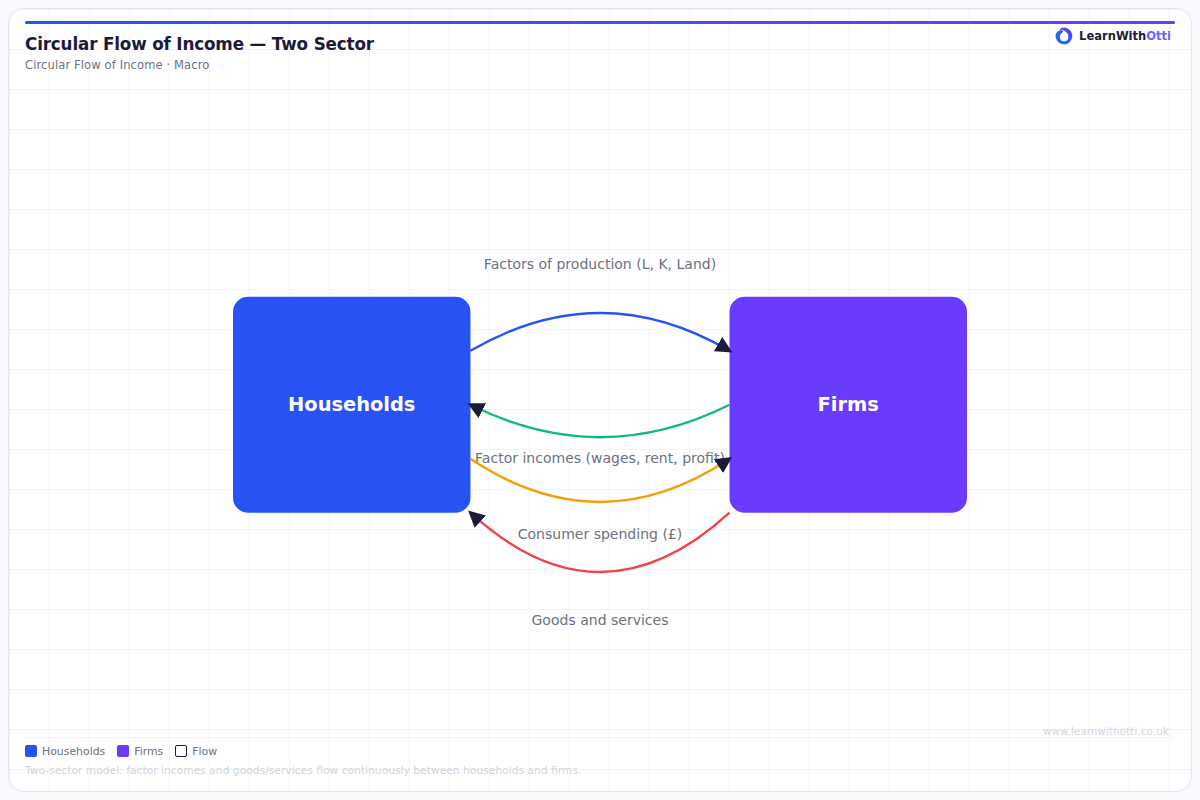
Two-sector circular flow model showing the flow of income and expenditure between households and firms through goods markets and factor markets.
Printable preview
Download a static PNG of this diagram to print or include in revision notes.
Download PNGWhat this diagram shows
The basic circular flow of income diagram shows how money moves continuously between households and firms in a simplified economy. Households provide factors of production (land, labour, capital) to firms and receive income in return (rent, wages, profit). This income is then spent on goods and services produced by firms, creating a circular flow of money around the economy that forms the foundation of economic activity.
Key points
- Households supply factors of production (land, labour, capital) to firms in exchange for income (rent, wages, profit)
- Households spend their income on goods and services produced by firms, creating consumer expenditure
- Firms use household expenditure as revenue to pay for factors of production, completing the circular flow
- The flow can be measured at any point and should theoretically be equal - income = expenditure = output
- This is a simplified model assuming no government, foreign trade, or saving/investment (closed economy with no leakages or injections)
Exam tip
Examiners are impressed when students can explain that the circular flow is a continuous process - money doesn't just flow once but keeps circulating around the economy. Always emphasize that households' expenditure becomes firms' revenue, which then becomes households' income again, creating an endless cycle.
Common mistakes
Students often forget that this is a flow of money, not goods and services - the diagram shows monetary flows only. They also commonly mix up the direction of flows, showing money going the wrong way around the circular flow.
Exam board notes
All major exam boards treat this diagram identically. It forms the foundation for more complex circular flow models that include government, foreign trade, and financial markets across all specifications.
Related diagrams
Ask Otti about this diagram
Our AI tutor can walk you through every curve, explain exam technique, and quiz you on it.