Contestable Markets
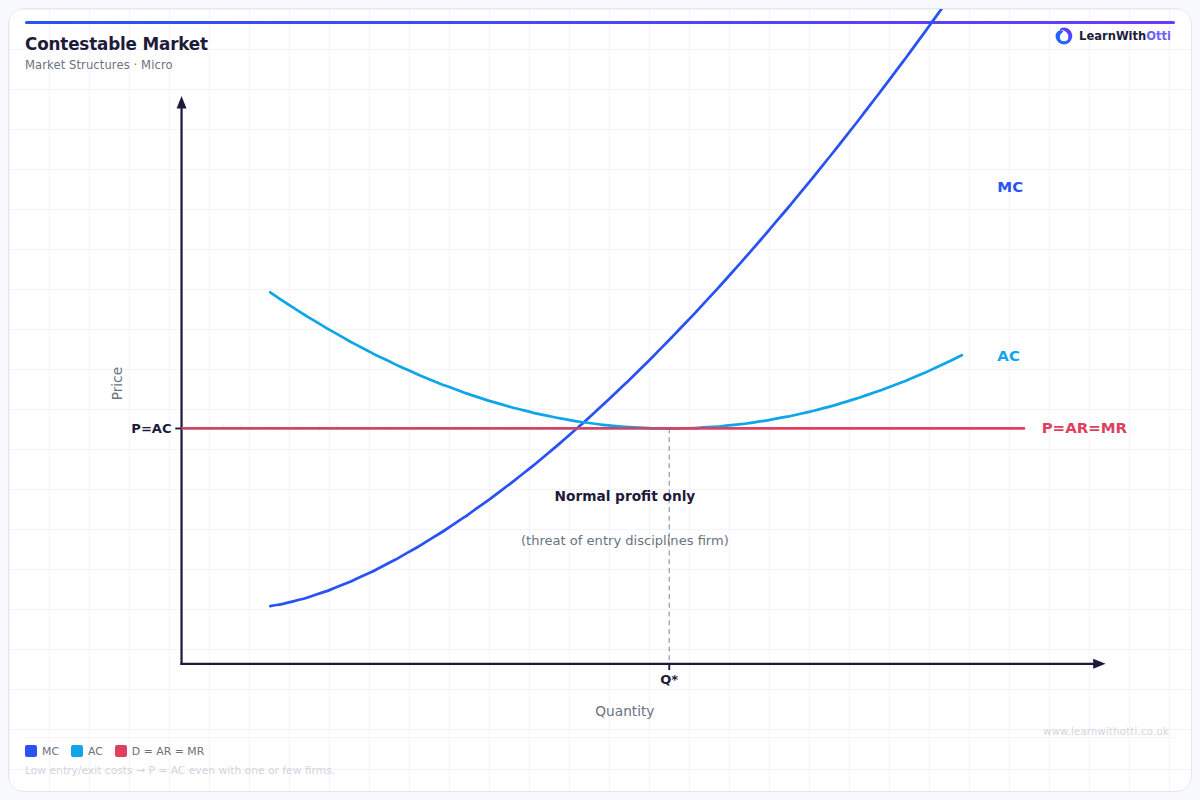
Diagram illustrating the theory of contestable markets, where the threat of new entry disciplines incumbent firms to price competitively even in concentrated markets.
Printable preview
Download a static PNG of this diagram to print or include in revision notes.
Download PNGWhat this diagram shows
A contestable markets diagram shows how the mere threat of new firms entering a market can force existing firms to behave competitively, even if they currently have market power. The key insight is that when barriers to entry and exit are low, incumbent firms must price at competitive levels to deter potential entrants. This creates efficiency benefits similar to perfect competition, but without needing many firms actually operating in the market. The diagram typically shows how supernormal profits attract entry, forcing prices down to normal profit levels.
Key points
- Low barriers to entry and exit are essential - this includes sunk costs being minimal so firms can enter and leave easily
- The threat of entry disciplines existing firms to price competitively and operate efficiently, even without actual entry occurring
- Perfect information is assumed so potential entrants know about profit opportunities in the market
- Hit-and-run entry is possible where firms can enter, take profits, and exit quickly before incumbents respond
- Results in allocative and productive efficiency similar to perfect competition, with prices close to marginal cost
Exam tip
Examiners are impressed when students distinguish between perfectly competitive markets and contestable markets - they're not the same thing! A monopoly can still be contestable if barriers to entry are low, so focus on the threat of entry rather than just the number of existing firms.
Common mistakes
Students often confuse contestable markets with perfectly competitive markets, thinking they need many small firms. The key point is that contestability depends on the ease of entry/exit, not the current number of firms in the market.
Exam board notes
All major exam boards treat this diagram identically, emphasizing the importance of barriers to entry/exit and the disciplining effect of potential competition. Some specifications place slightly more emphasis on real-world examples like airline routes or online markets.
Related diagrams
Ask Otti about this diagram
Our AI tutor can walk you through every curve, explain exam technique, and quiz you on it.