Marshall-Lerner Condition
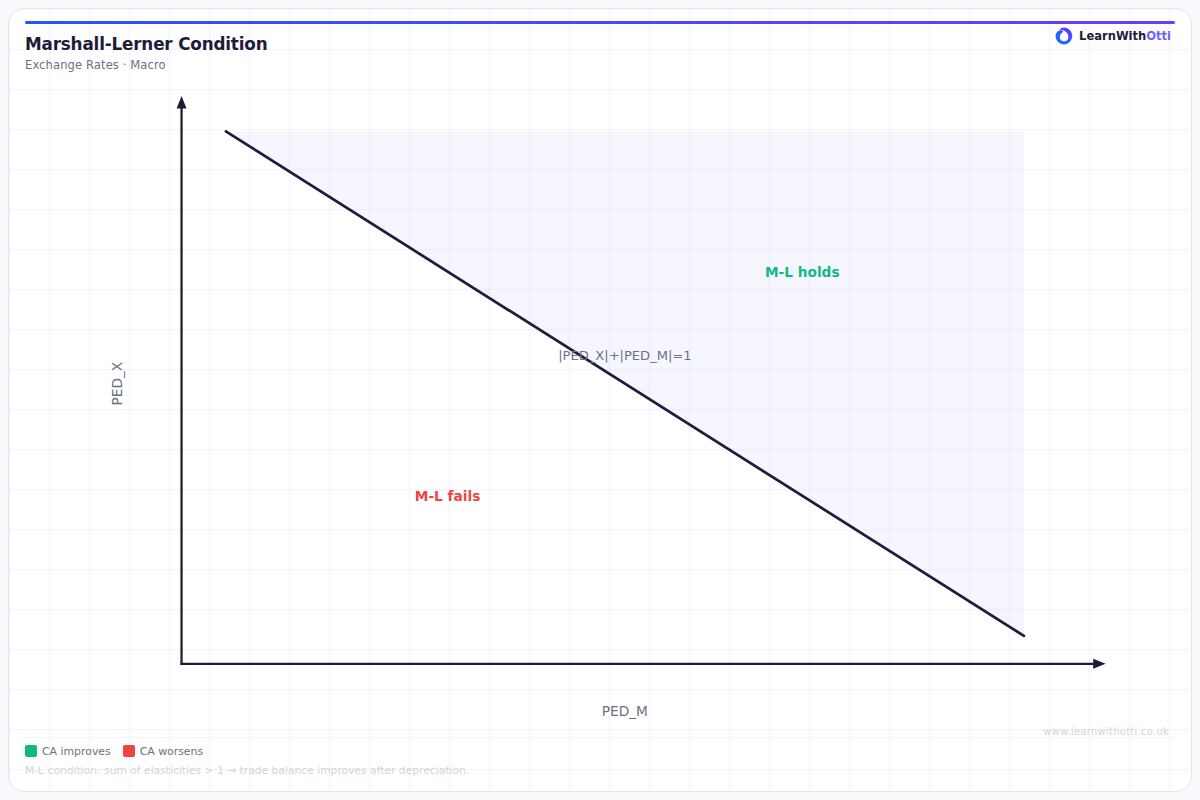
Diagram explaining the Marshall-Lerner condition: currency depreciation improves the current account only if the sum of PED for exports and imports exceeds one.
Printable preview
Download a static PNG of this diagram to print or include in revision notes.
Download PNGWhat this diagram shows
The Marshall-Lerner condition shows the relationship between exchange rates and the trade balance, specifically when a currency depreciation will improve a country's trade balance. It states that for a depreciation to be effective in reducing a trade deficit, the combined price elasticities of demand for exports and imports must be greater than 1. This diagram illustrates why currency devaluations don't always work as intended - if demand for imports and exports is relatively price inelastic, the volume changes won't be sufficient to offset the price effects of depreciation.
Key points
- The condition states: |PED exports| + |PED imports| > 1 for depreciation to improve trade balance
- If the condition is met, depreciation increases export revenue more than import expenditure
- If the condition is not met, depreciation worsens the trade balance despite making exports more competitive
- The condition helps explain the J-curve effect - trade balance initially worsens as elasticities are low in the short run
- Long-run elasticities are typically higher than short-run, making the condition more likely to be satisfied over time
Exam tip
Examiners love to see students explain that the Marshall-Lerner condition requires the sum of price elasticities of demand for imports and exports to exceed 1 for a currency depreciation to improve the trade balance. The most impressive answers demonstrate understanding that this condition explains why the J-curve effect occurs - initially the trade balance worsens before improving.
Common mistakes
Students often forget that it's the sum of the absolute values of both elasticities that must exceed 1, not just the export elasticity. Many also fail to explain why the condition might not hold in the short run due to existing contracts and limited substitutes.
Exam board notes
All major exam boards treat this diagram identically, though OCR places slightly more emphasis on the mathematical relationship while AQA focuses more on the policy implications for developing countries.
Related diagrams
Ask Otti about this diagram
Our AI tutor can walk you through every curve, explain exam technique, and quiz you on it.