PPF Inward Shift (Decrease in Productive Capacity)
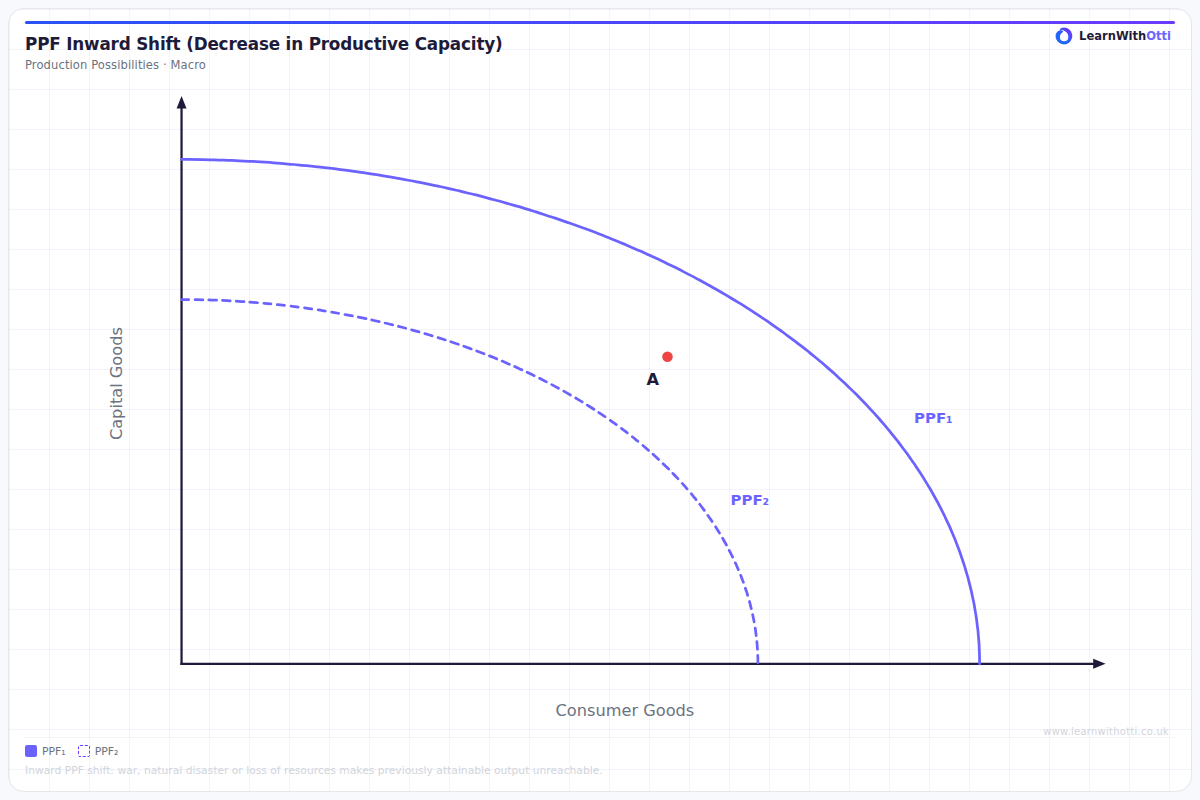
PPF diagram showing an inward shift representing a decrease in productive capacity, e.g. through war, natural disaster, or loss of resources, making previously attainable combinations unreachable.
Printable preview
Download a static PNG of this diagram to print or include in revision notes.
Download PNGWhat this diagram shows
An inward shift of the Production Possibilities Frontier (PPF) shows that an economy's maximum productive capacity has fallen, meaning it can now produce fewer goods and services than before even when all resources are fully and efficiently employed. This occurs when the quantity or quality of factors of production decreases — for example, through war, natural disaster, emigration of skilled labour, or the depletion of natural resources. Unlike a movement along the PPF (which reflects opportunity cost trade-offs), a shift of the entire curve represents a macroeconomic change in what the economy is capable of producing. Understanding inward shifts is crucial because they illustrate real-world economic decline and contrast sharply with outward shifts driven by economic growth.
Key points
- An inward (leftward) shift of the PPF represents a decrease in an economy's productive capacity, meaning fewer combinations of goods and services are attainable.
- Causes include a reduction in the quantity of factors of production (e.g. mass emigration reducing labour supply) or a fall in their quality (e.g. skills deterioration, capital depreciation without replacement).
- Natural disasters, wars, pandemics, and environmental degradation are classic real-world triggers for an inward PPF shift, as they destroy physical and human capital.
- An inward shift affects all points on the PPF simultaneously — every production combination becomes less achievable, not just those involving one specific good.
- The inward shift highlights that economic decline is not just about unemployment (a point inside the PPF) but about a permanent reduction in what the economy could achieve even at full efficiency.
Exam tip
Students often lose marks by simply stating that the PPF shifts inward without explaining the mechanism — examiners want you to identify the specific factor of production that has been lost or degraded and link it explicitly to reduced productive capacity. Impress examiners by distinguishing between a temporary inward shift (e.g. a natural disaster) and a more permanent one (e.g. sustained emigration of skilled workers), as this shows sophisticated understanding of long-run versus short-run supply-side effects.
Common mistakes
The most common mistake is confusing an inward shift of the PPF with a point moving inside the PPF — a point inside the curve shows inefficiency or unemployment of resources, whereas an inward shift means the maximum potential itself has fallen. Students also frequently forget that the shift must affect the entire frontier, not just one axis, unless the lost resource specifically affects only one type of production.
Exam board notes
Edexcel and AQA both integrate inward PPF shifts within broader questions on economic growth and supply-side policy, so students should be ready to link the diagram to a specific policy response. Both boards also expect a clear distinction between an inward shift and a movement to a point inside an unchanged PPF, since conflating the two is the most common source of lost marks.
Related diagrams
Ask Otti about this diagram
Our AI tutor can walk you through every curve, explain exam technique, and quiz you on it.