Transfer Pricing by a Multinational
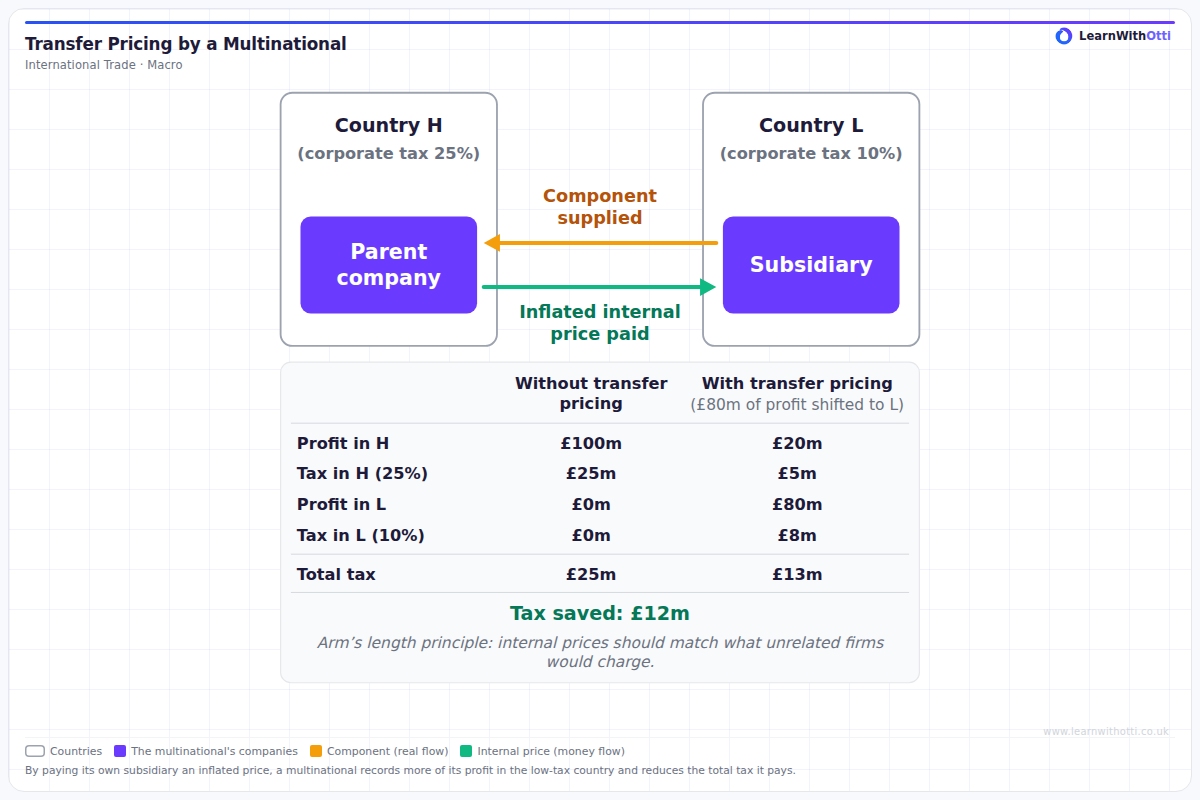
A parent company in Country H (corporate tax 25%) buys a component from its own subsidiary in Country L (corporate tax 10%) at an inflated internal price. Shifting £80m of a £100m profit to L cuts the total tax paid from £25m to £13m, saving £12m.
Printable preview
Download a static PNG of this diagram to print or include in revision notes.
Download PNGWhat this diagram shows
This diagram shows a multinational with its parent company in Country H, where corporate tax is 25%, and a subsidiary in Country L, where corporate tax is 10%. The subsidiary supplies a component to the parent, and the parent pays the subsidiary an internal price for it. Without transfer pricing, all £100m of profit is recorded in H and taxed at 25%, so the tax paid is £25m. With transfer pricing, the parent pays an inflated internal price, which shifts £80m of profit to L: H records £20m of profit and pays £5m in tax, and L records £80m and pays £8m. Total tax falls to £13m, saving £12m, although the multinational's total profit is still £100m.
Key points
- Transfer pricing is the setting of prices for goods and services traded within a multinational: here, a component supplied by the subsidiary in Country L to the parent company in Country H.
- An inflated internal price paid by the parent raises its costs in Country H, where corporate tax is 25%, and raises the subsidiary's revenue in Country L, where corporate tax is 10%.
- Without transfer pricing: £100m profit in H and £25m tax. With transfer pricing: £20m profit in H (£5m tax) and £80m in L (£8m tax), £13m tax in total.
- Total profit is £100m in both cases; only where it is recorded changes, and the tax saved is £25m − £13m = £12m.
- The arm's length principle says internal prices should match what unrelated firms would charge; when the internal price is set above that, Country H loses tax revenue.
Exam tip
Explain the mechanism step by step with the numbers. The parent company in Country H pays its own subsidiary in Country L an inflated internal price for a component. That raises the parent's costs, so profit recorded in H falls from £100m to £20m, while profit recorded in L rises from £0m to £80m. Taxed at 25% in H and 10% in L, the multinational's total tax falls from £25m to £13m, a saving of £12m. Use the arm's length principle as the benchmark: internal prices should match what unrelated firms would charge.
Common mistakes
Students often say the multinational makes more profit through transfer pricing; in the diagram total profit is £100m either way, and only the tax paid changes. Another slip is to reverse the flows: the component goes from the subsidiary in the low-tax country to the parent, and the inflated price is paid by the parent to the subsidiary, which moves profit into the low-tax country.
Related diagrams
Ask Otti about this diagram
Our AI tutor can walk you through every curve, explain exam technique, and quiz you on it.