Automatic Stabilisers
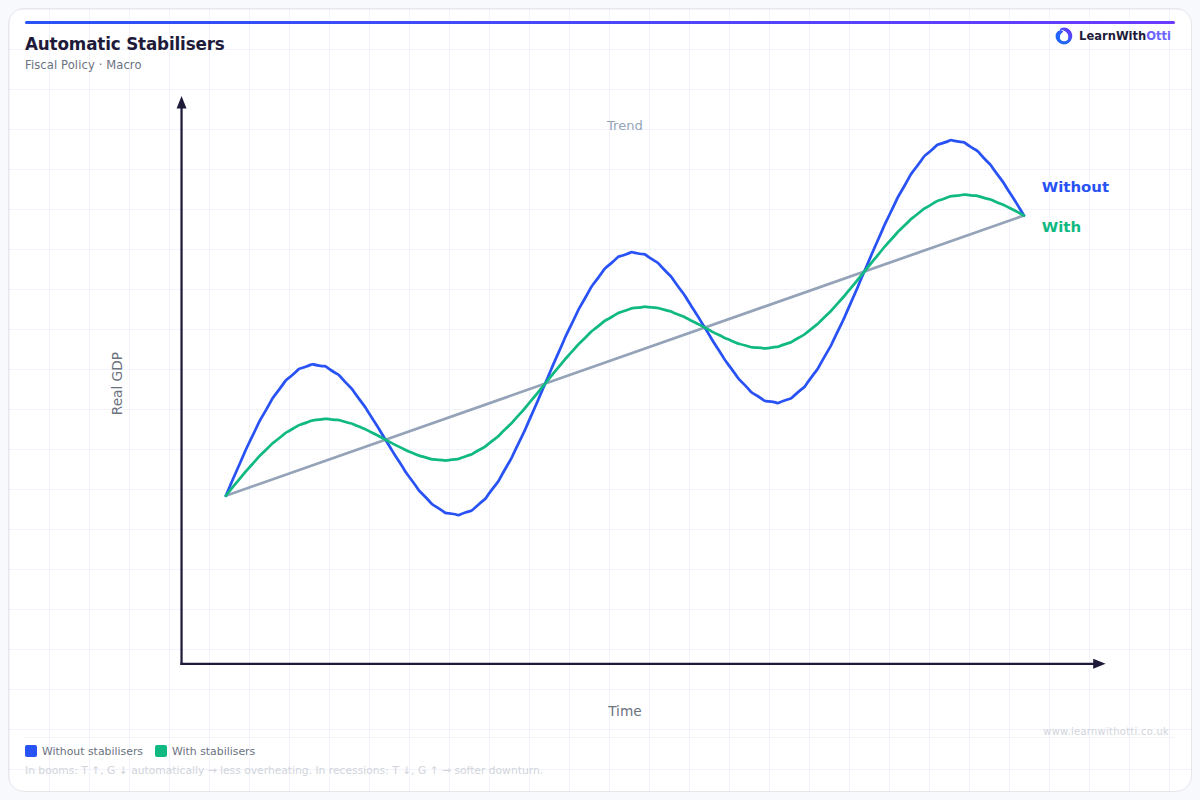
Diagram illustrating how automatic stabilisers (progressive tax and welfare spending) reduce the size of the fiscal multiplier and dampen cyclical fluctuations in GDP.
Printable preview
Download a static PNG of this diagram to print or include in revision notes.
Download PNGWhat this diagram shows
This diagram shows how automatic stabilisers help smooth out economic fluctuations without requiring government action. During recessions, tax receipts automatically fall (as incomes drop) while benefit payments rise (more unemployment), creating an automatic fiscal stimulus. Conversely, during booms, higher tax receipts and lower benefit payments automatically cool the economy. This creates a built-in stabilising mechanism that reduces the severity of both recessions and inflationary periods.
Key points
- Automatic stabilisers work without deliberate government policy changes - they respond automatically to economic conditions
- Progressive income tax acts as a stabiliser: tax receipts fall during recessions and rise during booms
- Means-tested benefits (like unemployment benefit) increase spending during downturns and decrease during recoveries
- They provide a fiscal stimulus during recessions (budget moves toward deficit) and fiscal restraint during booms (budget moves toward surplus)
- The size of the stabilising effect depends on the country's tax and benefit system structure
Exam tip
Examiners love when students clearly distinguish between automatic stabilisers and discretionary fiscal policy - emphasise that automatic stabilisers work WITHOUT government intervention. Always explain the 'automatic' nature by showing how tax receipts and benefit payments change naturally as the economy moves through the business cycle.
Common mistakes
Students often confuse automatic stabilisers with discretionary fiscal policy, failing to emphasise the 'automatic' nature. Many also forget to explain both sides - how they work in both recessions AND booms to provide economic stability.
Exam board notes
All major exam boards treat this diagram identically, focusing on the automatic nature of the mechanism and its role in reducing economic volatility. Some specifications may emphasise the mathematical relationship between the size of multiplier effects and automatic stabilisers.
Related diagrams
Ask Otti about this diagram
Our AI tutor can walk you through every curve, explain exam technique, and quiz you on it.