Types of Economies of Scale
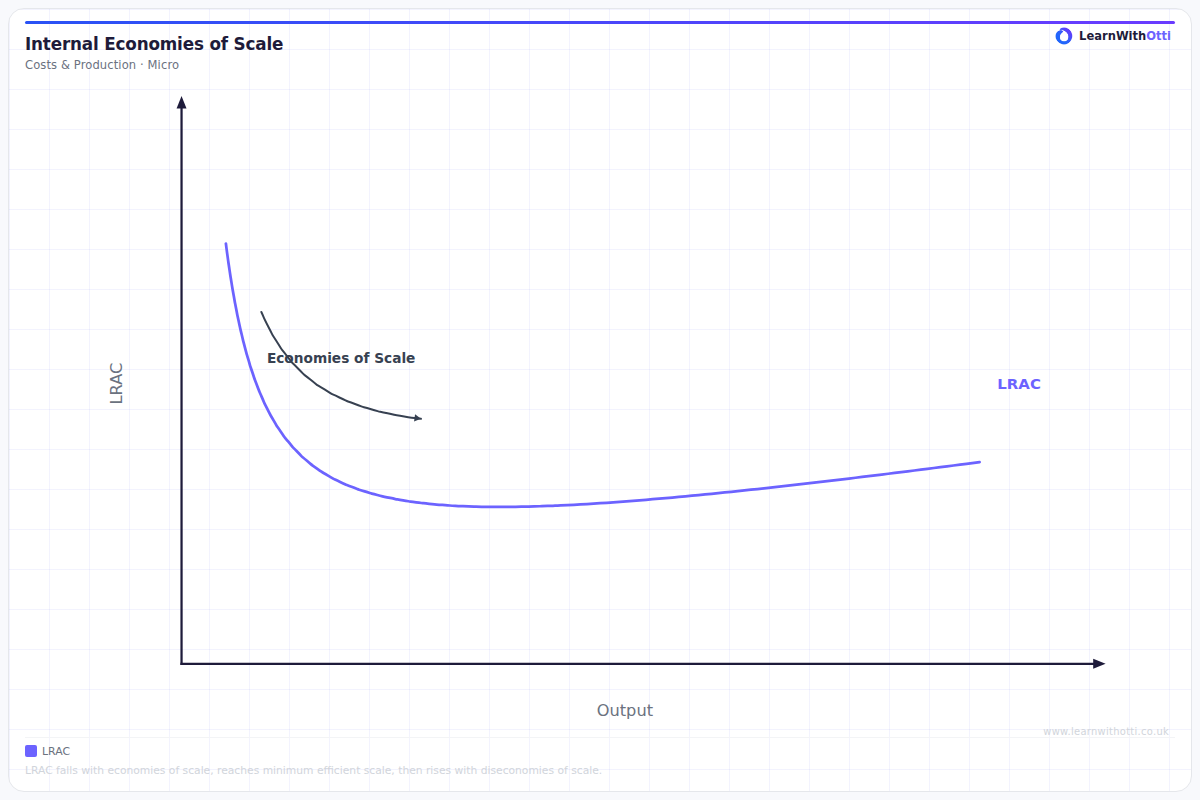
Diagram illustrating internal and external economies of scale, showing how average costs fall as a firm or industry expands output in the long run.
Printable preview
Download a static PNG of this diagram to print or include in revision notes.
Download PNGWhat this diagram shows
This diagram illustrates the different types of economies of scale that firms can experience as they increase their scale of production. Economies of scale are categorised into internal economies (cost advantages that arise from within the firm itself) and external economies (cost advantages that arise from factors outside the firm's control). Understanding these distinctions is crucial for analysing why some firms grow larger and how they can reduce their average costs. This concept is fundamental to understanding market structure and competitive advantage in business.
Key points
- Internal economies of scale include technical, purchasing, financial, marketing, managerial, and risk-bearing economies that arise from the firm's own expansion
- External economies of scale benefit all firms in an industry or region, including skilled labour pools, supplier networks, infrastructure, and knowledge spillovers
- Technical economies occur through improved production methods, specialisation of labour, and better utilisation of indivisible factors of production
- Financial economies allow larger firms to access cheaper credit and more diverse funding sources than smaller competitors
- External economies often cluster geographically, creating industrial districts where all firms benefit from shared advantages
Exam tip
Examiners are impressed when students can clearly distinguish between internal and external economies of scale, and provide specific, real-world examples for each type. The most common error is confusing technical economies (internal) with external economies - remember that internal economies are within the firm's control, while external economies benefit all firms in an industry or region.
Common mistakes
Students frequently mix up internal and external economies, particularly confusing technical economies (which are internal to the firm) with external economies that benefit the whole industry. Another common error is failing to provide specific examples when explaining each type of economy of scale.
Exam board notes
All major exam boards treat this diagram identically, requiring students to understand both internal and external economies of scale. However, some boards like AQA and Edexcel may place slightly more emphasis on real-world examples and case study applications in their mark schemes.
Related diagrams
Ask Otti about this diagram
Our AI tutor can walk you through every curve, explain exam technique, and quiz you on it.