Trade Union vs Monopsony (Bilateral Monopoly)
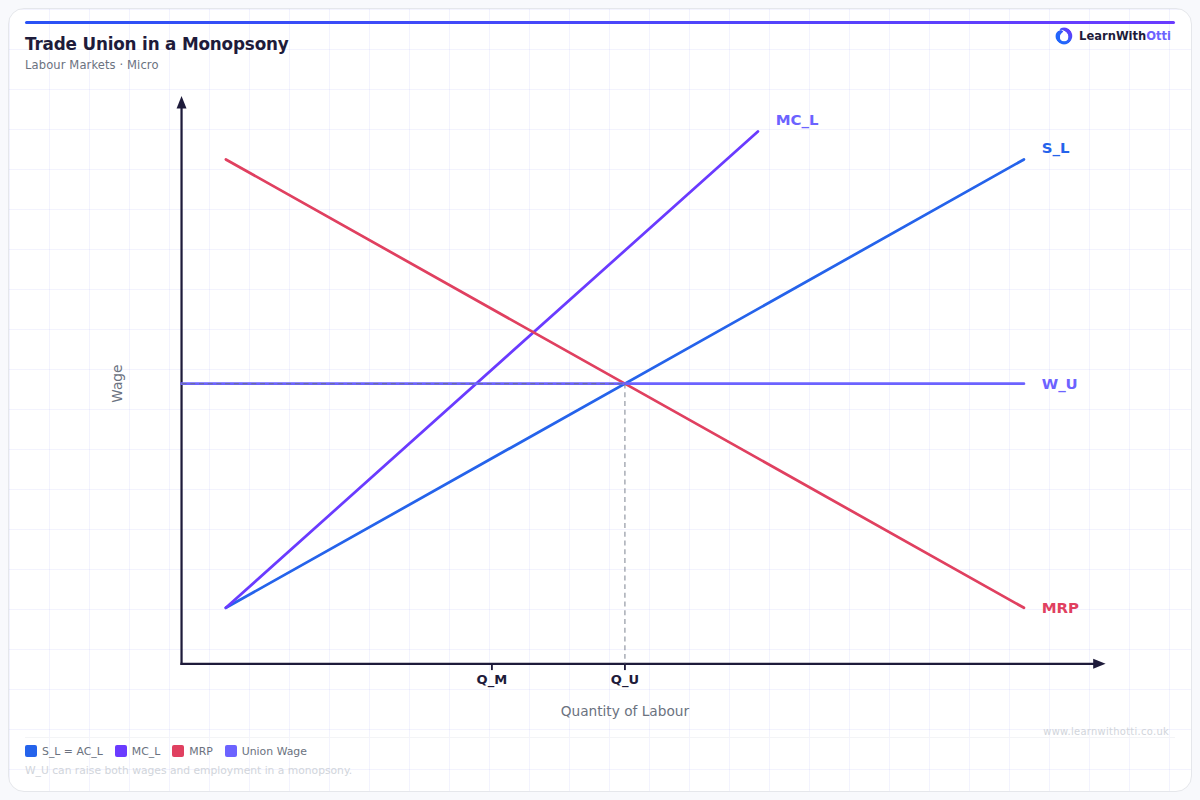
Diagram showing bilateral monopoly in the labour market — a trade union negotiating against a monopsonist employer, with the wage and employment level indeterminate between the two extremes.
Printable preview
Download a static PNG of this diagram to print or include in revision notes.
Download PNGWhat this diagram shows
This diagram shows a bilateral monopoly situation where a single trade union (monopoly seller of labour) faces a single employer (monopsony buyer of labour). The union wants to push wages up to Wu by restricting labour supply, while the monopsonist wants to push wages down to Wm by restricting labour demand. This creates a bargaining situation where the final wage and employment level depends on the relative negotiating strength of each party. Understanding this helps explain wage determination in industries like railways or teaching where strong unions face dominant employers.
Key points
- A bilateral monopoly occurs when a monopoly seller (trade union) meets a monopsony buyer (single employer)
- The trade union aims for higher wages (Wu) by restricting labour supply, while the monopsonist prefers lower wages (Wm)
- The actual wage outcome is indeterminate and falls between Wu and Wm, depending on relative bargaining power
- Employment levels are also uncertain and depend on which party has stronger negotiating position
- This model explains wage determination in industries with strong unions facing dominant employers (e.g. public sector)
Exam tip
Examiners are impressed when students clearly identify that the wage outcome in bilateral monopoly is indeterminate - it depends on the relative bargaining power of the union and monopsony employer. Avoid the common trap of trying to pinpoint an exact wage level; instead, explain that it will fall somewhere between the monopsony and union's preferred wages.
Common mistakes
Students often try to identify a specific equilibrium wage and employment level, when the key insight is that these are indeterminate in bilateral monopoly. They also frequently forget to explain that the outcome depends entirely on the relative bargaining strength of the union versus the employer.
Exam board notes
All major exam boards treat this diagram identically, focusing on the concept of indeterminate outcomes and the importance of bargaining power. Some boards may emphasise real-world applications more than others, but the theoretical framework is consistent across AQA, Edexcel, OCR and CIE.
Related diagrams
Ask Otti about this diagram
Our AI tutor can walk you through every curve, explain exam technique, and quiz you on it.