AQA A-Level Economics · Revision notes
4.1.2.2 Imperfect Information
What the specification covers
In our own words — not the official specification wording
Why good decisions depend on good information, and what goes wrong when one side of a deal knows more than the other.
- Sound choices depend on having the information needed to make them.
- What goes wrong when one party to a transaction knows more than the other.
Markets work well when buyers and sellers know what they are trading. When they do not, people make choices they would not have made with full information, and resources end up in the wrong places. This topic covers why information matters for decision making, the difference between symmetric and asymmetric information, and how imperfect information makes rational decisions difficult and causes market failure.
Symmetric and asymmetric information
- Symmetric information means buyers and sellers have the same information about the good being traded, its quality and its likely effects.
- Asymmetric information means one party knows more than the other. Usually the seller knows more than the buyer, but sometimes the buyer knows more.
Rational decision making assumes consumers and firms have all the information they need. In reality, information is often incomplete, costly to obtain or unevenly shared.
Why information matters for decision making
Good decisions depend on good information. A consumer choosing between products needs to know their prices, quality and likely effects, and a firm deciding whether to invest needs to know about future costs and demand. With better information, economic agents are more likely to make choices that maximise their utility or profit. When information is missing, wrong or too costly to gather, people may buy products that do not suit them, pay more than necessary, or avoid choices that would have benefited them.
Examples of asymmetric information
Key idea: An information gap can push demand either way. It depends on whether buyers overestimate or underestimate what a product is worth to them.
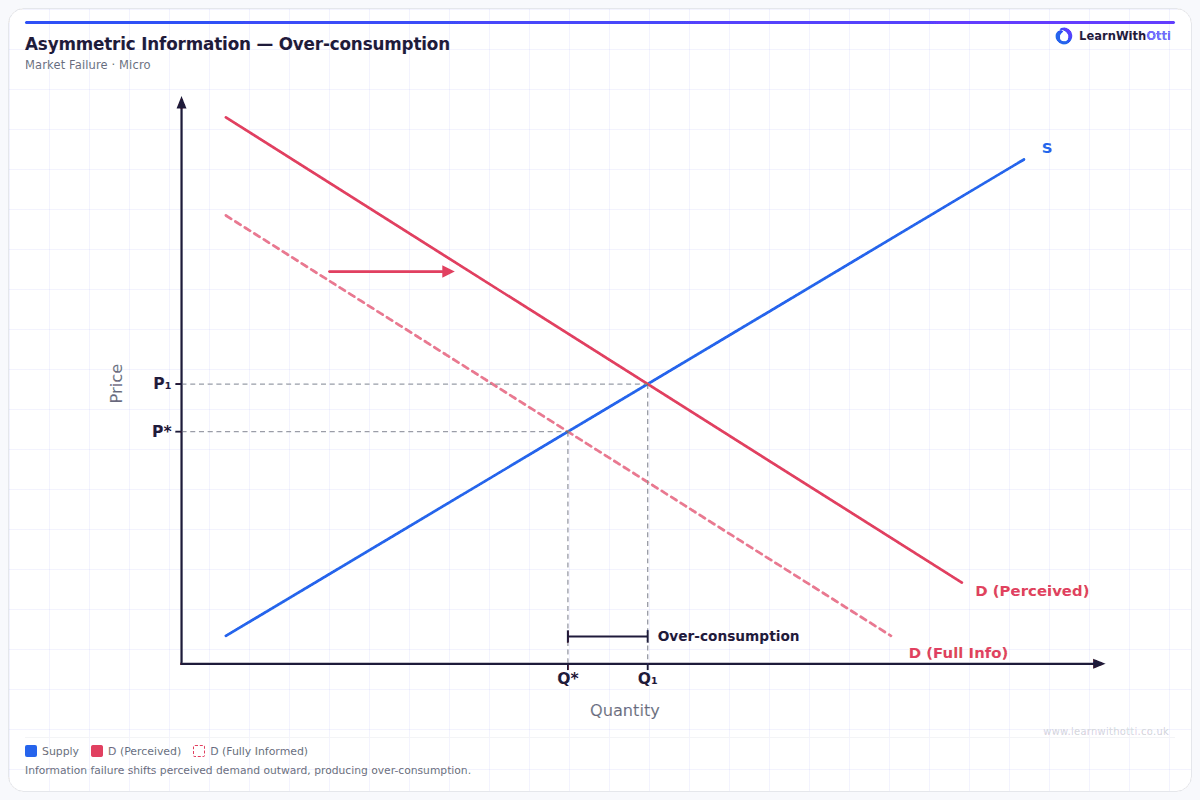
When full information would reduce demand (over-consumption)
Buyers think the product is worth more to them than it really is. Demand based on what they believe (perceived demand) sits to the right of the demand they would have with full information, so too much is bought.
- Second-hand cars. The seller knows whether the car has a hidden fault; the buyer does not, so can end up paying more than the car is worth.
- Financial products. A firm selling an investment product understands its charges and risks better than the customer, who may buy a product that does not suit them.
- Trades and repairs. A mechanic or builder can recommend work the customer has no way of checking, so the customer pays for work that is not needed.
- Health care treatment. A doctor knows far more than a patient about which treatment is needed, and can recommend more treatment than the patient would choose with full information.
When full information would increase demand (under-consumption)
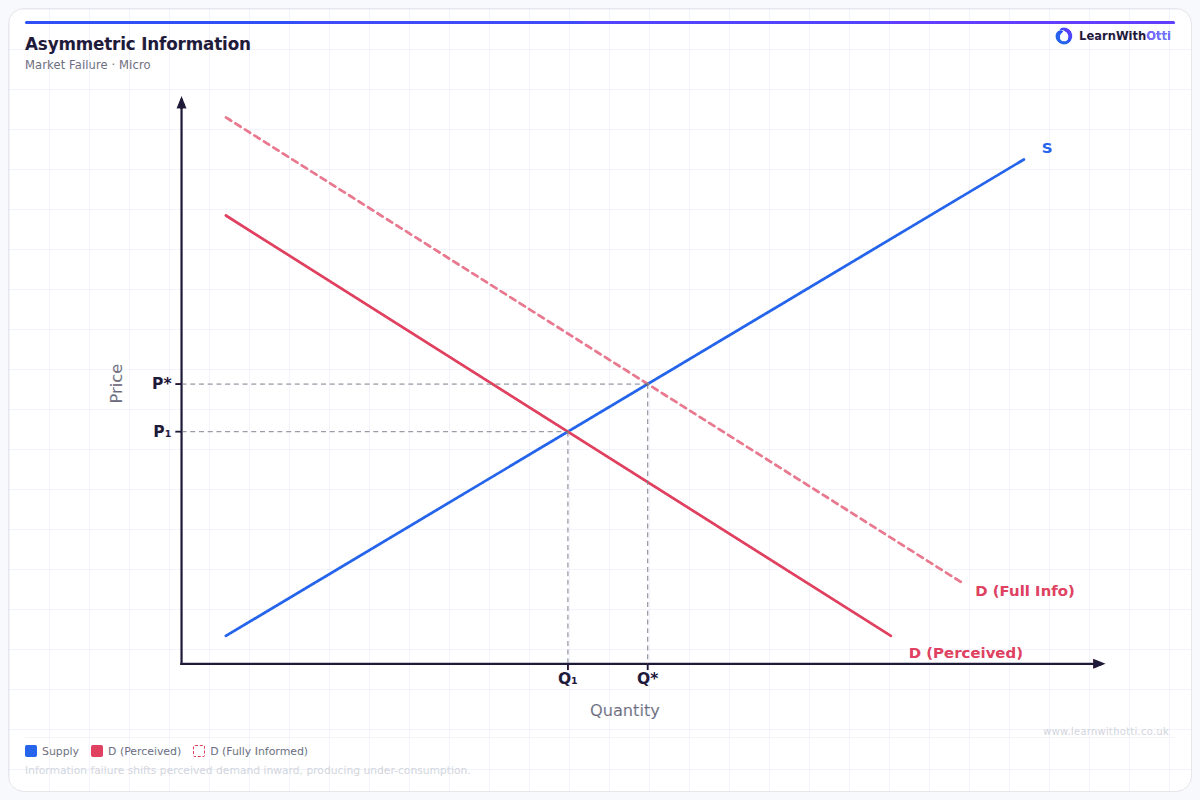
Buyers underestimate the benefits. Perceived demand sits to the left of the demand they would have with full information, so too little is bought.
- Vaccinations and health checks. Doctors and nurses know the long-term benefits far better than patients, many of whom put them off or skip them.
- Pensions. Pension providers and advisers understand how much early saving builds up over time; many young workers underestimate this and save too little.
- Education. Colleges and employers can see the long-term benefits of a qualification more clearly than a 16 year old deciding whether to stay in education.
When the buyer knows more
- Insurance. A person buying health or life insurance knows more about their own lifestyle and risks than the insurer does. This leads to adverse selection, explained below.
How imperfect information leads to a misallocation of resources
Over-consumption of goods whose costs are underestimated
When consumers underestimate the harm a good does to them, they consume too much of it. Smoking, excessive alcohol and gambling are examples. Goods that are over-consumed because people underestimate their costs are often called demerit goods.
Under-consumption of goods whose benefits are underestimated
When consumers underestimate the long-term benefits of a good, they consume too little of it. Education, pensions, health checks and vaccinations are examples. Goods that are under-consumed for this reason are often called merit goods.
In both cases, consumers' private decisions lead to a quantity that differs from the one they would choose with full information, so the market misallocates resources.
Sellers exploiting their information advantage
When sellers know more than buyers, they can charge higher prices than the product is worth, sell poor-quality goods as if they were good ones, or recommend services the buyer does not need. Buyers pay too much, and resources flow to the wrong products.
Markets that shrink or disappear
If buyers cannot tell good products from bad ones, they may only be willing to pay an average price. Sellers of good-quality products are then unwilling to sell at that price and leave the market, so the quality of what is left falls. This is called adverse selection. In the second-hand car market, it means poor-quality cars can drive good ones out.
Watch out: In insurance, adverse selection works the other way round. People who know they are high risk are the most eager to buy insurance, which pushes up premiums and can price low-risk customers out.
Responses to information gaps
Both markets and governments try to close information gaps:
- Warranties, guarantees and reviews give buyers some assurance of quality.
- Regulation requires sellers to disclose information, such as nutritional labelling on food or clear statements of charges on financial products.
- Government information campaigns try to change behaviour, such as public health campaigns on smoking or saving for retirement.
- Professional standards and licensing protect consumers who cannot judge quality for themselves.
These responses are covered further under government intervention.
Key terms
| Term | Meaning |
|---|---|
| Symmetric information | Buyers and sellers have the same information |
| Asymmetric information | One party to a transaction has more information than the other |
| Information gap | A lack of the information needed to make a rational decision |
| Demerit good | A good that is over-consumed because people underestimate its costs |
| Merit good | A good that is under-consumed because people underestimate its benefits |
| Adverse selection | When information gaps lead to the wrong mix of buyers or sellers in a market |
Common mistakes
- Treating any lack of information as asymmetric. Asymmetric information means one side knows more than the other, not just that information is missing.
- Describing the gap without the misallocation. The point is that choices lead to over- or under-consumption, or to the wrong goods being bought.
- Assuming the seller always has the advantage. In insurance, the buyer often knows more.
- Confusing merit goods with public goods. Merit goods are rival and excludable; their problem is under-consumption due to poor information.
How this has been examined
In the AQA papers indexed on this site, this topic has appeared in one format:
- 1-mark multiple choice — asked twice across 2 series (2021 to 2024)
Where this goes next
The rational model that assumes full information is set out in 4.1.2.1 Consumer behaviour, and the behavioural reasons consumers make poor choices in 4.1.2.3 Aspects of behavioural economic theory. Imperfect information as a source of market failure is developed in 4.1.8.2 The meaning of market failure and 4.1.8.5 Merit and demerit goods, and provision of information and regulation as government responses are covered in 4.1.8.9 Government intervention in markets.
Otti is an AI tutor built for A-Level students. Ask it anything, practise exam questions, and get instant feedback written like an examiner would give it — not just right or wrong, but why.
Get one answer marked free