AQA A-Level Economics · Revision notes
4.1.8.6 Market Imperfections
Markets work well when buyers and sellers know what they are trading, when firms face competition, and when resources can move to where they are needed. When any of these conditions is missing, resources end up in the wrong places. This page covers three market imperfections: imperfect and asymmetric information, monopoly power, and the immobility of factors of production.
Imperfect and asymmetric information
- Symmetric information means buyers and sellers have the same information about the good being traded, its quality and its likely effects.
- Asymmetric information means one party knows more than the other. Usually the seller knows more than the buyer, but sometimes the buyer knows more.
Rational decision making assumes consumers and firms have all the information they need. In reality, information is often incomplete, costly to obtain or unevenly shared.
Key idea: An information gap can push demand either way. It depends on whether buyers overestimate or underestimate what a product is worth to them.
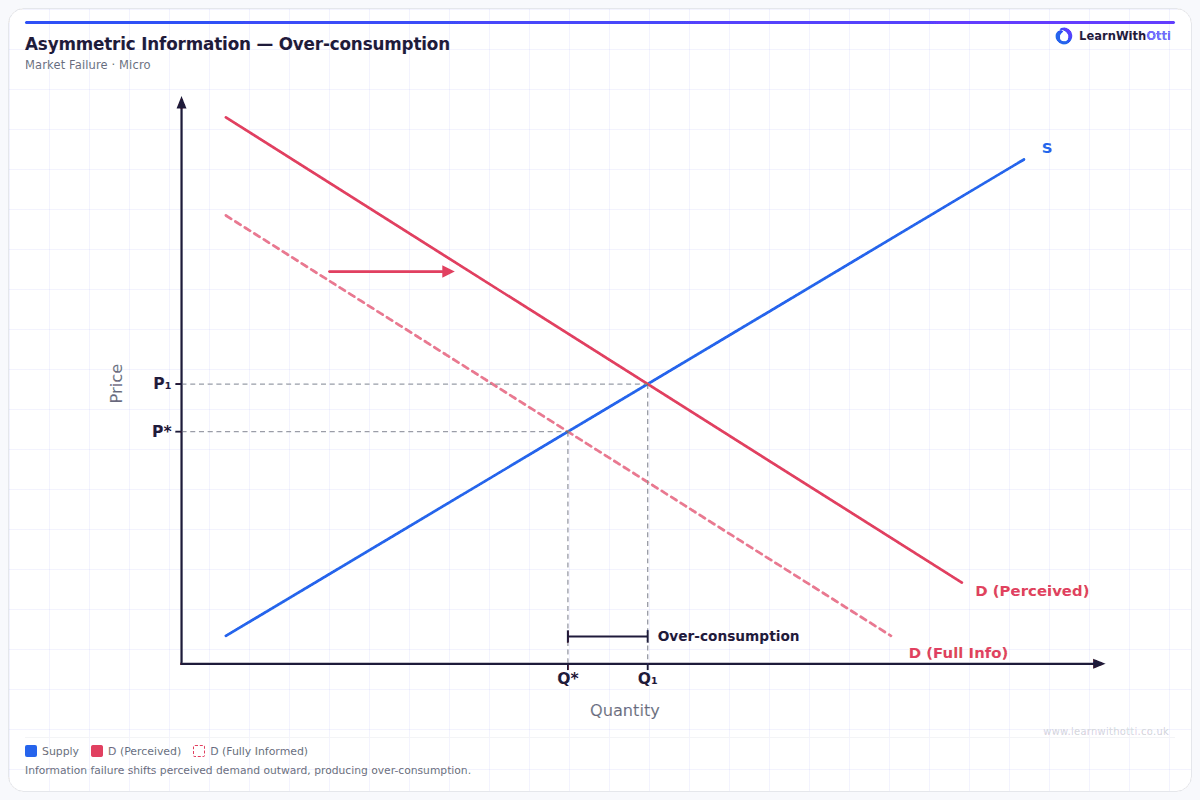
When full information would reduce demand (over-consumption)
Buyers think the product is worth more to them than it really is. Demand based on what they believe (perceived demand) sits to the right of the demand they would have with full information, so too much is bought.
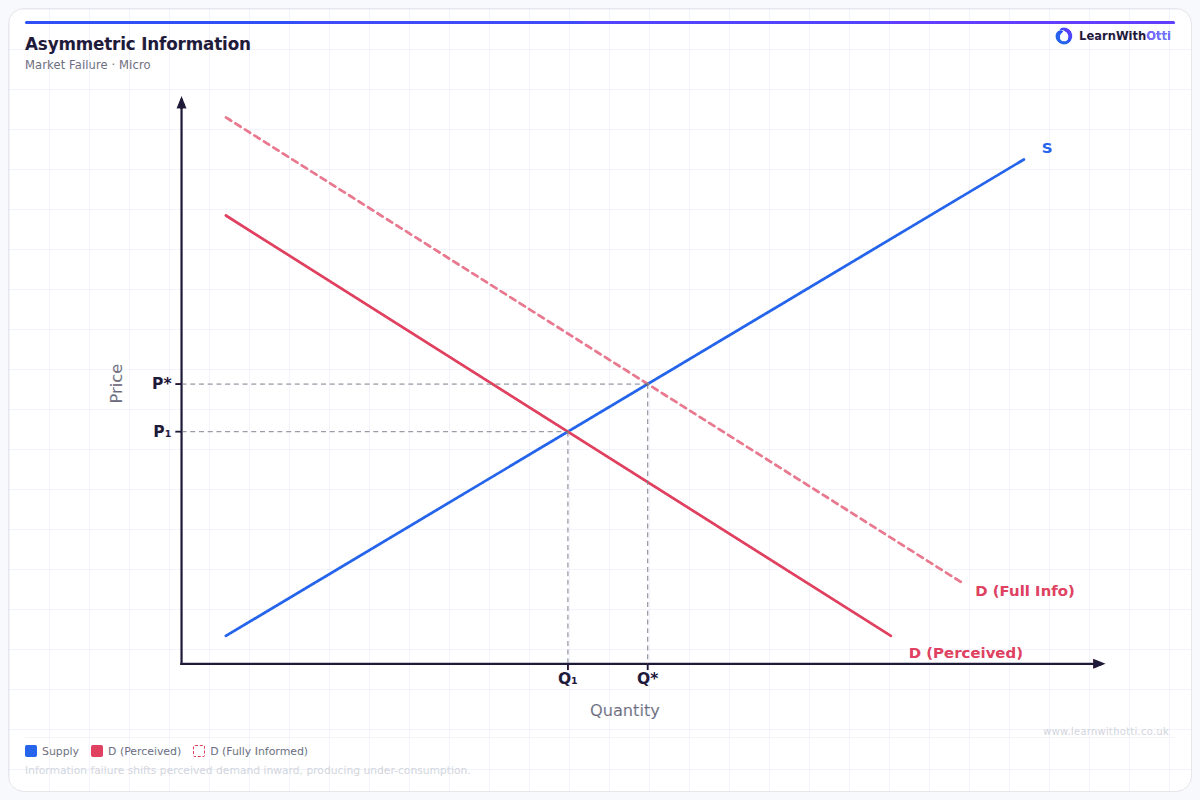
When full information would increase demand (under-consumption)
Buyers underestimate the benefits. Perceived demand sits to the left of the demand they would have with full information, so too little is bought.
How imperfect information leads to a misallocation of resources
Over-consumption of goods whose costs are underestimated
When consumers underestimate the harm a good does to them, they consume too much of it. Smoking, excessive alcohol and gambling are examples. Goods that are over-consumed because people underestimate their costs are often called demerit goods.
Under-consumption of goods whose benefits are underestimated
When consumers underestimate the long-term benefits of a good, they consume too little of it. Education, pensions, health checks and vaccinations are examples. Goods that are under-consumed for this reason are often called merit goods.
In both cases, consumers' private decisions lead to a quantity that differs from the one they would choose with full information, so the market misallocates resources.
Sellers exploiting their information advantage
When sellers know more than buyers, they can charge higher prices than the product is worth, sell poor-quality goods as if they were good ones, or recommend services the buyer does not need. Buyers pay too much, and resources flow to the wrong products.
Markets that shrink or disappear
If buyers cannot tell good products from bad ones, they may only be willing to pay an average price. Sellers of good-quality products are then unwilling to sell at that price and leave the market, so the quality of what is left falls. This is called adverse selection. In the second-hand car market, it means poor-quality cars can drive good ones out.
Watch out: In insurance, adverse selection works the other way round. People who know they are high risk are the most eager to buy insurance, which pushes up premiums and can price low-risk customers out.
Monopoly and monopoly power
A firm with monopoly power faces a downward-sloping demand curve, so it can restrict output to raise its price. This leads to market failure because too few resources are allocated to the good.
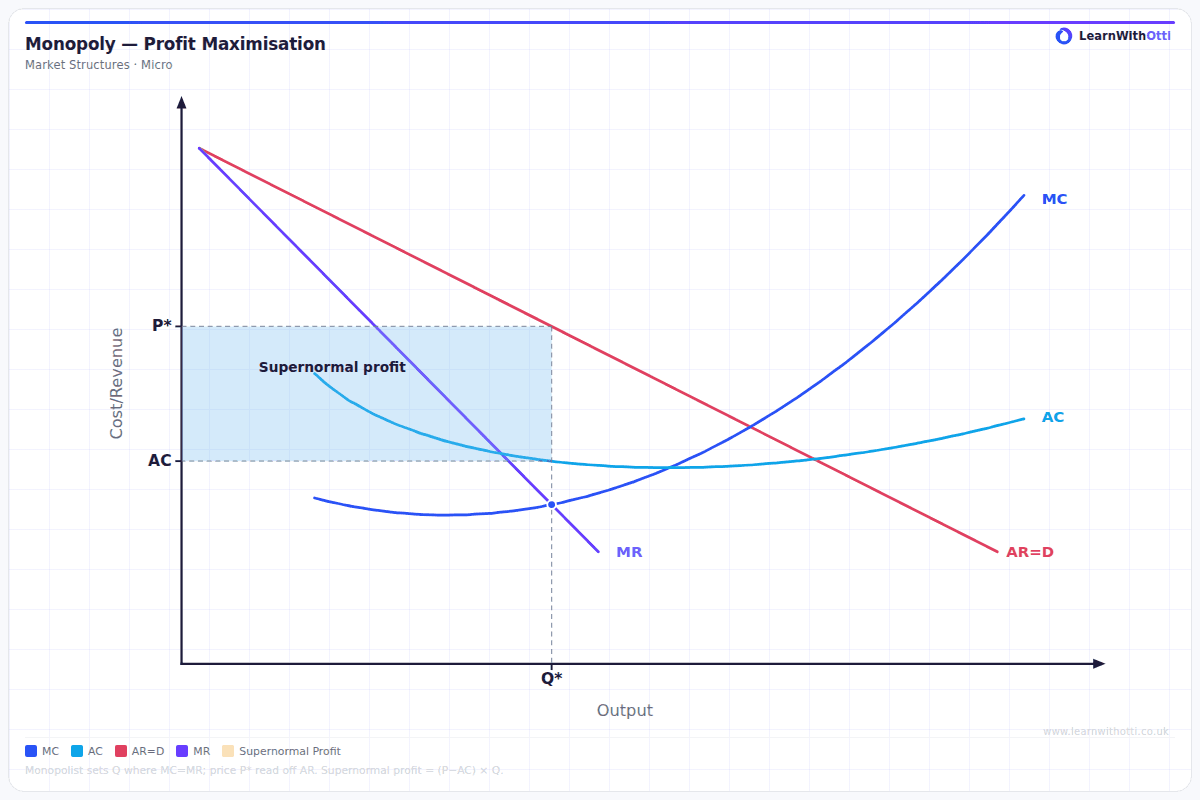
The monopoly diagram shows AR and MR sloping downwards, with MC and AC curves. Compared with a competitive market with the same costs:
- Output is lower and price is higher. A competitive market would produce where price equals MC; the monopolist restricts output to where MC = MR.
- Not allocatively efficient, because price is above MC.
- Usually not productively efficient, because output is not at the minimum of AC.
- Deadweight welfare loss. The units between the monopoly output and the competitive output would have been worth more to consumers than they cost to produce, but are not produced. This lost welfare is a triangle between the demand curve and MC.
- X-inefficiency is likely, because with no rivals the firm has little pressure to control costs.
Evaluation: The overall verdict depends on the market. A monopoly that exploits its power with high prices and poor service imposes clear costs. One that uses its profits to innovate, and reaches economies of scale that no smaller firm could, may serve consumers better than a competitive market would.
Immobility of factors of production
In a well-functioning labour market, workers move to where they are needed: from declining industries to growing ones, and from areas with few jobs to areas with many. When they cannot move easily, the market fails. Unemployment and vacancies exist side by side, and resources are misallocated.
Geographical immobility
Geographical immobility is when workers find it hard to move to a different area to take up a job.
Causes of geographical immobility
- Differences in house prices and rents. Housing in areas with many jobs, such as London and the South East, may be far more expensive than in areas of high unemployment.
- Family and social ties, such as children in local schools, caring responsibilities or a partner's job.
- The cost of moving, including removal costs and the time involved.
- Lack of information about job opportunities in other areas.
Consequences of geographical immobility
- Regional unemployment. Unemployment stays high in areas where jobs have been lost, even when there are vacancies elsewhere in the country.
- Unfilled vacancies in high-cost areas, which push up wages there and hold back the growth of firms.
- Regional inequality, as some areas prosper while others decline.
Occupational immobility
Occupational immobility is when workers find it hard to move to a different type of job.
Causes of occupational immobility
- Lack of the right skills or qualifications. A coal miner cannot easily become a software engineer.
- The cost and time of retraining, which may be difficult to afford, especially for older workers.
- Lack of information about which skills are in demand.
Consequences of occupational immobility
- Structural unemployment, as workers from declining industries lack the skills to fill vacancies in growing ones.
- Skills shortages in growing industries, which hold back output and push up wages in those occupations.
Immobility of other factors
Other factors of production can also be immobile. Land cannot be moved to where it is needed, and specialist machinery or buildings may have no other use, so resources stay tied up in declining industries.
Consequences for the economy as a whole
Both types of immobility mean that labour is not used where it is most productive. This leads to:
- Lower productivity and growth, because output is lower than it would be if workers could move to where they are needed.
- A misallocation of resources, with unemployment and vacancies existing side by side.
- Costs for the government, as spending on unemployment benefits rises and tax revenue falls.
Key terms
| Term | Meaning |
|---|---|
| Symmetric information | Buyers and sellers have the same information |
| Asymmetric information | One party to a transaction has more information than the other |
| Adverse selection | When information gaps lead to the wrong mix of buyers or sellers in a market |
| Monopoly | A market with a single seller, or one firm with a dominant market share |
| Deadweight welfare loss | The loss of welfare from output being below the level where price equals marginal cost |
| Geographical immobility | Difficulty in moving to a different area to take up a job |
| Occupational immobility | Difficulty in moving to a different type of job |
| Structural unemployment | Unemployment caused by a mismatch between workers' skills or location and available jobs |
Common mistakes
- Treating any lack of information as asymmetric. Asymmetric information means one side knows more than the other, not just that information is missing.
- Describing the gap without the misallocation. The point is that choices lead to over- or under-consumption, or to the wrong goods being bought.
- Assuming the seller always has the advantage. In insurance, the buyer often knows more.
- Concluding monopoly is always bad. Economies of scale, natural monopoly and dynamic efficiency can benefit consumers.
- Mixing up the two types of immobility. Geographical immobility is about place; occupational immobility is about skills.
- Describing immobility without the market failure. The point is that unemployment and vacancies exist at the same time, so resources are misallocated.
How this has been examined
In the AQA papers indexed on this site, this topic has appeared in two formats:
- 15-mark "Explain" essay — asked twice across 2 series (2020 to 2024)
- 1-mark multiple choice — asked twice across 2 series (2017 to 2022)
Where this goes next
Market imperfections are one of the causes of market failure set out in 4.1.8.2 The meaning of market failure. Information problems are developed in 4.1.2.2 Imperfect information and 4.1.8.5 Merit and demerit goods, and monopoly in 4.1.5.6 Monopoly and monopoly power, with policy responses in 4.1.8.7 Competition policy. Labour mobility links to 4.1.6.2 Influences upon the supply of labour to different markets and structural unemployment to 4.2.3.2 Employment and unemployment.
Otti is an AI tutor built for A-Level students. Ask it anything, practise exam questions, and get instant feedback written like an examiner would give it — not just right or wrong, but why.
Get one answer marked free