AQA A-Level Economics · Revision notes
4.1.5.9 Contestable and Non-Contestable Markets
Market structures are usually judged by how many firms there are. Contestability looks at something different: how easily new firms could enter. A market with only one or two firms can still behave competitively if the threat of entry is real. This page covers what makes a market contestable, how it changes firms' behaviour, and the barriers and sunk costs that reduce contestability.
Characteristics of contestable markets
A contestable market is one in which new firms can enter and leave freely. A perfectly contestable market has:
- No barriers to entry or exit. Any firm can enter the market and leave it again without restriction. There are no legal barriers such as licences or patents, and no strategic barriers such as heavy advertising or aggressive price cutting by existing firms. If supernormal profit appears, nothing stops new firms competing for it.
- No sunk costs. A firm that leaves can recover everything it spent on entering, for example by selling its equipment or using it in another market. An airline can move a plane to a different route, but money spent advertising a new brand is lost if the firm leaves. Sunk costs act as a barrier to exit, and so they also deter entry.
- Access to the same technology as existing firms, so an entrant can produce at the same cost. If existing firms had better technology or patented processes, they could undercut any entrant, and the threat of entry would not be credible.
- Perfect information about prices and profits in the market. Potential entrants must be able to see when existing firms are earning supernormal profit, so they know when entry is worthwhile.
Perfect contestability is a theoretical benchmark, like perfect competition, and no real market meets all four conditions. Real markets are more or less contestable depending on how high their barriers to entry and exit are, especially the size of their sunk costs. This means a market with only a few firms can still be highly contestable, while a market with many firms can have low contestability if entry is difficult.
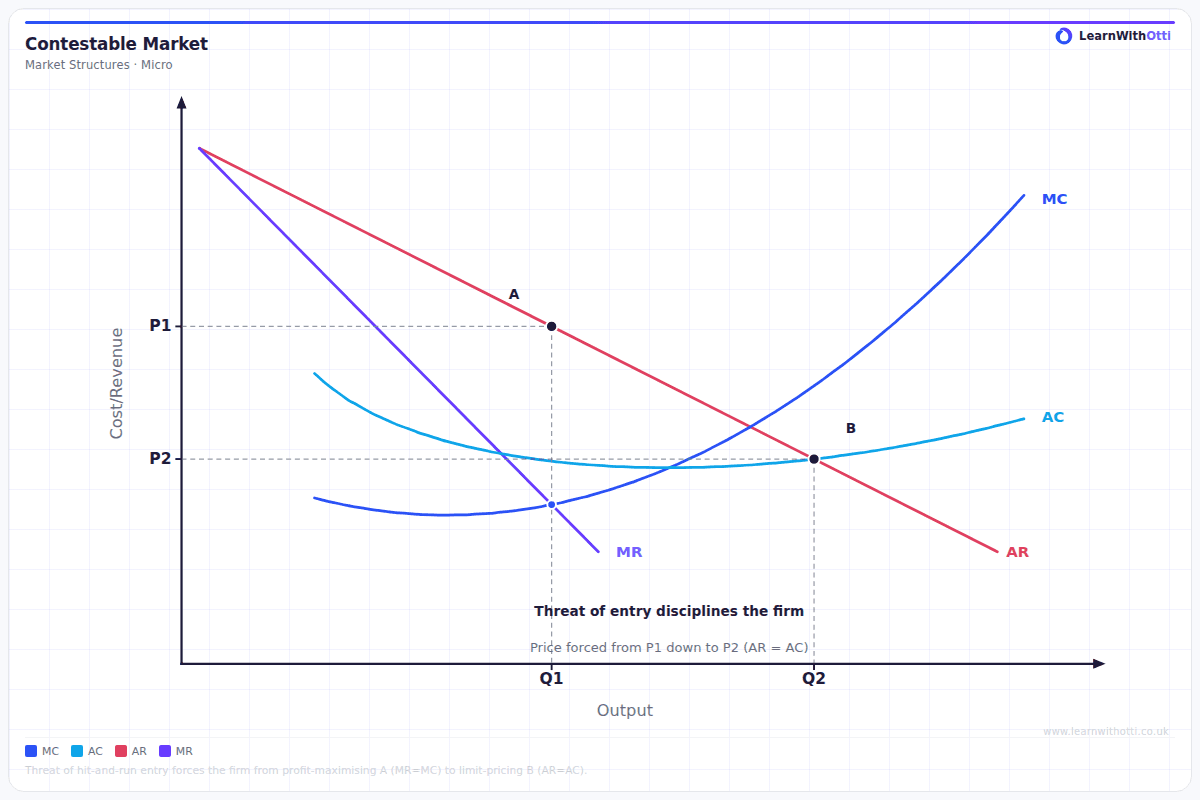
Implications for the behaviour of firms
Key idea: The central idea is that the threat of entry, not the number of firms, disciplines behaviour.
In a highly contestable market:
- Firms make only normal profit in the long run. If existing firms earn supernormal profit, new firms enter to take a share. This is hit-and-run competition: an entrant can come in, take the profit, and leave without loss if conditions change.
- Firms keep prices low. Even a monopolist may set prices close to average cost to avoid attracting entrants. This is a form of limit pricing.
- Firms keep costs down. A firm with costs above the minimum would be undercut by a more efficient entrant, so X-inefficiency is reduced.
- Efficiency improves. Contestable markets tend towards productive and allocative efficiency, even with few firms.
Evaluation: The implication for policy is significant. A competition authority may be less concerned about a market with few firms if that market is highly contestable, and more concerned about one where barriers are high.
Types of barrier to entry and exit
Barriers to entry make it harder for new firms to enter:
- Economies of scale. Established firms produce at low average cost; a small entrant cannot match them.
- High start-up costs, such as factories, networks or research.
- Legal barriers, such as patents, licences and franchises.
- Brand loyalty and advertising, which make it costly for an entrant to win customers.
- Control of essential resources or distribution, such as supply chains, retail space or airport landing slots.
- Anti-competitive practices, such as predatory or limit pricing by existing firms.
Barriers to exit make it costly to leave a market:
- Sunk costs that cannot be recovered.
- Long-term contracts with suppliers or employees.
- Specialist equipment with no other use.
Key idea: Barriers to exit matter because they also deter entry. A firm thinking of entering knows it will lose money if it has to leave.
Sunk costs and the degree of contestability
Sunk costs are costs that cannot be recovered if a firm leaves the market. Examples include advertising, research and development, and specialist equipment that cannot be sold or used elsewhere.
Sunk costs are the key to contestability:
- Low sunk costs mean a firm can enter, and leave if it does not succeed, at little risk. The market is highly contestable.
- High sunk costs make entry risky, because the money is lost if the venture fails. The market is less contestable, and existing firms are protected.
An example. Some airline routes are relatively contestable. An airline can move an aircraft onto a new route, and move it off again if the route is unprofitable, because the plane can be used elsewhere. Building a new railway line is the opposite: the track and stations are sunk costs that cannot be moved.
Key terms
| Term | Meaning |
|---|---|
| Contestable market | A market that new firms can enter and leave freely |
| Perfectly contestable market | A market with no barriers to entry or exit and no sunk costs |
| Sunk costs | Costs that cannot be recovered if a firm leaves the market |
| Hit-and-run competition | Entering a market to take supernormal profit, then leaving without loss |
| Barrier to entry | Anything that makes it harder for new firms to enter a market |
| Barrier to exit | Anything that makes it costly for firms to leave a market |
Common mistakes
- Judging competition only by the number of firms. A market with few firms can be highly contestable.
- Confusing sunk costs with fixed costs. Fixed costs do not vary with output; sunk costs cannot be recovered on exit. Some fixed costs, such as a building that can be sold, are not sunk.
- Ignoring barriers to exit. They deter entry as well as exit.
- Treating perfect contestability as realistic. It is a benchmark; real markets vary in how contestable they are.
How this has been examined
In the AQA papers indexed on this site, this topic has appeared in three formats:
- 15-mark "Explain" essay — asked once (2023)
- 9-mark "Explain" data response — asked once (2018)
- 1-mark multiple choice — asked once (2018)
Where this goes next
Barriers to entry are central to 4.1.5.5 Oligopoly and 4.1.5.6 Monopoly and monopoly power, and limit pricing appears in 4.1.5.5 Oligopoly. Economies of scale as a barrier are covered in 4.1.4.5 Economies and diseconomies of scale, and the efficiency criteria in 4.1.5.10 Market structure, static efficiency, dynamic efficiency and resource allocation. Government action to promote competition and contestability is covered in 4.1.8.7 Competition policy.
Otti is an AI tutor built for A-Level students. Ask it anything, practise exam questions, and get instant feedback written like an examiner would give it — not just right or wrong, but why.
Get one answer marked free