AQA A-Level Economics · Revision notes
4.2.2.3 The Determinants of Aggregate Demand
Aggregate demand (AD) is the total planned spending on an economy's goods and services at a given price level over a period of time. This topic covers what is meant by AD and what determines each of its components: consumption, investment, government spending, exports and imports. It also covers the determinants of saving, the difference between saving and investment, and the basic accelerator process.
What is meant by AD
AD = C + I + G + (X − M)
- C, consumption: spending by households on goods and services.
- I, investment: spending by firms on capital goods, such as machinery, buildings and equipment.
- G, government spending: spending by government on goods and services, such as wages of public sector workers and building roads and hospitals. Transfer payments such as pensions and benefits are not included, because they are not payments for output.
- X − M, net trade: exports minus imports. Exports are spending by foreigners on UK output, so they add to AD. Imports are spending by UK residents on foreign output, so they are subtracted.
The relative importance of the components
The components are very different in size.
- Consumption is by far the largest, at around 62% of UK GDP. Changes in household spending have the biggest effect on AD.
- Government spending on goods and services is around 21%.
- Investment is around 19%, but it is the most volatile component. Because it depends heavily on business confidence, it can rise or fall sharply.
- Net trade is small relative to the others, at around −1% of GDP. It has usually been negative for the UK, although exports and imports are each large.
These shares are approximate recent figures and change a little from year to year. What matters is that consumption is by far the largest component.
Key distinction: Size and volatility both matter. A small change in consumption can move AD more than a large change in a smaller component, but investment's volatility makes it a frequent source of fluctuations in the economic cycle.
Consumption (C)
Disposable income
The most important influence on consumption is disposable income: the income households have available to spend or save after direct taxes have been deducted and state benefits added.
Disposable income = gross income − direct taxes + state benefits
When disposable income rises, households spend more. When it falls, through job losses, tax rises or wages failing to keep pace with prices, they spend less.
Watch out: What matters is real disposable income, adjusted for inflation: a 3% pay rise when prices rise by 5% leaves households able to buy less.
The marginal propensity to consume (MPC) measures the link between extra income and spending. It is the share of any extra income that is spent:
MPC = change in consumption ÷ change in income
Lower-income households tend to have a higher MPC. They spend most of any extra income because they have more unmet needs. Higher-income households save a larger share of each extra pound.
Interest rates
A rise in interest rates tends to reduce consumption:
- Borrowing becomes more expensive, so households buy fewer goods on credit, such as cars and furniture.
- Saving becomes more attractive, because the reward for saving rises.
- Mortgage payments rise for households on variable-rate or expiring fixed-rate mortgages, leaving less income for other spending.
A cut in interest rates has the opposite effects. This is one of the main channels through which the Bank of England influences the economy.
Consumer confidence
When households feel secure about their jobs and future income, they spend more and borrow more freely. When they fear unemployment or falling incomes, they cut back and save more, even before their income actually falls.
Key idea: Confidence can therefore make changes in the economy self-reinforcing: pessimism reduces spending, which reduces output and jobs, which justifies the pessimism.
Wealth effects
Wealth is the stock of assets households own, such as houses, shares and savings. When the value of these assets rises, households feel better off and tend to spend more, even though their income has not changed. Some also borrow against the rising value of their homes.
Rising house prices are the most important wealth effect in the UK, because housing is the largest asset most households own. A fall in house or share prices has the opposite effect.
Saving and its determinants
Income that is not spent is saved. Saving and consumption are therefore two sides of the same decision:
Disposable income = consumption + saving
It follows that the marginal propensity to save (MPS) is the share of extra income saved, and in this simple model MPC + MPS = 1.
The household saving ratio measures saving as a percentage of disposable income. When households become more cautious, the saving ratio rises and consumption falls, even if income has not changed. This happened sharply during the 2020 pandemic, when many households could not spend and others saved out of fear for their jobs.
The determinants of saving are largely the mirror image of those of consumption. Saving tends to rise when disposable income rises, when interest rates rise, when confidence falls and households save for precautionary reasons, and when the value of household wealth falls, so that people save to rebuild it.
Investment (I)
Investment is spending on capital goods: machinery, buildings, vehicles, computer systems and other assets used to produce goods and services in the future. It matters twice over, because it adds to demand now and to productive capacity later.
Watch out: It does not include buying shares or putting money in a savings account. Those are financial transactions that move ownership of existing assets; they are often called investment in everyday speech, but they do not create new capital.
Gross and net investment
Capital wears out or becomes outdated over time. This loss of value is called depreciation (or capital consumption).
- Gross investment is the total spending on capital goods in a period, including spending that simply replaces worn-out capital.
- Net investment is gross investment minus depreciation: the actual addition to the stock of capital.
Net investment = gross investment − depreciation
Net investment is what determines whether an economy's productive capacity is growing.
The rate of economic growth and the accelerator
Firms invest to meet rising demand. When the economy grows quickly, firms need more capacity, so investment rises.
Key idea: This is the accelerator effect: investment depends on the rate of change of output, not its level.
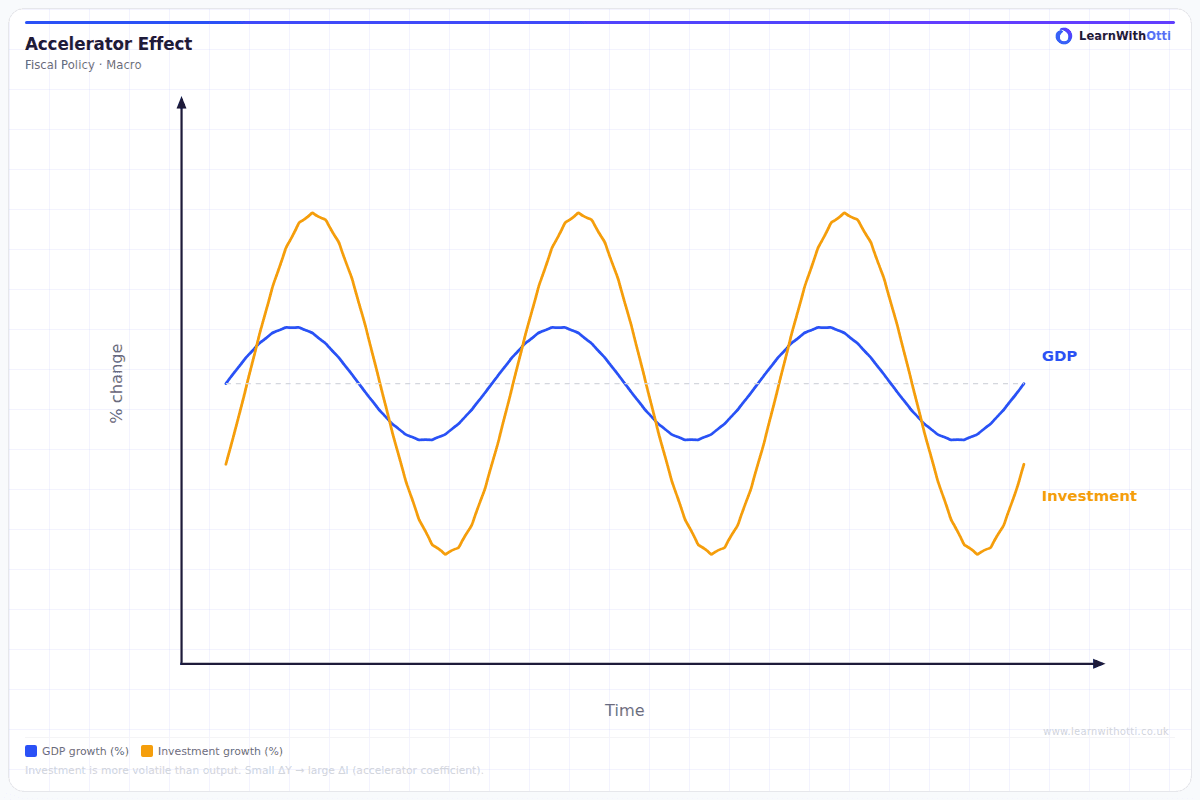
A simple example shows why investment is so volatile. A firm uses 10 machines, each lasting 10 years, so it replaces one machine a year. If demand for its output rises by 10%, it needs 11 machines: one replacement plus one new machine, so investment doubles from one machine to two. If demand then stops growing, investment falls back to one machine, a 50% drop, even though output is still at its higher level. Small changes in the growth of demand cause much larger swings in investment.
Other influences on investment
Business expectations and confidence
Investment pays off over many years, so firms must judge what demand, costs and profits will be well into the future. When firms are confident, they invest; when they are uncertain, they delay. Political uncertainty, such as a change in trading arrangements, can hold back investment for years.
Keynes and 'animal spirits'
John Maynard Keynes argued that investment decisions cannot be based purely on calculation, because the future is genuinely uncertain. Instead, they depend on animal spirits: waves of optimism and pessimism among business leaders. This helps explain why investment can rise or fall sharply without any obvious change in interest rates or profits.
Demand for exports
Firms that sell abroad invest to meet foreign demand. Strong growth in the UK's export markets, or a fall in the pound that makes UK goods cheaper abroad, encourages investment in capacity.
Interest rates
Many investment projects are financed by borrowing. A rise in interest rates makes borrowing more expensive and raises the return a project must earn to be worthwhile, so fewer projects go ahead. Even firms using their own retained profits face an opportunity cost, because the money could earn interest instead.
Access to credit
Firms need to be able to borrow, not just afford the interest. After the 2008 financial crisis, banks cut lending sharply, and many small firms could not raise finance for investment even when interest rates were very low.
The influence of government and regulations
Government can encourage investment through tax allowances that let firms deduct the cost of new capital from their taxable profits, through grants, and through its own spending on infrastructure. Regulation can work both ways: clear, stable rules support investment, while complex or frequently changing rules add costs and uncertainty that deter it.
The difference between saving and investment
Saving is income that households do not spend. Investment is spending by firms on new capital goods. They are carried out by different people for different reasons, so planned saving and planned investment need not be equal. Saving is a withdrawal from the circular flow and investment is an injection into it. Saving can finance investment when banks lend it to firms, but higher saving does not automatically lead to higher investment.
Government spending (G)
The G in AD = C + I + G + (X − M) includes only spending that directly buys goods and services:
- Current spending: day-to-day spending on public services, such as salaries of public sector workers and the running costs of hospitals and schools.
- Capital spending: spending on long-lasting assets, such as roads, railways, school buildings and hospitals.
Key distinction: It does not include transfer payments, such as state pensions, Universal Credit and Child Benefit. These move money from taxpayers to recipients without buying any output in return. They affect AD indirectly, by raising the disposable income of the people who receive them, which then shows up in consumption.
The trade cycle
Government spending changes automatically as the economy moves through the trade cycle, without any new decision by government.
In a downturn:
- unemployment rises, so spending on unemployment-related benefits rises;
- incomes fall, so more households qualify for means-tested support;
- tax revenue falls at the same time, because incomes and spending are lower.
In a boom:
- unemployment falls, so benefit spending falls;
- tax revenue rises as incomes and spending grow.
These changes are called automatic stabilisers. They support demand in a downturn and restrain it in a boom, which helps smooth the trade cycle.
Fiscal policy
Key distinction: Fiscal policy is the use of government spending and taxation to influence the economy. Unlike automatic stabilisers, it involves a deliberate decision, usually announced in the Budget.
- Expansionary fiscal policy increases government spending (or cuts taxes) to raise aggregate demand, typically in a recession. Spending on infrastructure projects is a common example.
- Contractionary fiscal policy cuts government spending (or raises taxes) to reduce aggregate demand or reduce government borrowing.
Government decisions about Government Expenditure are also shaped by:
- Political priorities, such as commitments to spend more on health, defence or the green transition.
- Demographic pressures. An ageing population raises spending on health care and social care.
- The state of the public finances. High government debt and borrowing costs can force spending restraint, as in the UK's austerity period after 2010.
- Unexpected events, such as the pandemic in 2020, when government spending rose sharply to support the economy.
Exports and imports (X − M)
- Exports (X) are goods and services produced in the UK and sold abroad, such as cars sold to Germany or financial services sold to clients in New York.
- Imports (M) are goods and services produced abroad and bought by UK residents, such as clothes made in Bangladesh or holidays in Spain.
- Net trade is X − M. If exports exceed imports, there is a trade surplus and net trade adds to AD. If imports exceed exports, there is a trade deficit and net trade subtracts from AD.
A rise in net exports therefore increases AD, raising real output and employment, while a fall in net exports reduces them. Changes in net exports also affect the current account of the balance of payments.
Real income
Real income in the UK affects imports. When UK incomes rise, households spend more, and some of that extra spending goes on imported goods and services. So rising UK income tends to increase imports and worsen the trade balance. In a recession, falling incomes reduce imports and the trade balance tends to improve.
Real income abroad affects exports. When incomes rise in the UK's main trading partners, they buy more UK goods and services, so exports rise.
The share of any extra income spent on imports is the marginal propensity to import. The UK's is relatively high, because it imports many of the goods its consumers buy.
Exchange rates
The exchange rate is the price of one currency in terms of another. It changes the price of exports and imports without any change in their price at home.
- A fall in the value of the pound (a depreciation) makes UK exports cheaper for foreign buyers and imports dearer for UK buyers. Exports tend to rise and imports to fall, so the trade balance tends to improve.
- A rise in the value of the pound (an appreciation) makes exports dearer abroad and imports cheaper at home, so the trade balance tends to worsen.
A simple way to remember the effect of a rise is SPICED: a Strong Pound makes Imports Cheap and Exports Dear.
Evaluation: How much the trade balance actually changes depends on how sensitive demand for exports and imports is to price. If demand is price inelastic, a depreciation may improve the balance only slowly, or not at all.
The state of the world economy
Exports depend on the health of the economies that buy them. When the global economy grows strongly, demand for UK exports rises. When major trading partners fall into recession, as many did after the 2008 financial crisis, UK exports fall, whatever happens in the UK itself.
The degree of protectionism
Protectionism is the use of barriers to restrict trade, such as tariffs (taxes on imports), quotas (limits on the quantity of imports) and regulations that make importing harder.
- If other countries raise barriers against UK goods, UK exports fall.
- If the UK raises barriers against foreign goods, imports fall, but other countries may retaliate against UK exports.
Non-price factors
Price is not the only reason customers choose one country's products over another's. Non-price factors include:
- Quality and reliability of the product;
- Design and innovation;
- Brand reputation, such as the image of British luxury cars or Scotch whisky;
- After-sales service and the speed and reliability of delivery.
Key terms
| Term | Meaning |
|---|---|
| Aggregate demand | Total planned spending on an economy's goods and services at a given price level |
| Consumption | Household spending on goods and services |
| Disposable income | Income after direct taxes are deducted and state benefits added |
| Marginal propensity to consume | The share of extra income spent |
| Marginal propensity to save | The share of extra income saved |
| Household saving ratio | Saving as a percentage of disposable income |
| Wealth effect | A change in spending caused by a change in the value of households' assets |
| Investment | Spending on capital goods that will be used to produce goods and services in the future |
| Net investment | Gross investment minus depreciation |
| Accelerator | The idea that investment depends on the rate of change of output |
| Animal spirits | Keynes's term for the optimism or pessimism that drives investment decisions |
| Transfer payment | A payment for which no good or service is provided in return, such as a pension or benefit |
| Automatic stabilisers | Changes in spending and tax revenue that happen automatically over the trade cycle |
| Net trade | The value of exports minus the value of imports (X − M) |
| Marginal propensity to import | The share of extra income spent on imports |
| Protectionism | Restricting trade through barriers such as tariffs and quotas |
Common mistakes
- Including transfer payments in G. Pensions and benefits are not spending on output; they affect AD only when recipients spend them, through C.
- Adding imports instead of subtracting them. Imports are spending on foreign output and reduce AD.
- Treating the largest component as the most volatile. Consumption is largest; investment is the most volatile.
- Ignoring real income. A rise in money income does not raise spending power if prices rise faster.
- Counting financial assets as investment. Buying shares does not create new capital.
- Describing the accelerator in terms of the level of output. It depends on the change in output.
- Getting the exchange rate effect backwards. A fall in the pound makes exports cheaper abroad and imports dearer at home.
- Linking UK income to exports. UK income mainly affects imports; foreign income affects exports.
How this has been examined
In the AQA papers indexed on this site, this topic has appeared in five formats:
- 25-mark "To what extent" essay — asked once (2021)
- 15-mark "Explain" essay — asked once (2021)
- 4-mark "Explain" data response — asked once (2018)
- 2-mark calculation — asked once (2018)
- 1-mark multiple choice — asked twice across 2 series (2021 to 2025)
Where this goes next
The AD curve and the factors that shift it are covered in 4.2.2.2 Aggregate demand and aggregate supply analysis, and the way a change in any component is amplified through the multiplier in 4.2.2.4 Aggregate demand and the level of economic activity. Saving, investment, government spending and trade reappear as withdrawals and injections in 4.2.2.1 The circular flow of income. Fiscal policy is developed in 4.2.5.1 Fiscal policy, the influence of interest rates in 4.2.4.3 Central banks and monetary policy, and exchange rates in 4.2.6.4 Exchange rate systems.
Otti is an AI tutor built for A-Level students. Ask it anything, practise exam questions, and get instant feedback written like an examiner would give it — not just right or wrong, but why.
Get one answer marked free