AQA A-Level Economics · Revision notes
4.1.6.1 The demand for labour, marginal productivity theory
Firms do not hire workers for their own sake. They hire them to produce goods and services that customers want to buy. That simple idea, that labour is a derived demand, is the starting point for understanding the demand side of every labour market. This page covers marginal productivity theory, the causes of shifts in the demand curve for labour and the elasticity of demand for labour.
Demand for labour as a derived demand
Labour is a derived demand: firms want workers because of the demand for the goods and services those workers produce.
- If demand for a firm's product rises, it needs more workers to produce it, so the demand for labour rises.
- If demand for the product falls, the demand for labour falls.
Key idea: This explains why jobs are lost in declining industries and created in growing ones. When online shopping grew, the demand for warehouse and delivery workers rose and the demand for high street shop workers fell.
The workers had not changed; the demand for what they produced had.
The demand curve for labour
The demand for labour is the number of workers firms are willing and able to employ at each wage rate, over a given period. The demand curve for labour slopes downwards: at a lower wage, firms employ more workers.
Key distinction: A change in the wage rate causes a movement along the demand curve. A change in any other factor shifts the whole curve.
Why the curve slopes downwards
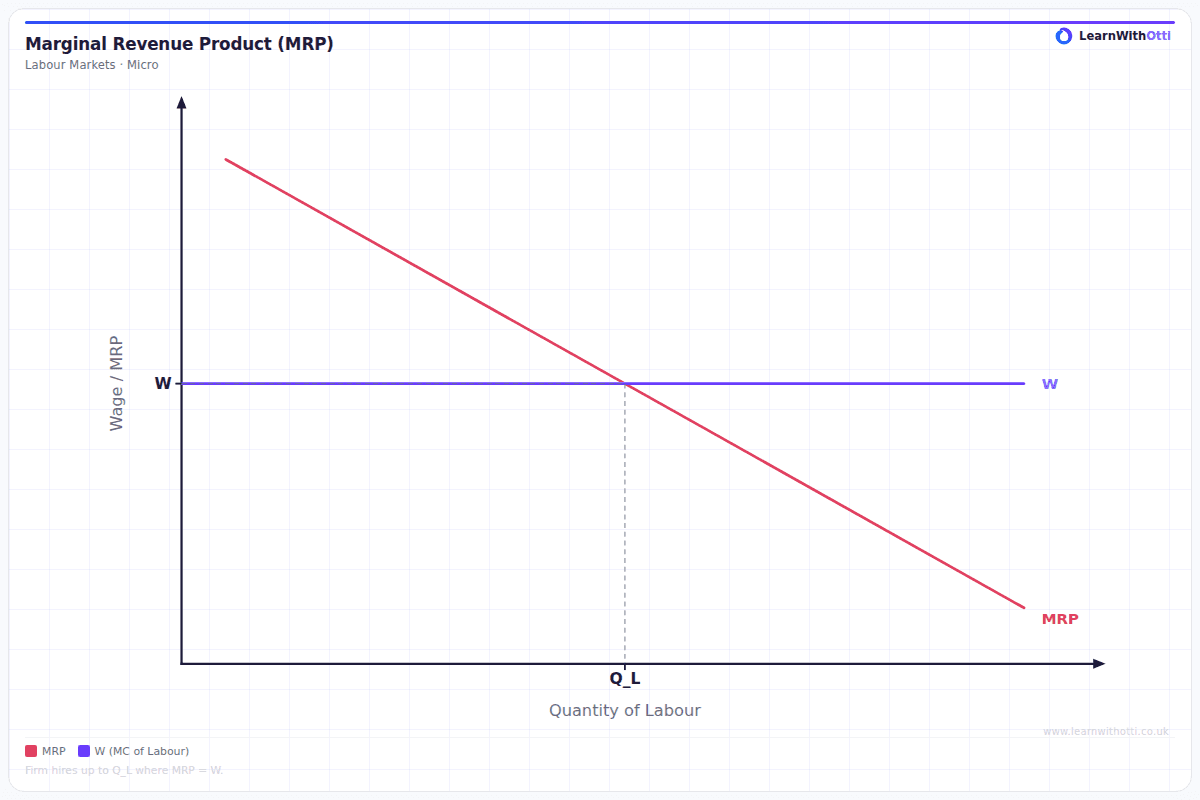
In the short run, a firm's capital is fixed: it has a set number of machines, tools and amount of floor space, and these cannot be increased quickly. As it employs more workers with this fixed capital, each extra worker has less equipment and space to work with, so adds less to output than the one before. This is diminishing marginal returns. The value of what each extra worker produces, the marginal revenue product (MRP), therefore falls as employment rises.
Marginal revenue product = marginal physical product × marginal revenue
Key idea: A profit-maximising firm employs workers up to the point where the wage equals the MRP of the last worker. If the wage falls, it becomes worth hiring workers who add less value, so employment rises.
This is the marginal productivity theory of the demand for labour. Because the firm always employs workers up to the point where MRP equals the wage, its MRP curve is its demand curve for labour.
Factors that influence the demand for labour
These factors shift the demand curve for labour.
Demand for the product. As derived demand, the demand for labour rises when demand for the final product rises.
The price of the product. If the price of the product rises, each worker's output is worth more, so the MRP of labour rises and firms employ more workers at every wage.
Labour productivity. If workers become more productive, through training, better technology or better management, each worker produces more. The MRP rises and the demand for labour shifts right.
The price and availability of substitutes for labour. If machinery and automation become cheaper or more capable, firms may replace workers with capital, reducing the demand for labour. Self-service checkouts are an example.
Non-wage costs of employment. Employing a worker costs more than the wage: there are employers' National Insurance contributions, pension contributions, training and recruitment costs. A rise in these costs reduces the demand for labour.
The number of firms in the industry. More firms in a growing industry increase the total demand for labour in that market.
The elasticity of demand for labour
How strongly employment responds to a change in the wage depends on the wage elasticity of demand for labour. Demand for labour is more elastic when:
- labour can easily be replaced by machines;
- labour costs are a large share of total costs;
- demand for the final product is price elastic;
- the time period is longer, giving firms time to change their methods.
Evaluation: If demand for labour is elastic, a rise in wages, such as from a minimum wage, causes a larger fall in employment.
Why this elasticity matters for wage differences, minimum wages and trade union bargaining is covered in 4.1.6.3 The determination of relative wage rates and levels of employment in perfectly competitive labour markets.
Key terms
| Term | Meaning |
|---|---|
| Demand for labour | The number of workers firms are willing and able to employ at each wage rate |
| Derived demand | Demand for a factor of production that comes from the demand for the goods it produces |
| Marginal physical product | The extra output produced by employing one more worker |
| Marginal revenue product | The extra revenue earned from employing one more worker |
| Marginal productivity theory | The theory that firms employ workers up to the point where the wage equals the marginal revenue product, so the MRP curve is the demand curve for labour |
| Non-wage costs | Costs of employing workers other than wages, such as National Insurance and pensions |
| Wage elasticity of demand for labour | The responsiveness of the demand for labour to a change in the wage |
Common mistakes
- Shifting the demand curve for a change in the wage. A change in the wage causes a movement along the curve.
- Forgetting derived demand. The demand for labour depends on the demand for what workers produce.
- Confusing productivity with the number of workers. Productivity is output per worker.
- Ignoring substitution by capital. Cheaper technology can reduce the demand for labour.
- Forgetting elasticity. The effect of a wage change on employment depends on the elasticity of demand for labour.
How this has been examined
In the AQA papers indexed on this site, this topic has appeared in three formats:
- 15-mark "Explain" essay — asked once (2025)
- 9-mark "Explain" data response — asked twice across 2 series (2017 to 2018)
- 1-mark multiple choice — asked 6 times across 6 series (2017 to 2024)
Where this goes next
The supply side of the labour market is covered in 4.1.6.2 Influences upon the supply of labour to different markets, and the two are brought together in 4.1.6.3 The determination of relative wage rates and levels of employment in perfectly competitive labour markets. Diminishing marginal returns are introduced in 4.1.4.3 The law of diminishing returns and returns to scale, marginal revenue in 4.1.4.6 Marginal, average and total revenue, and a single dominant employer in 4.1.6.4 The determination of relative wage rates and levels of employment in imperfectly competitive labour markets.
Otti is an AI tutor built for A-Level students. Ask it anything, practise exam questions, and get instant feedback written like an examiner would give it — not just right or wrong, but why.
Get one answer marked free