AQA A-Level Economics · Revision notes
4.1.8.4 Positive and Negative Externalities in Consumption and Production
An externality is a cost or benefit that falls on someone who is not directly involved in buying or selling a good. Because buyers and sellers ignore it, the market produces the wrong quantity. This page covers how to measure externalities, how to show them on a diagram in both production and consumption, and why missing property rights allow them to arise.
Private, external and social costs
- Private costs are the costs paid by the producer or consumer directly involved: a factory's spending on raw materials, wages and energy.
- External costs are costs imposed on third parties, who receive no compensation: the damage to health and property from the factory's pollution.
- Social costs are the full cost to society of an activity.
Social cost = private cost + external cost
Key idea: When external costs exist, the social cost of production is greater than the private cost, but the producer only takes the private cost into account.
Private, external and social benefits
- Private benefits are the benefits received by the consumer or producer directly involved: the protection a person gets from being vaccinated.
- External benefits are benefits received by third parties who did not pay: the lower risk of infection for everyone around the vaccinated person.
- Social benefits are the full benefit to society.
Social benefit = private benefit + external benefit
When external benefits exist, the social benefit of consumption is greater than the private benefit, but the consumer only considers the private benefit.
External costs of production: the diagram
This diagram uses marginal analysis: it compares the cost and benefit of each additional unit.
- Marginal private cost (MPC) is the supply curve, because firms decide how much to supply based on their own costs.
- Marginal social cost (MSC) lies above MPC. The vertical gap between them is the marginal external cost of each unit.
- Marginal private benefit (MPB) is the demand curve. With no external benefits, it is also the marginal social benefit (MSB).
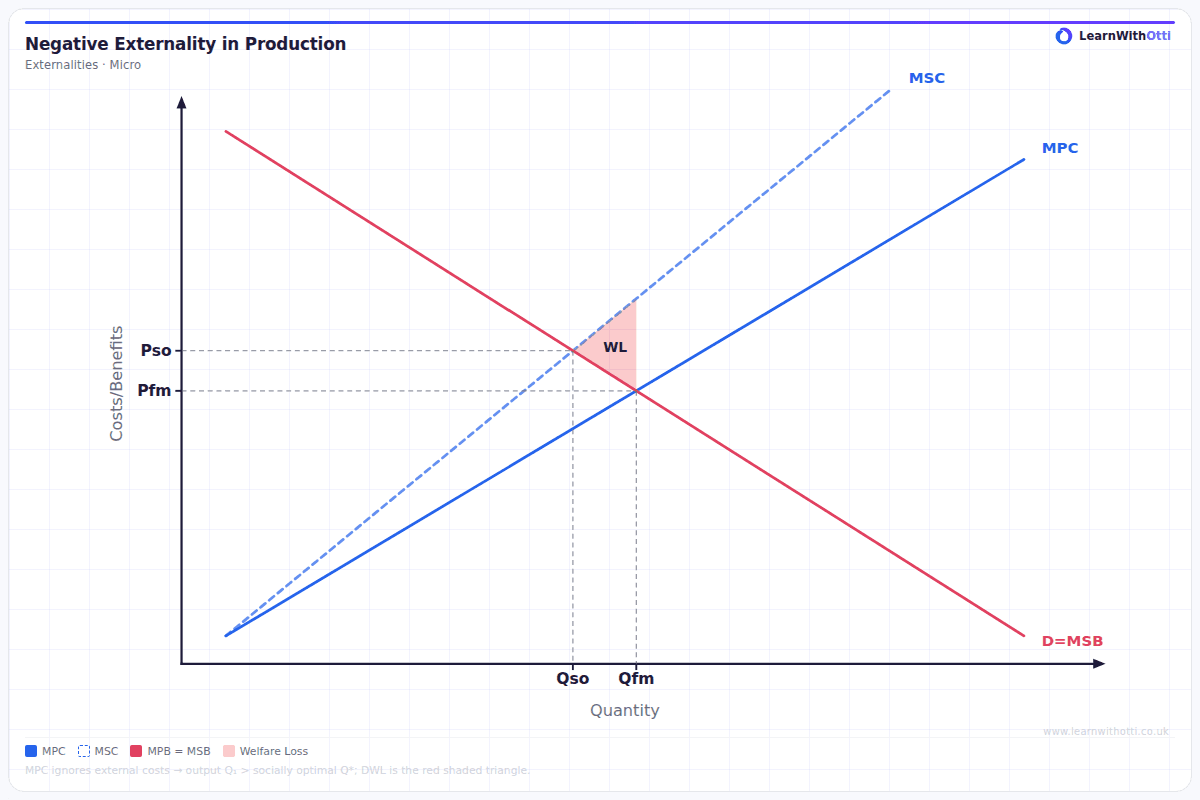
Market equilibrium and social optimum
- The market equilibrium is where MPC = MPB. This is the quantity the free market produces, because no one pays for the external cost.
- The social optimum is where MSC = MSB. This is the quantity that maximises society's welfare.
- With external costs, the market produces more than the social optimum, at a lower price than is socially optimal. The good is over-produced and over-consumed.
The welfare loss area
For every unit between the social optimum and the market equilibrium, the cost to society (MSC) is greater than the benefit to society (MSB). Society would be better off if those units were not produced.
Watch out: The welfare loss is the triangle between the MSC and MSB curves, from the socially optimal quantity to the market quantity. It points towards the social optimum.
External benefits of consumption: the diagram
- Marginal private benefit (MPB) is the demand curve, because consumers decide how much to buy based on their own benefit.
- Marginal social benefit (MSB) lies above MPB. The vertical gap is the marginal external benefit of each unit.
- Marginal private cost (MPC) is the supply curve and, with no external costs, it equals MSC.
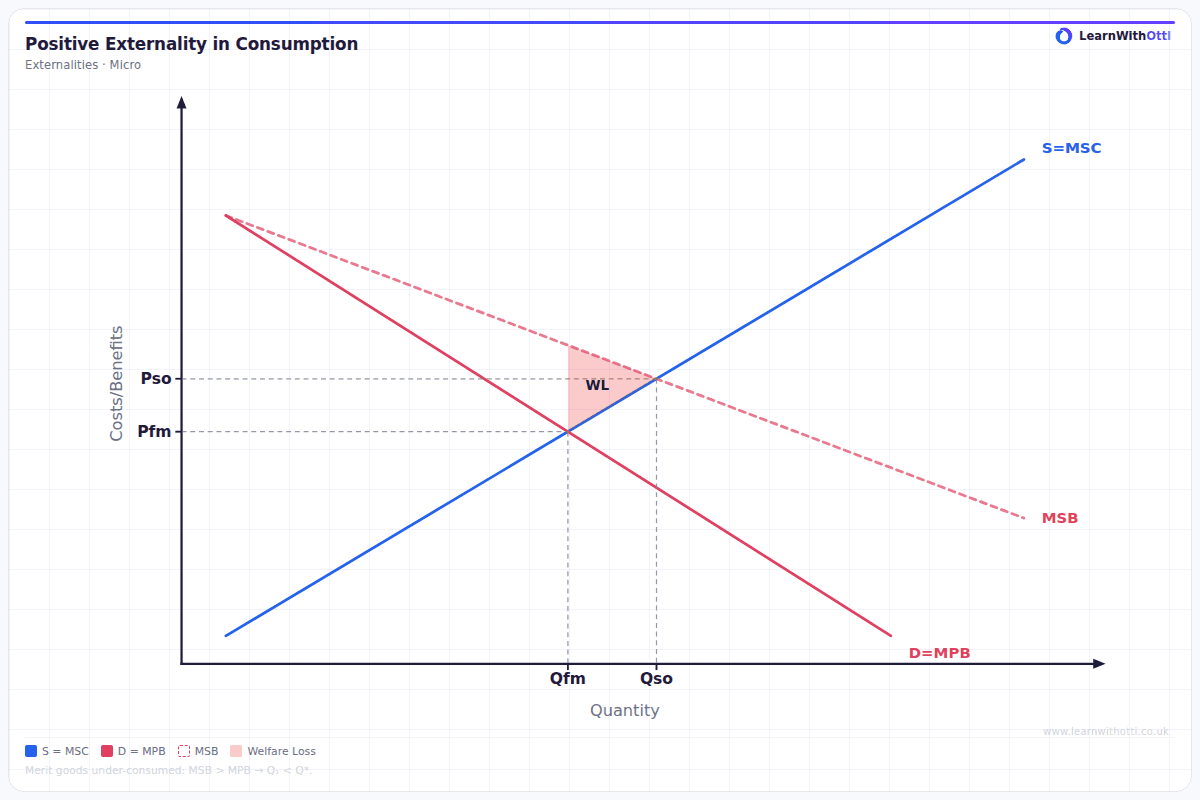
Market equilibrium and social optimum
- The market equilibrium is where MPB = MPC.
- The social optimum is where MSB = MSC.
- With external benefits, the market produces less than the social optimum. The good is under-consumed. Examples include education, vaccinations and training.
The welfare gain area
For every unit between the market quantity and the social optimum, the benefit to society (MSB) is greater than the cost (MSC). Those units are not produced by the market, so society misses out on the gain.
This is the welfare gain that would be achieved by moving to the social optimum: the triangle between MSB and MSC, from the market quantity to the socially optimal quantity. If the market stays where it is, the same area is a welfare loss.
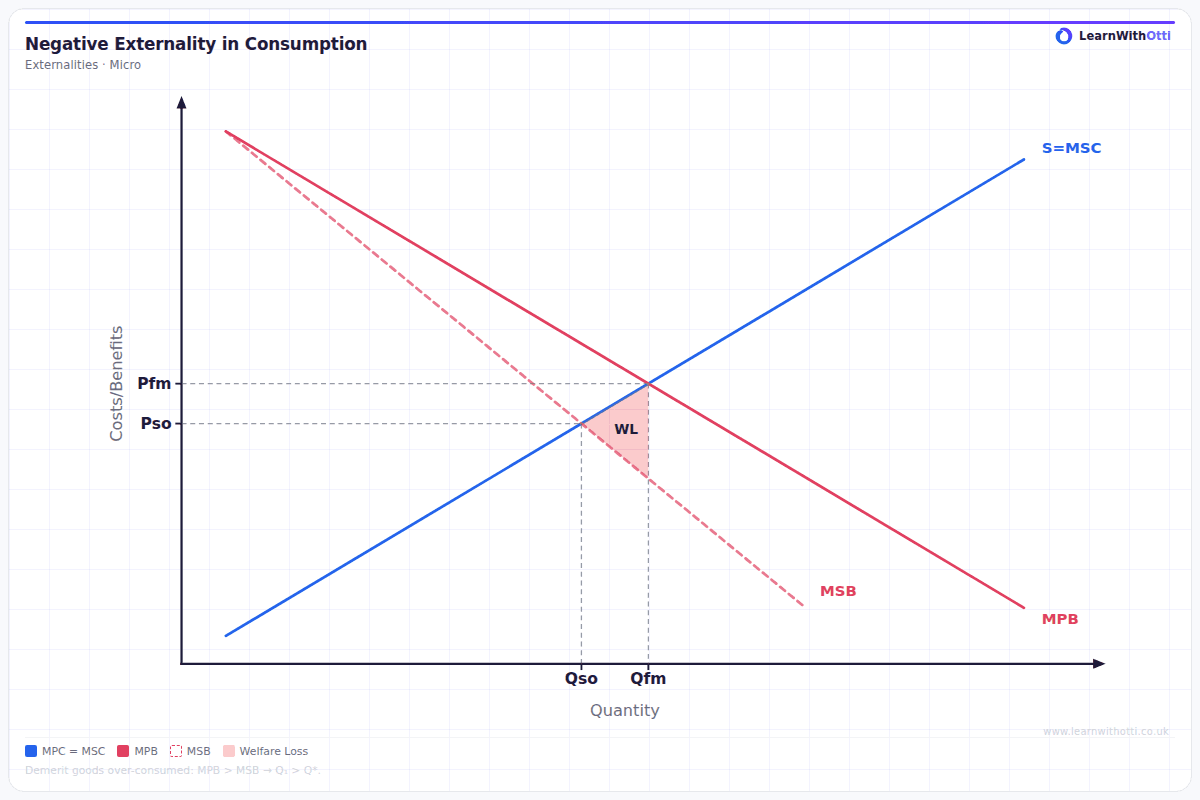
External costs of consumption and external benefits of production
Externalities can also arise on the other side of the market.
External costs of consumption. Some consumption harms third parties, such as passive smoking or noise from loud music. MSB lies below MPB, so the market consumes more than the social optimum.
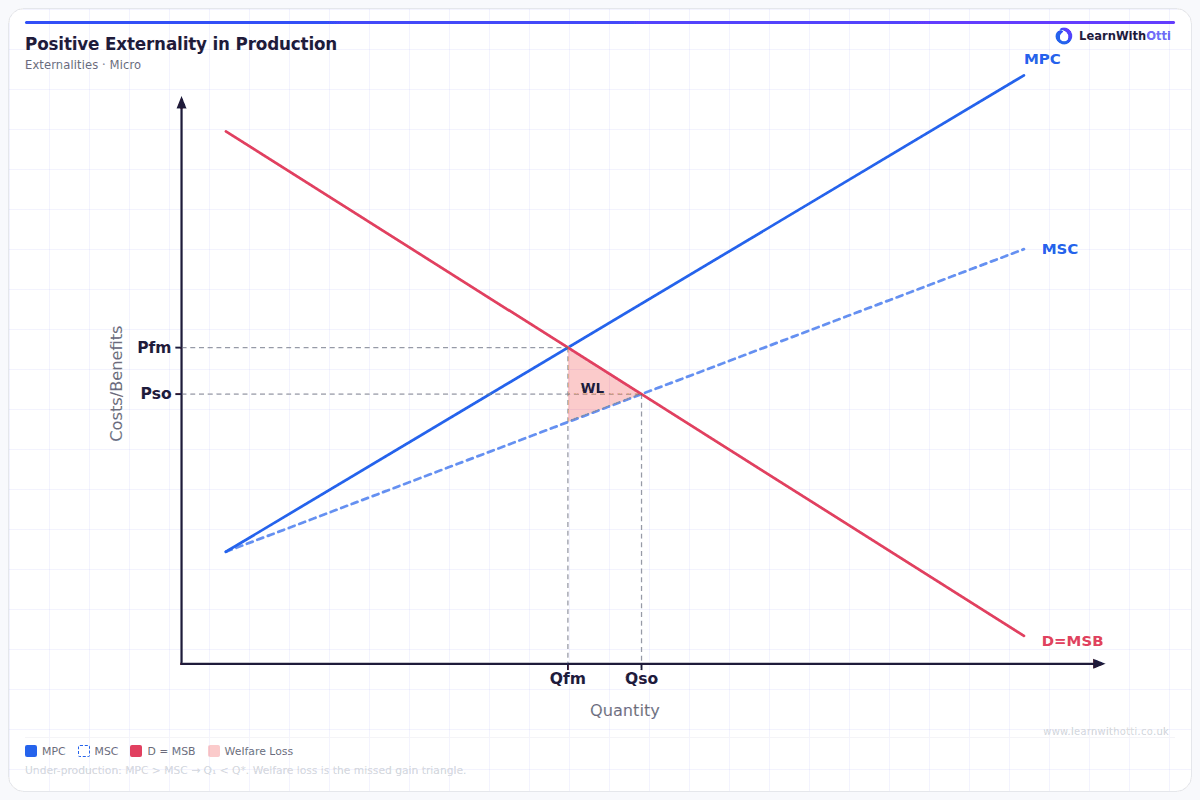
External benefits of production. Some production benefits third parties, such as a firm whose staff training raises the skills available to other employers. MSC lies below MPC, so the market produces less than the social optimum.
Externalities and property rights
Externalities arise largely because property rights over some resources are missing or cannot be enforced. Nobody owns the air, rivers or the sea, so a firm that pollutes them pays no one for the damage, and a driver pays nothing for the fumes imposed on others. If property rights were clearly defined and enforced, those harmed could demand compensation and those creating benefits could charge for them. In practice, rights over resources such as the atmosphere are hard to assign and enforce.
The impact on economic agents
Externalities and the responses to them affect different groups in different ways.
- Third parties bear external costs, such as residents near an airport living with noise, or receive external benefits, such as the wider community gaining from a well-educated workforce.
- Consumers pay prices that do not reflect the full social cost or benefit. Government intervention, such as a tax on a polluting good, raises the price they pay.
- Producers of goods with external costs may face taxes, regulation or the cost of pollution permits, which reduce their profits. Producers of goods with external benefits may receive subsidies.
- Government gains revenue from taxing goods with external costs, but bears the cost of subsidies and the administration of any intervention.
Evaluation: Government intervention can move the market towards the social optimum, but it is difficult to measure external costs and benefits accurately. If the government gets the size of the intervention wrong, it can create a new misallocation of resources.
Key terms
| Term | Meaning |
|---|---|
| Externality | A cost or benefit that falls on a third party |
| Private cost | The cost borne by the producer or consumer directly involved |
| Social cost | Private cost plus external cost |
| Social benefit | Private benefit plus external benefit |
| Marginal external cost | The external cost of producing one more unit |
| Social optimum | The output where marginal social cost equals marginal social benefit |
| Welfare loss | The loss to society from producing more or less than the social optimum |
| Property rights | The legal right to own and control a resource, and to be compensated if it is damaged |
Common mistakes
- Drawing the welfare loss triangle the wrong way. It sits between the social cost and social benefit curves, between the two quantities, and points towards the social optimum.
- Confusing over- and under-provision. External costs lead to over-production; external benefits lead to under-consumption.
- Assuming all externalities are bad. External benefits are externalities too.
- Forgetting third parties. An externality only exists if someone outside the transaction is affected.
How this has been examined
In the AQA papers indexed on this site, this topic has appeared in six formats:
- 15-mark "Explain" essay — asked twice across 2 series (2018 to 2021)
- 10-mark "To what extent" data response — asked once (2021)
- 9-mark "Explain" data response — asked twice across 2 series (2020 to 2023)
- 4-mark "Explain" data response — asked once (2020)
- 2-mark calculation — asked twice across 2 series (2020 to 2025)
- 1-mark multiple choice — asked 6 times across 5 series (2017 to 2023)
Where this goes next
Externalities are introduced as one cause of market failure in 4.1.8.2 The meaning of market failure, and their link to merit and demerit goods is developed in 4.1.8.5 Merit and demerit goods. The over-use of resources that no one owns is covered in 4.1.8.3 Public goods, private goods and quasi-public goods. Government responses, including taxes, subsidies, regulation, the extension of property rights and pollution permits, are covered in 4.1.8.9 Government intervention in markets, and the risk that intervention makes things worse in 4.1.8.10 Government failure.
Otti is an AI tutor built for A-Level students. Ask it anything, practise exam questions, and get instant feedback written like an examiner would give it — not just right or wrong, but why.
Get one answer marked free