AQA A-Level Economics · Revision notes
4.1.5.7 Price Discrimination
Price discrimination is when a firm with market power charges different prices to different groups of customers for the same product. This page covers the conditions a firm needs to do it, the diagram for third-degree price discrimination, and how it affects producers and consumers.
What price discrimination is
Price discrimination is charging different prices to different groups of customers for the same product, where the price difference does not reflect any difference in cost. Third-degree price discrimination divides customers into separate groups, such as peak and off-peak rail travellers, or adults and students at the cinema.
The conditions necessary for price discrimination
- Market power. The firm must be a price maker.
- Separate markets with different price elasticities of demand. Peak commuters have few alternatives, so their demand is inelastic; leisure travellers can choose when to travel, so theirs is elastic.
- The ability to prevent resale between the groups. If students could buy cheap tickets and resell them to adults, the scheme would collapse. Tickets tied to a time or an ID card prevent this.
Diagrammatic analysis
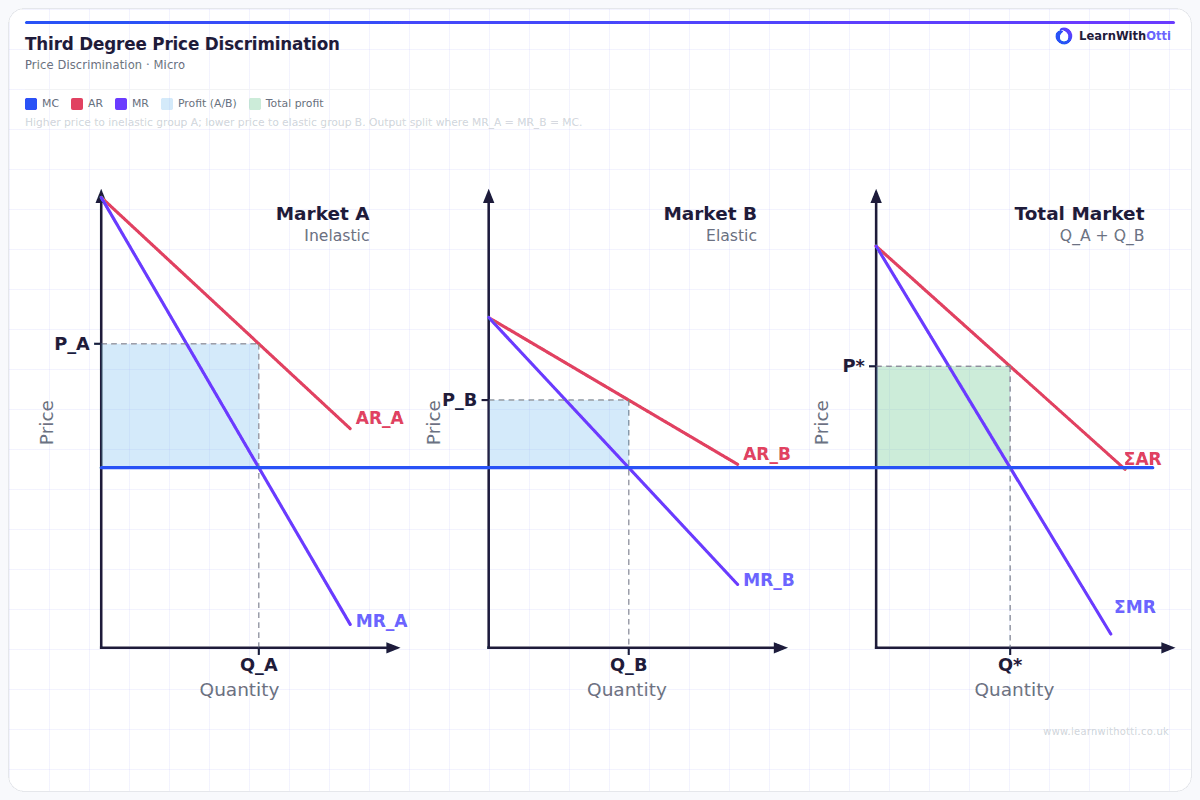
The firm sets output where MC equals MR in each market. The result is a higher price in the market with inelastic demand and a lower price in the market with elastic demand. Total profit is higher than it would be with a single price.
Costs and benefits of price discrimination
- Producers gain higher profits, which may fund investment.
- Consumers with inelastic demand lose: they pay more, and some of their consumer surplus becomes producer surplus.
- Consumers with elastic demand may gain: some people, such as students or off-peak travellers, can buy a product they could not otherwise afford.
- Output may rise overall, which can make a service viable that would not run at a single price, such as a rail service that is profitable only with both peak and off-peak fares.
Key terms
| Term | Meaning |
|---|---|
| Price maker | A firm that can set its own price because it faces a downward-sloping demand curve |
| Third-degree price discrimination | Charging different prices to separate groups of customers for the same product |
Common mistakes
- Leaving out a condition for price discrimination. All three are needed, especially the ability to prevent resale.
- Charging the higher price in the elastic market. The higher price goes to the group with inelastic demand.
How this has been examined
In the AQA papers indexed on this site, this topic has appeared in three formats:
- 25-mark "Assess" essay — asked once (2020)
- 25-mark "Evaluate" essay — asked once (2024)
- 1-mark multiple choice — asked once (2022)
Where this goes next
Price discrimination relies on the market power analysed in 4.1.5.6 Monopoly and monopoly power, and on differences in 4.1.3.2 Price, income and cross elasticities of demand. The transfer of consumer surplus to producers is developed in 4.1.5.11 Consumer and producer surplus.
Otti is an AI tutor built for A-Level students. Ask it anything, practise exam questions, and get instant feedback written like an examiner would give it — not just right or wrong, but why.
Get one answer marked free