AQA A-Level Economics · Revision notes
4.2.2.5 Determinants of Short-Run Aggregate Supply
Short-run aggregate supply (SRAS) shows how much firms produce at each price level using the current factors of production. Anything that changes firms' costs of production shifts the whole SRAS curve. This topic covers the main causes of those shifts and what they do to the price level and real output.
What shifts SRAS
SRAS shifts when firms' costs of production change at every price level.
- A rise in costs shifts SRAS to the left (upwards). At every price level, firms produce less, because each unit is less profitable.
- A fall in costs shifts SRAS to the right (downwards). At every price level, firms produce more.
Watch out: A change in the price level itself does not shift SRAS. It causes a movement along the curve.
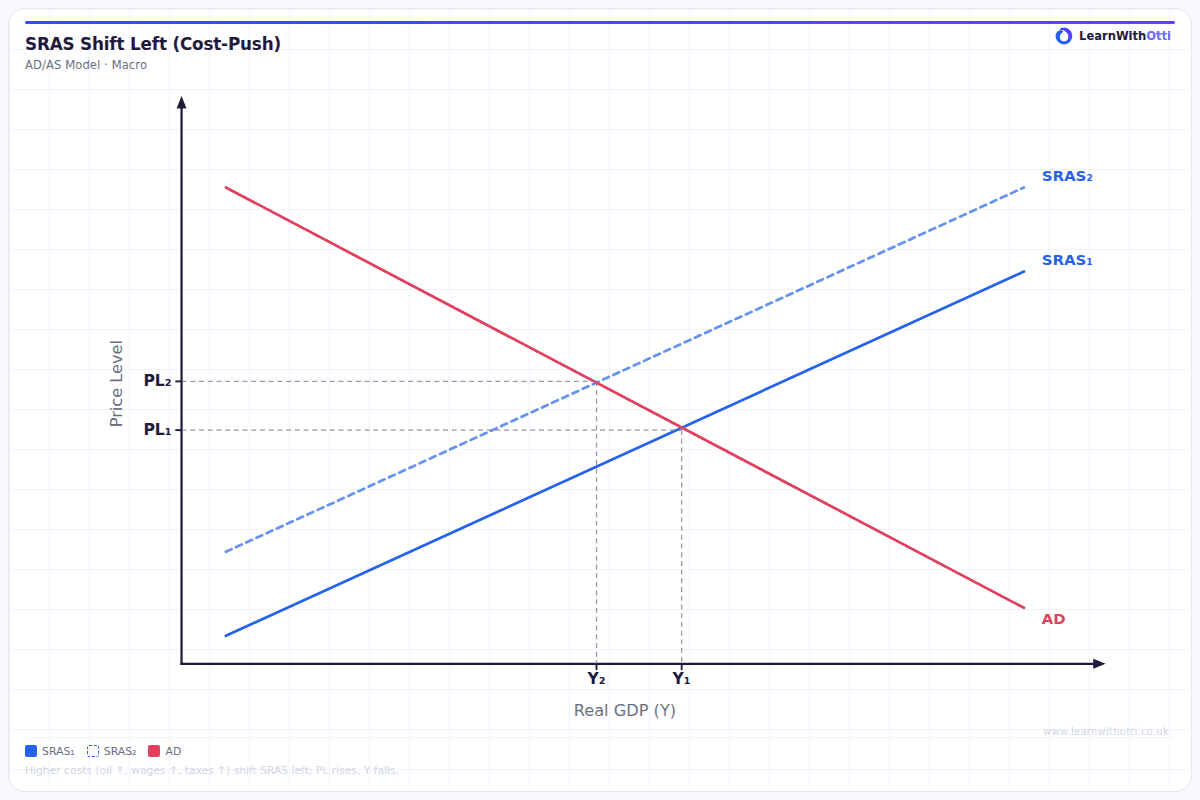
Changes in the costs of raw materials and energy
Almost every firm uses raw materials and energy. When their prices rise, costs rise across the whole economy and SRAS shifts left.
The sharp rise in oil and gas prices in 2022, after Russia's invasion of Ukraine, is a clear example. Energy costs rose for households and firms alike, pushing up prices across the economy while output was squeezed. When world commodity prices fall, the opposite happens: costs fall and SRAS shifts right.
Changes in exchange rates
Many raw materials, components and energy supplies are imported, so their cost in pounds depends on the exchange rate.
- A depreciation of the pound makes imports more expensive in pounds. Firms that rely on imported inputs face higher costs, so SRAS shifts left.
- An appreciation of the pound makes imported inputs cheaper, so SRAS shifts right.
Evaluation: The effect is larger in an economy such as the UK that imports a high proportion of its energy, food and components.
Changes in tax rates
Taxes paid by firms are part of their costs of production.
- A rise in indirect taxes, such as VAT or fuel duty, raises firms' costs and shifts SRAS to the left.
- A rise in taxes on employing workers, such as employers' National Insurance contributions, raises the cost of labour and shifts SRAS left.
- Cuts in these taxes lower costs and shift SRAS to the right.
Subsidies to producers work in the opposite direction to taxes: they lower costs and shift SRAS right.
Changes in money wage rates and productivity
Labour is the largest single cost for most firms, so wages and productivity have a big effect on SRAS:
- Wage costs. A rise in wages that is not matched by higher productivity raises unit costs and shifts SRAS left.
- Productivity. A short-run rise in output per worker lowers unit costs and shifts SRAS right.
The effect of a shift in SRAS
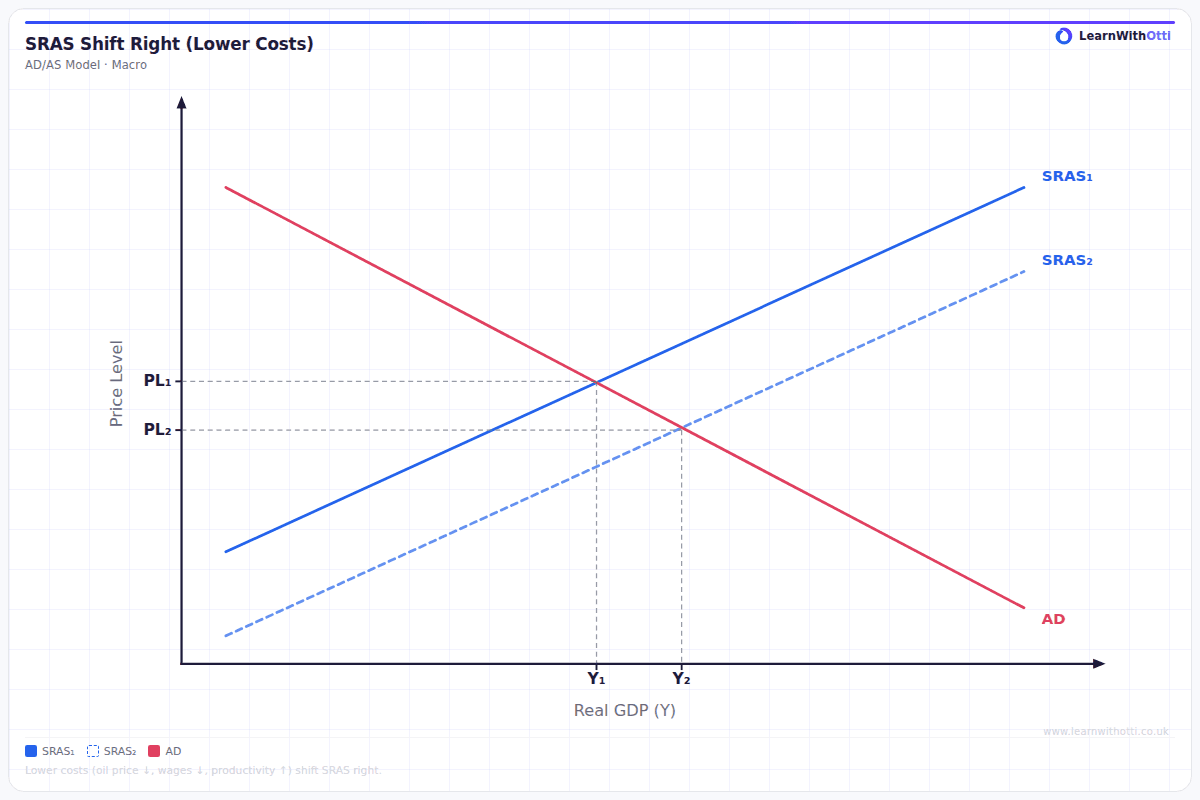
A leftward shift (a negative supply shock):
- the price level rises, causing cost-push inflation;
- real output falls, so unemployment tends to rise;
- the economy can face rising inflation and falling output at the same time, a combination known as stagflation.
A rightward shift (a positive supply shock):
- the price level falls, or rises more slowly;
- real output rises and unemployment tends to fall.
A rightward shift is therefore good news on several fronts at once, which is why falling energy prices are welcome.
Key terms
| Term | Meaning |
|---|---|
| Short-run aggregate supply | How much firms produce at each price level using the current factors of production |
| Supply shock | A sudden change in costs that shifts the SRAS curve |
| Cost-push inflation | Inflation caused by rising costs of production |
| Stagflation | Rising inflation combined with falling output and rising unemployment |
| Depreciation | A fall in the value of a currency against others |
Common mistakes
- Shifting SRAS for a change in the price level. A change in the price level causes a movement along SRAS.
- Getting the exchange rate effect backwards. A depreciation raises the cost of imported inputs and shifts SRAS to the left.
- Confusing SRAS shifts with LRAS shifts. Short-term cost changes shift SRAS; changes in productive capacity shift LRAS.
- Forgetting the effect on output. A leftward shift raises the price level and reduces real output.
How this has been examined
In the AQA papers indexed on this site, this topic has appeared in two formats:
- 15-mark "Explain" essay — asked once (2023)
- 1-mark multiple choice — asked 4 times across 4 series (2017 to 2025)
Where this goes next
The SRAS curve and the effect of its shifts on equilibrium are covered in 4.2.2.2 Aggregate demand and aggregate supply analysis, and productive capacity in 4.2.2.6 Determinants of long-run aggregate supply. Cost-push inflation is developed in 4.2.3.3 Inflation and deflation, and the exchange rate in 4.2.6.4 Exchange rate systems.
Otti is an AI tutor built for A-Level students. Ask it anything, practise exam questions, and get instant feedback written like an examiner would give it — not just right or wrong, but why.
Get one answer marked free