AQA A-Level Economics · Revision notes
4.2.5.2 Supply-Side Policies
Supply-side policies aim to increase the productive capacity of the economy by improving the quantity and quality of the factors of production and the efficiency with which they are used. If they work, they shift long-run aggregate supply (LRAS) to the right, allowing the economy to grow without generating inflation. This topic covers the difference between supply-side policies and supply-side improvements, free market and interventionist approaches, how the policies are shown on AD/AS diagrams, and their effects on unemployment, inflation and the current account.
What supply-side policies aim to do
Key distinction: Demand-side policies change how much of the economy's existing capacity is used. Supply-side policies try to increase that capacity.
They work by:
- raising the productivity of labour and capital
- increasing the size of the labour force, or the number of hours people are willing to work
- encouraging investment, enterprise and innovation
- making markets work more efficiently
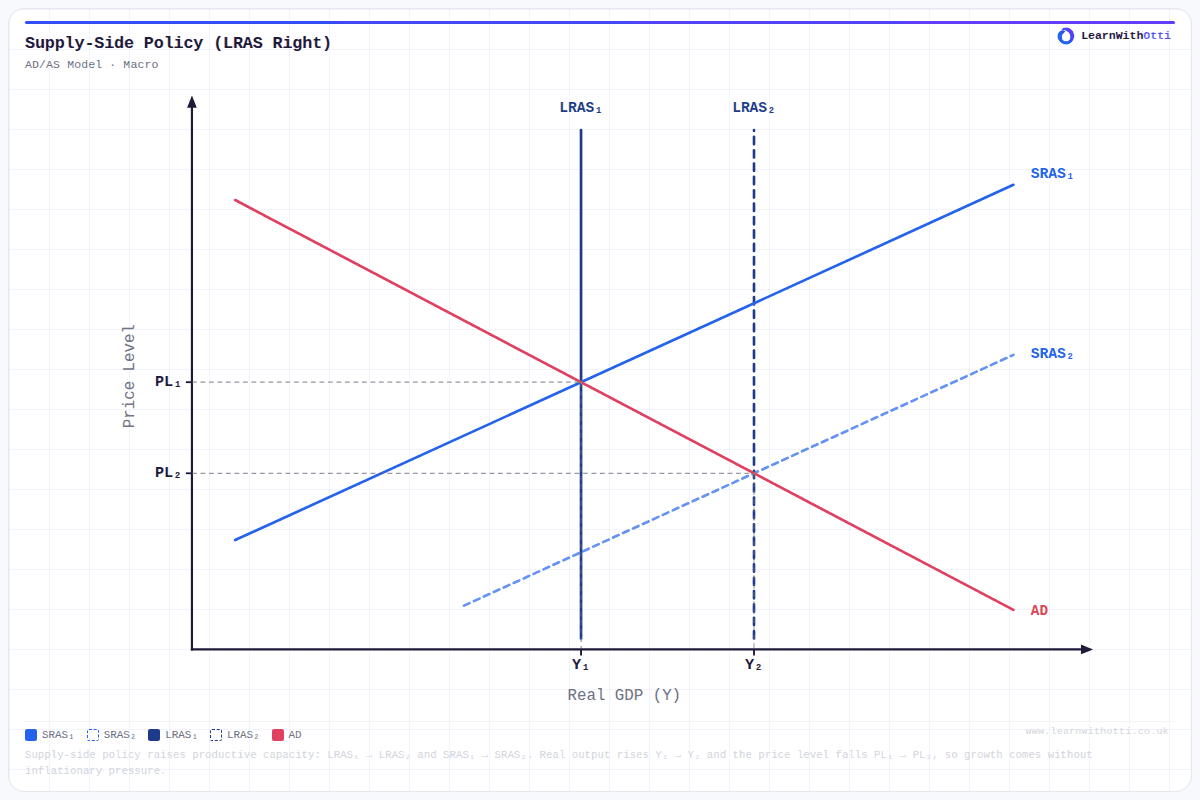
Key idea: A rightward shift in LRAS raises potential output. If AD grows in line with it, real output rises and the price level stays stable. This is why supply-side improvements are seen as the route to sustained, non-inflationary growth.
Supply-side policies and supply-side improvements
Supply-side improvements are increases in the economy's productive capacity from any source. Many come from the private sector, independently of government, as firms invest, innovate and raise productivity. Supply-side policies are government measures designed to bring about these improvements. Some correct market failures, such as short-termism, where firms and lenders favour quick returns and under-invest. Others improve incentives and the way markets work.
Market-based and interventionist methods
The two approaches reflect different views about the role of the state.
- Market-based (free market) policies aim to make markets work better by reducing the role of the government. They remove barriers, lower taxes and cut regulation so that the price mechanism allocates resources more efficiently. They are associated with classical and free market economists.
- Interventionist policies involve the government taking an active role, usually by spending money, to correct market failures that hold back productive capacity. They are associated with the view that markets under-provide things like training, research and infrastructure because of positive externalities and information gaps.
Most governments use a mix of both. The rest of this topic takes each of the five areas in turn.
Policies to increase incentives
Market-based
- Cutting income tax. Lower marginal tax rates raise the reward from working, so people may work longer hours, take on extra responsibility or enter the labour force. Raising the personal allowance takes low earners out of income tax altogether.
- Cutting corporation tax. Higher post-tax profits give firms more incentive and more funds to invest, and may attract investment from foreign firms. The UK main rate was cut from 28% in 2010 to 19% by 2017, before rising to 25% in 2023.
- Reforming welfare benefits. Reducing benefits, or withdrawing them more gradually as earnings rise, increases the gap between income in and out of work. Universal Credit was designed partly to make work pay.
Interventionist
- Tax incentives for investment and research. The government can allow firms to deduct more of their spending on new capital or research and development from their taxable profits.
- Grants and subsidies for new business start-ups or for investment in particular regions.
- Industrial policy. The government can support industries it sees as important for future growth, through targeted investment, subsidies and research funding.
Policies to promote competition
Market-based
- Privatisation. Selling state-owned firms to the private sector introduces the profit motive, which should give firms an incentive to cut costs and innovate. Examples include BT, British Gas and the water companies in the 1980s, and Royal Mail in 2013.
- Deregulation. Removing rules that restrict entry into a market allows new firms to compete. Bus services outside London were deregulated in 1986.
- Competitive tendering. Private firms bid for contracts to provide public services, such as refuse collection or hospital cleaning, which can lower costs.
- Free trade. Removing barriers to trade exposes domestic firms to competition from foreign firms.
Interventionist
- Competition policy. The Competition and Markets Authority (CMA) investigates mergers and anti-competitive behaviour, such as price fixing, to keep markets competitive.
- Support for small firms, such as start-up loans and lower taxes for small businesses, to increase the number of potential competitors.
These policies are covered in more detail in 4.1.8.7 Competition policy and 4.1.8.8 Public ownership, privatisation, regulation and deregulation of markets.
Policies to reform the labour market
Market-based
- Reducing trade union power. Laws passed in the 1980s required secret ballots before strikes and restricted other forms of industrial action. The aim was to make wages more responsive to market conditions and reduce days lost to strikes.
- More flexible employment contracts. Making it easier and cheaper to hire workers on part-time or temporary contracts can encourage firms to take on staff.
- Reducing or limiting the minimum wage. Free market economists argue that a minimum wage set above the equilibrium wage reduces the demand for labour, especially for young and low-skilled workers.
Interventionist
- Improving information. Jobcentres and online services help people find vacancies faster, reducing frictional unemployment.
- Help with childcare. Funded childcare hours make it easier for parents to work.
- Improving geographical mobility, for example through help with housing or relocation costs, so that workers can move to where jobs are.
Policies to improve skills and the quality of the labour force
Key idea: This is mainly an area for interventionist policy, because firms and individuals tend to under-invest in education and training. A firm that trains a worker may lose that worker to a rival, and the wider economy gains benefits the firm does not receive.
Interventionist
- Spending on education, from early years through to universities, to raise the human capital of future workers.
- Apprenticeships. Since 2017, large employers in the UK have paid the Apprenticeship Levy, which is used to fund apprenticeship training.
- Training for unemployed workers, so that people whose skills are no longer in demand can retrain for growing industries, reducing structural unemployment.
Market-based
- Tax relief for firms that train their workers, leaving firms to decide what training they need.
- Student loans, which let individuals invest in their own education and repay from their future higher earnings.
Policies to improve infrastructure
Infrastructure is the transport, energy and communications networks that firms rely on: roads, railways, ports, power stations and broadband. Better infrastructure cuts firms' costs, reduces journey times and widens the area from which firms can recruit workers.
Interventionist
- Direct government spending on transport and energy, such as new rail lines, road improvements and the expansion of full-fibre broadband to areas the market would not serve.
Market-based
- Using private finance. The government can contract private firms to build and run infrastructure, or rely on privately owned utilities to invest, regulated so that they meet targets.
- Reforming the planning system so that private investment in housing, energy and transport can go ahead more quickly.
Illustrating supply-side policies on AD/AS diagrams
On the classical model, a successful supply-side policy shifts the vertical LRAS curve to the right. Real output rises and, if AD is unchanged, the price level falls.
On the Keynesian model, supply-side policy shifts the whole AS curve to the right, moving out the point at which it becomes vertical. The economy's full-capacity output rises.
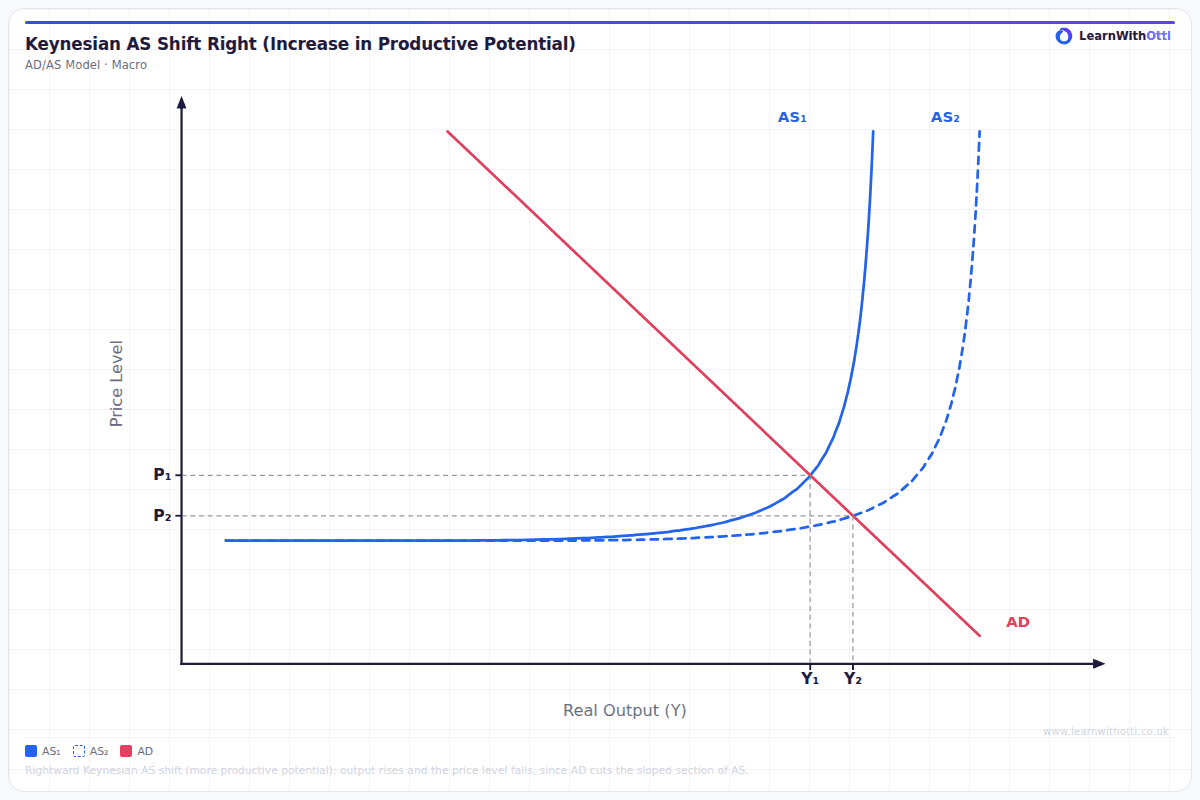
Two further points matter when using these diagrams:
- Supply-side policies can affect AD too. Government spending on education or infrastructure, and cuts in income tax, raise AD in the short run, before any effect on capacity appears years later.
- The effect on output depends on AD. If the economy has a large negative output gap, raising capacity does little to raise actual output in the short run. Supply-side policies are most useful when the economy is close to full capacity.
Supply-side policies and the natural rate of unemployment
Policies that improve skills, labour mobility, information about vacancies and the incentive to work reduce frictional and structural unemployment. This lowers the natural rate of unemployment, so the economy can sustain a lower level of unemployment without rising inflation.
Supply-side policies have microeconomic as well as macroeconomic effects. They change incentives and efficiency in individual markets, such as the labour market or a privatised industry, as well as shifting LRAS for the economy as a whole.
Strengths and weaknesses of supply-side policies
Strengths
- Non-inflationary growth. They can raise output without pushing up the price level, avoiding the conflict between growth and inflation.
- Lower unemployment. Better skills and mobility reduce structural and frictional unemployment, which demand-side policy cannot reach.
- International competitiveness. Higher productivity lowers unit costs, which can improve the current account.
- Higher living standards in the long run, as potential output per head rises.
Weaknesses
- Long time lags. Education, training and infrastructure can take many years, even decades, to raise productive capacity. They are no help in an immediate recession.
- Cost and opportunity cost. Interventionist policies require government spending, which must be paid for with higher taxes, borrowing or cuts elsewhere.
- Uncertain effects. Cutting income tax may not lead people to work more, because higher take-home pay may allow them to work fewer hours for the same income. Firms may not invest, even with lower corporation tax, if confidence is low.
- Inequality. Many market-based policies, such as cuts in higher rates of tax, benefit cuts and weaker employment protection, tend to benefit high earners and can widen inequality.
- Risks of privatisation and deregulation. A state monopoly may become a private monopoly, and deregulation may lead to lower safety or environmental standards.
- Government failure. The government may spend on the wrong projects, and large infrastructure projects often run over budget. HS2 is a well-known example of rising costs.
Key terms
| Term | Meaning |
|---|---|
| Supply-side policies | Policies that aim to increase the productive capacity of the economy |
| Supply-side improvements | Increases in productive capacity from any source, including the private sector |
| Market-based policies | Supply-side policies that reduce the role of the government to make markets work better |
| Interventionist policies | Supply-side policies in which the government takes an active role, usually through spending |
| Industrial policy | Government support for industries seen as important for future growth |
| Privatisation | The sale of state-owned firms or assets to the private sector |
| Deregulation | The removal of rules that restrict competition or entry into a market |
| Competitive tendering | Private firms bidding for contracts to supply goods or services to the government |
| Labour market flexibility | How easily wages, hours and employment adjust to changing conditions |
| Human capital | The skills, knowledge and experience of the workforce |
| Infrastructure | The transport, energy and communications networks the economy relies on |
Common mistakes
- Shifting SRAS instead of LRAS. Supply-side policies aim to raise productive capacity, so they shift LRAS, or the whole Keynesian AS curve.
- Ignoring time lags. Most supply-side policies take years to work. Saying that more education spending will end a recession misunderstands what the policy does.
- Forgetting the AD effect. Spending on education or infrastructure raises AD in the short run, before it raises capacity.
- Mixing up the two approaches. Privatisation and tax cuts are market-based. Spending on training and infrastructure is interventionist. Be clear which is which.
- Assuming tax cuts always increase work. Some people may choose to work fewer hours if they can earn the same income with less effort.
- Treating all supply-side policies as free. Interventionist policies cost money, and market-based policies can have costs for workers and for equality.
How this has been examined
In the AQA papers indexed on this site, this topic has appeared in four formats:
- 25-mark "Justify" essay — asked 3 times across 3 series (2017 to 2025)
- 25-mark "Evaluate" essay — asked twice across 2 series (2020 to 2022)
- 15-mark "Explain" essay — asked 3 times across 3 series (2018 to 2025)
- 1-mark multiple choice — asked 5 times across 5 series (2019 to 2025)
Where this goes next
The factors that shift LRAS are covered in 4.2.2.6 Determinants of long-run aggregate supply, and the causes of long-run growth in 4.2.3.1 Economic growth and the economic cycle. The natural rate of unemployment is introduced in 4.2.3.2 Employment and unemployment. The alternative approach of managing demand is covered in 4.2.5.1 Fiscal policy and 4.2.4.3 Central banks and monetary policy, and the conflicts between policies in 4.2.3.4 Possible conflicts between macroeconomic policy objectives. The labour market reforms build on 4.1.6.5 The influence of trade unions in determining wages and levels of employment and 4.1.6.6 The National Minimum Wage.
End of topic 4.2.5
Quiz yourself on 4.2.5 Fiscal policy and supply-side policies
10 multiple-choice questions drawn from the 30 we have on the whole of topic 4.2.5, with instant feedback on every answer.
Start the 4.2.5 quiz →Otti is an AI tutor built for A-Level students. Ask it anything, practise exam questions, and get instant feedback written like an examiner would give it — not just right or wrong, but why.
Get one answer marked free