AQA A-Level Economics · Revision notes
4.2.6.2 Trade
Why does a country import anything it could make itself? The answer is comparative advantage, and it is worth getting exactly right: a country can be worse at producing everything and still gain from trade. This page covers that model, the wider benefits and costs of trade, the changing pattern of UK trade, protectionism, customs unions, the Single European Market and the World Trade Organisation.
Absolute and comparative advantage
Absolute advantage means producing more of a good with the same resources than another country can — simply being better at it.
Comparative advantage means producing a good at a lower opportunity cost than another country. This, not absolute advantage, is what determines who should specialise in what.
Key idea: The distinction is the whole topic. A country with no absolute advantage in anything still has a comparative advantage in something, because opportunity cost is relative. You cannot be worse at everything in relative terms.
Worked example
Two countries can produce wheat and cloth. Each has the same resources.
| Wheat (tonnes) | Cloth (metres) | |
|---|---|---|
| Country A | 100 | 200 |
| Country B | 40 | 120 |
Country A has an absolute advantage in both: more wheat and more cloth.
Now the opportunity costs.
Country A: producing 100 wheat means giving up 200 cloth, so 1 wheat costs 2 cloth. Conversely 1 cloth costs 0.5 wheat.
Country B: producing 40 wheat means giving up 120 cloth, so 1 wheat costs 3 cloth. Conversely 1 cloth costs 0.333 wheat.
Compare:
- Country A has the lower opportunity cost for wheat (2 cloth, versus 3 for B), so it has the comparative advantage in wheat.
- Country B has the lower opportunity cost for cloth (0.333 wheat, versus 0.5 for A), so it has the comparative advantage in cloth.
So A should specialise in wheat and B in cloth, even though A is better at producing both.
Watch out: Both countries can then consume beyond what they could produce alone, provided the terms of trade lie between the two opportunity cost ratios — here, between 2 and 3 cloth per wheat.
That last condition is easy to forget and it is where the gains actually come from. Outside that range, one country is better off not trading.
Method: for each country, work out what one unit of a good costs in terms of the other. Lowest opportunity cost wins the comparative advantage. Do not compare output levels — that gives you absolute advantage, which is the wrong answer.
Showing it on a diagram
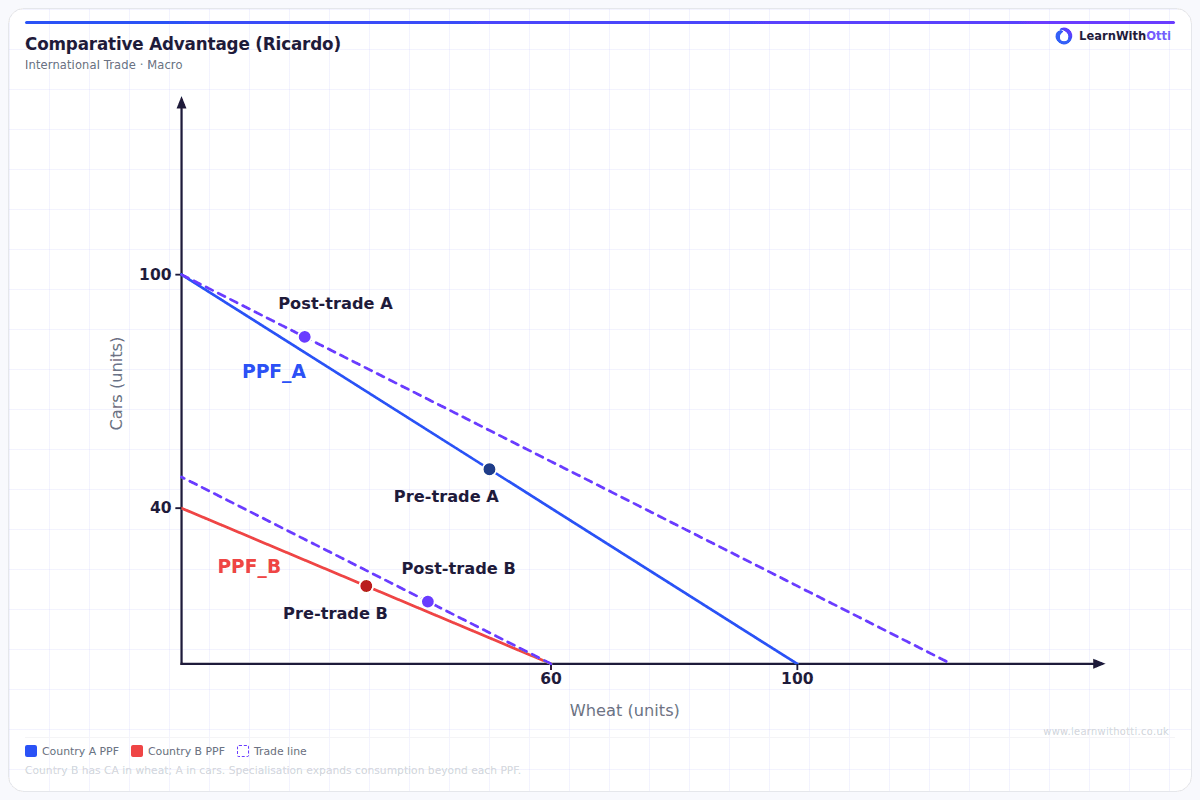
Comparative advantage can be shown with production possibility frontiers. Each country's PPF is a straight line whose gradient is its opportunity cost ratio. The country with the shallower gradient in a good has the comparative advantage in it.
After specialisation and trade, each country can consume at a point outside its own PPF — the visual statement of the gain from trade.
Assumptions, and why they matter
The theory rests on assumptions that rarely hold in full:
- No transport costs. Real transport costs can exceed the cost advantage, which is why heavy, low-value goods are often produced locally.
- Constant returns to scale, giving straight-line PPFs. In reality opportunity cost usually rises as a country specialises further, which limits how far specialisation goes.
- Perfect factor mobility. Workers and capital are assumed to shift between industries costlessly. In practice a steelworker does not become a software engineer, so specialisation creates structural unemployment concentrated in particular regions.
- No trade barriers. Tariffs and quotas can reverse the pattern.
- Only two countries and two goods, which is a simplification rather than a flaw.
- Externalities ignored. The environmental cost of transporting goods is not in the model.
Evaluation: Naming and explaining the assumption that fails in a given case is far more useful than reciting the list.
Advantages and disadvantages of specialisation and trade
Advantages
- Higher world output, since resources go where opportunity cost is lowest.
- Lower prices and wider choice for consumers.
- Economies of scale, as producing for a world market allows larger output.
- Greater competition, which pushes domestic firms towards efficiency and innovation.
- Access to resources a country lacks entirely.
Disadvantages
- Over-dependence. A country specialised in a narrow range is exposed if demand or price collapses — particularly acute for commodity exporters.
- Structural unemployment in industries that lose out, often geographically concentrated.
- Infant industries may never develop if exposed to established foreign competitors too early.
- Loss of sovereignty over essential goods, a concern that resurfaces whenever supply chains are disrupted.
- Environmental cost of transporting goods across the world.
- Risk of a race to the bottom in labour and environmental standards.
Changes in the pattern of trade
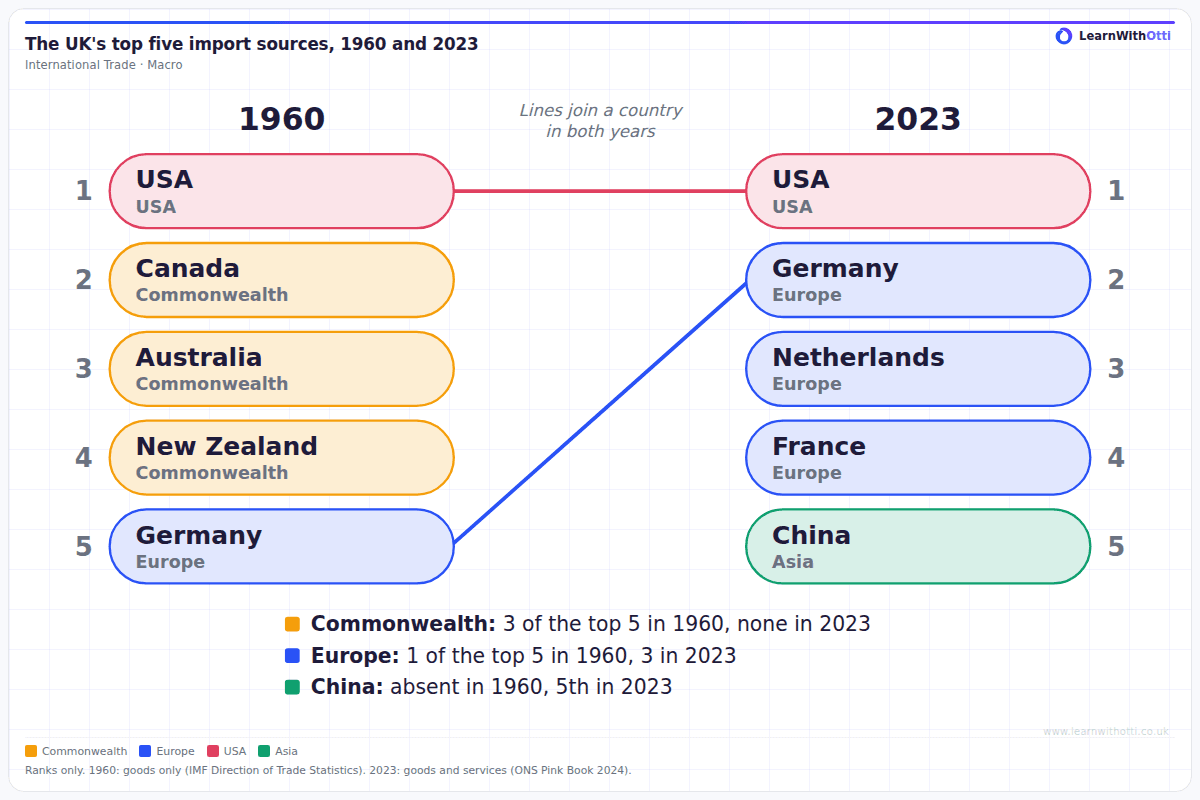
Comparative advantage explains why countries trade. It does not fully explain who trades with whom, or why those patterns shift. The countries Britain buys most of its imports from today are largely different from those of 1960, as the diagram below shows. The reasons for that change are what this section covers.
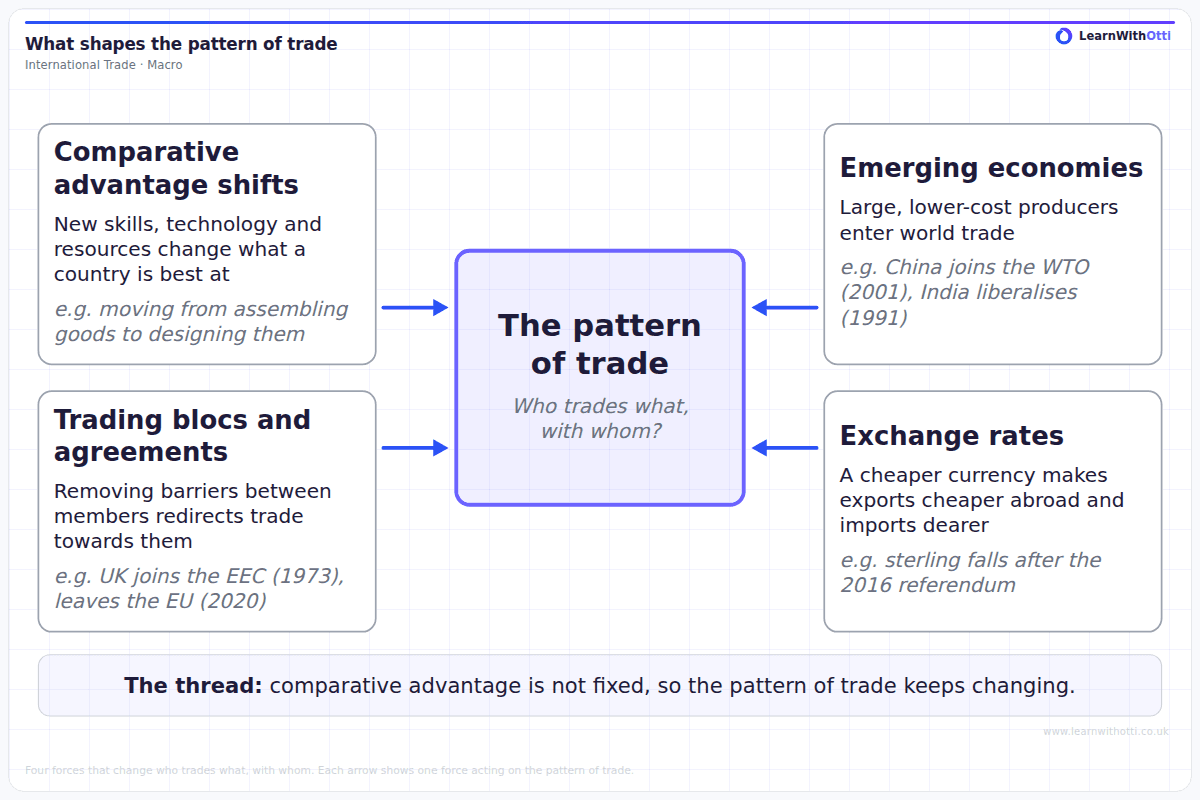
Four forces drive changes like these, and each has its own section below.
Comparative advantage
The underlying driver remains comparative advantage: countries tend to export goods they can produce at a lower opportunity cost than their partners.
But comparative advantage is not fixed. It shifts as the things underlying it shift:
- Factor endowments change. Resources are discovered or exhausted; populations age; capital accumulates.
- Technology changes. An innovation can hand a country an advantage it did not previously have.
- Skills and education change. A country that invests in human capital moves up the value chain, from assembly into design.
Key idea: So the pattern of trade is comparative advantage in motion, not a fixed allocation.
The impact of emerging economies
The single largest change in world trade over the past forty years has been the entry of large, lower-cost producers.
China's reforms from 1978 and its WTO accession in 2001 added hundreds of millions of workers to the traded economy. India's liberalisation from 1991 did similarly, with a stronger weighting towards services.
The effects on trade patterns:
- Manufacturing shifted towards lower-cost economies, so developed economies import more manufactured goods and export more services and high-value goods.
- Commodity demand rose sharply, benefiting resource exporters in Africa, Latin America and Australia, and tying their fortunes to Chinese growth.
- South-south trade grew. Emerging economies increasingly trade with each other rather than only with developed economies.
- Developed economies' manufacturing shrank as a share of output, with job losses concentrated in particular industries and regions.
Trading blocs and bilateral agreements
Membership of a trading bloc reshapes trade patterns in two distinct ways:
- Trade creation. Removing barriers between members means production shifts to the lower-cost producer within the bloc. This raises welfare.
- Trade diversion. A common external barrier means members buy from a higher-cost partner inside the bloc rather than a lower-cost producer outside it. This lowers welfare.
Evaluation: Whether a bloc improves things overall depends on which effect dominates.
The UK's EU membership increased trade with Europe and reduced it with Commonwealth countries — creation and diversion operating together.
Bilateral agreements between two countries have the same effects on a smaller scale, and have multiplied as progress through the WTO has slowed.
Changes in relative exchange rates
A currency's value alters the competitiveness of everything a country sells.
If sterling depreciates, UK exports become cheaper in foreign currency and imports dearer in sterling. Export volumes tend to rise and import volumes to fall, shifting the pattern of trade.
Two qualifications matter:
- The effect depends on elasticities. If demand for exports and imports is price-inelastic, a depreciation may worsen the trade balance before it improves it — the J-curve effect, with the Marshall-Lerner condition setting out when a depreciation improves the balance at all.
- Exchange rate moves can be temporary, while trade relationships take years to build. A short-lived depreciation may change little.
Other influences
- Transport and communication costs, which have fallen dramatically and made fragmented supply chains viable.
- Geography, which still matters: countries trade disproportionately with neighbours.
- Historical and cultural links, including language and former colonial relationships.
- Protectionism, which can redirect flows deliberately.
Protectionism
If free trade raises world output, why does almost every country restrict it? Because the gains and losses from trade fall on different people, and the losers are usually concentrated, visible and politically organised while the gainers are dispersed and quiet.
Types of restriction
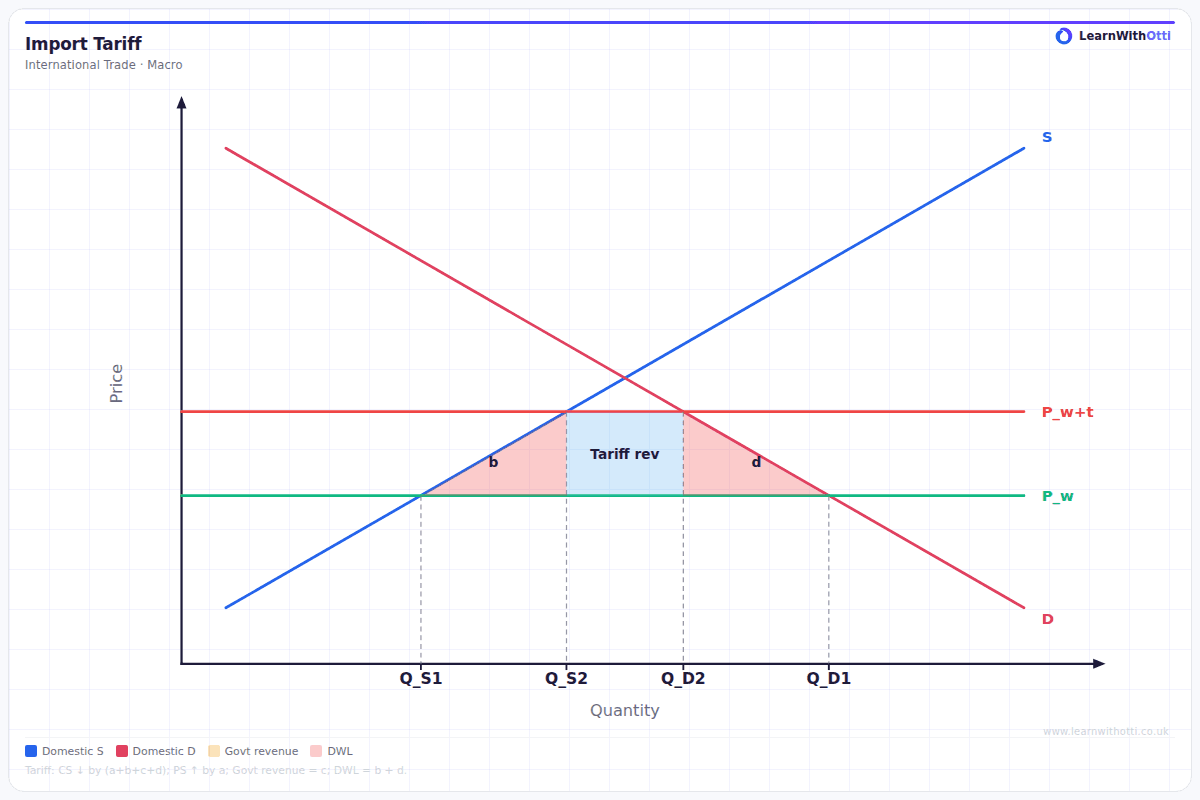
Tariffs — a tax on imports. The domestic price rises by the tariff, so domestic production rises, imports fall, and the government collects revenue. Consumers pay more and consume less, and the loss to consumers exceeds the gains to producers and government combined — the net welfare loss. This loss arises because some goods are now made by less efficient domestic firms, and some consumers who valued the good above the world price no longer buy it.
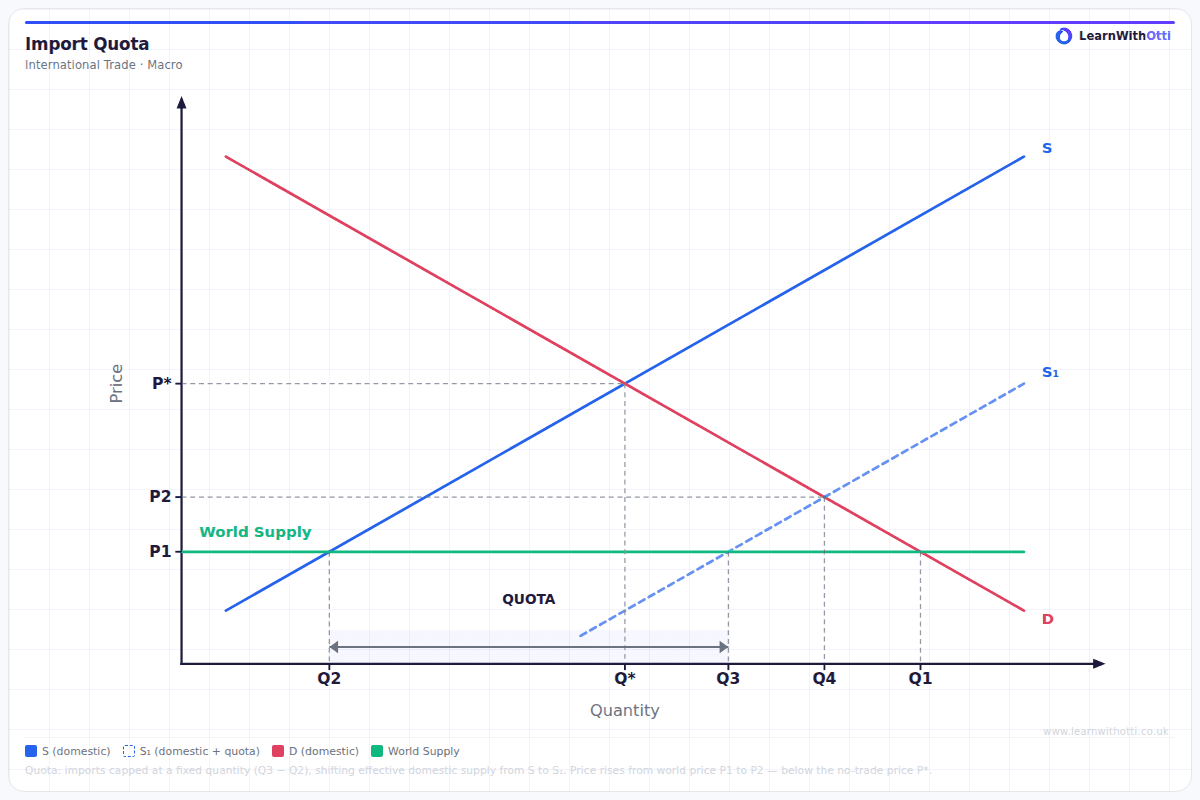
Quotas — a physical limit on the quantity imported.
Key distinction: The effect on price and quantity resembles a tariff, with one key difference: the government collects no revenue. The gain from the higher price goes to whoever holds the import licences, often foreign producers.
Because the quantity of imports is fixed, a rise in domestic demand cannot be met by more imports, so it pushes the price up further than it would under a tariff.
Subsidies to domestic producers — payments that lower domestic costs, letting home firms undercut imports. Domestic output rises and imports fall, but the cost falls on taxpayers rather than consumers, and consumer prices do not rise. Subsidies have an opportunity cost, because the money could have been spent on health, education or other priorities, and they can be hard to remove once firms depend on them.
Export subsidies — payments to domestic firms that sell abroad. They lower the price of exports in foreign markets, making domestic firms more competitive overseas at the expense of foreign producers. Like other subsidies, the cost falls on taxpayers, and they can provoke disputes and retaliation.
Non-tariff barriers — everything else:
- Product standards and safety regulations. Foreign firms must adapt their products to meet domestic rules, which raises their costs, even when the rules have a genuine safety purpose.
- Complex customs procedures and documentation. Delays at the border and extra paperwork raise the cost of importing, especially for small firms and for goods that perish quickly.
- Licensing requirements. Importers must obtain a licence before goods can enter, which lets the government limit imports without declaring an open quota.
- Government procurement favouring domestic suppliers. Public bodies buy from home firms even when foreign firms are cheaper, which raises costs for taxpayers.
- Voluntary export restraints. The exporting country agrees to limit its own exports, usually to avoid tougher restrictions. The effect is similar to a quota.
Non-tariff barriers have grown in importance as tariffs have fallen, because they are harder to measure and harder to challenge.
Reasons for restricting trade
Infant industry argument. A new domestic industry cannot yet compete with established foreign firms that already enjoy economies of scale. Temporary protection gives it time to grow, so that its average costs fall as output rises and it can eventually compete without help. The weakness is practical: protection intended as temporary rarely ends, because the industry lobbies to keep it, and firms sheltered from competition have little incentive to become efficient.
Protecting employment. Imports displace domestic production and jobs, often concentrated in particular towns, where the loss of one large employer can hit the whole local economy. Restricting imports can slow this decline and give workers time to retrain. The counter-argument is that protection preserves jobs in inefficient industries at the cost of jobs elsewhere, and raises prices for everyone. Higher import prices also raise costs for firms that use imported inputs, which can cost jobs in those industries.
Preventing dumping. Dumping is selling exports below cost, or below the home market price, to drive out competitors. Once domestic firms have left the market, the foreign firm may raise its prices, so consumers gain only in the short run. Anti-dumping duties are permitted under WTO rules. The difficulty is proving it: a genuinely lower-cost producer looks much the same from outside.
Correcting a trade deficit. Restricting imports improves the balance directly, because spending switches from foreign to domestic goods. But it invites retaliation, which reduces exports and can cancel out the gain. It also does nothing about the underlying lack of competitiveness, so the deficit is likely to return once the restrictions are removed.
National security. A country may not wish to depend on imports for food, energy or defence. The argument is economically weak in normal times, because buying from the cheapest supplier is usually more efficient, but it carries much more weight when supply chains break. The Covid-19 pandemic and the rise in gas prices in 2022 showed how quickly an economy can be hit when essential imports are disrupted.
Protecting standards. Imports produced to lower environmental or labour standards may be restricted. Without restrictions, domestic firms that meet higher standards face higher costs and can be undercut by imports. This can be genuine, or protectionism wearing a respectable coat, because strict standards can also be used to keep out imports that are perfectly safe.
Raising revenue. Tariffs are relatively easy to collect, because goods pass through a small number of ports and border points. This matters more for developing economies with limited administrative capacity, where collecting income tax from a large informal economy is difficult.
Retaliation. A country may impose restrictions in response to another country's tariffs or quotas, to put pressure on it to remove them. This is why trade disputes escalate: each new restriction invites a response, and both sides end up trading less.
The impact of protection
Key idea: Consumers lose. Prices rise, choice narrows, and the burden falls hardest on low-income households, who spend a larger share of income on traded goods. Protection is therefore usually regressive.
With less competition from imports, domestic firms also face less pressure to improve quality or keep prices down.
Domestic producers of the protected good gain: higher prices, higher output, more employment. Producers who use the protected good as an input lose, since their costs rise — a steel tariff helps steelmakers and harms carmakers. In the long run, protected firms may become less efficient, because they no longer have to compete with the best producers in the world.
Government gains revenue from tariffs, nothing from quotas, and pays out under subsidies. Tariff revenue may also shrink over time, because the tariff reduces the quantity of imports on which it is collected.
Living standards generally fall. Resources are retained in industries where the country lacks comparative advantage, so output is lower than it could be. Consumers pay more for goods that could be bought more cheaply abroad, so their real incomes fall.
Equality is usually worsened, for the reason above: higher prices for necessities hit poorer households hardest. Meanwhile, the gains go mainly to the owners and workers of the protected industries.
Foreign producers lose access, and developing economies dependent on agricultural exports are particularly exposed to developed-country agricultural protection. Lower export earnings reduce their ability to pay for imports of capital goods, which can slow their growth and development.
The wider world loses, because retaliation can escalate into a trade war in which every participant ends up worse off. As trade falls, countries lose the benefits of specialisation and comparative advantage, so world output falls.
Evaluating protectionism
Three questions usually decide the answer:
- How long? Is the protection temporary or permanent?
- Who bears the cost? The costs are dispersed across consumers and the benefits concentrated among producers, which explains the politics.
- Will there be retaliation? A restriction that provokes retaliation may leave the imposing country worse off overall.
Evaluation: Temporary protection for a genuine infant industry is defensible; permanent protection for a declining industry is a subsidy to inefficiency.
Customs unions and the Single European Market
Types of trading bloc
The four forms represent increasing degrees of integration. Each includes everything in the one before it.
1. Free trade area. Members remove tariffs and quotas between themselves, but each keeps its own trade policy towards non-members. Example: USMCA.
Because external barriers differ, goods can be imported through whichever member has the lowest external tariff and then moved on tariff-free. Rules of origin exist to prevent this, and they add considerable administrative cost.
2. Customs union. A free trade area plus a common external tariff. All members apply the same barriers to non-members, which removes the need for rules of origin but also removes each member's ability to set its own trade policy. Example: Mercosur.
3. Common market (single market). A customs union plus free movement of labour and capital, and harmonised regulation so goods need meet only one set of standards. Example: the EU single market.
4. Monetary union. A common market plus a shared currency and a single central bank. Example: the Eurozone.
A bilateral agreement is simply an agreement between two countries, which may go as far or as little as they choose.
The Single European Market
The Single European Market (SEM), completed in 1993, is the EU's common market. Its main characteristics are the free movement of goods, services, capital and people between member states, common product standards so that a good approved for sale in one member state can be sold in all of them, common competition rules that limit state aid to domestic firms, and a common external tariff, since the EU is also a customs union.
Costs and benefits of membership
Benefits
- Trade creation, as production moves to the lowest-cost producer within the bloc.
- Economies of scale from access to a larger market.
- More competition, pushing domestic firms towards efficiency.
- Greater inward investment, since firms locate inside the bloc to sell within it tariff-free.
- Lower prices and more choice for consumers.
- Stronger bargaining power in negotiations with other blocs.
Costs
- Trade diversion, where a common external barrier shifts purchasing to a higher-cost producer inside the bloc.
- Loss of sovereignty over trade policy, and in a monetary union over monetary policy too.
- Structural unemployment in industries that cannot compete within the bloc.
- Membership costs and regulatory compliance.
- Distorted regional development, as activity concentrates in the most productive areas.
Evaluation: Whether membership is net beneficial turns largely on whether trade creation exceeds trade diversion.
The WTO and trade liberalisation
The World Trade Organisation has around 165 members and three main functions:
- Negotiating multilateral reductions in trade barriers.
- Administering the agreements, including the most-favoured-nation principle: a concession offered to one member must be offered to all.
- Settling disputes between members, with authority to permit retaliation.
Conflict between blocs and the WTO
Regional agreements sit awkwardly with the WTO's central principle.
Key idea: A trade bloc, by definition, gives members better terms than non-members — which is exactly what most-favoured-nation treatment forbids. The WTO permits them as an exception, on the grounds that they liberalise trade overall.
The tension is real:
- Blocs may divert trade rather than create it, leaving the world worse off.
- The proliferation of overlapping agreements creates a tangle of different rules — the "spaghetti bowl" problem.
- Progress through the WTO has stalled, with the Doha round unresolved since 2001, which has pushed countries towards regional deals instead.
- Larger blocs hold more bargaining power, which can disadvantage smaller developing economies.
Key terms
| Term | Meaning |
|---|---|
| Absolute advantage | Producing more of a good than another country with the same resources |
| Comparative advantage | Producing a good at a lower opportunity cost than another country |
| Opportunity cost | The next best alternative given up |
| Terms of trade | The rate at which one good exchanges for another |
| Specialisation | Concentrating production on a narrower range of goods |
| Pattern of trade | Which goods a country trades, and with which partners |
| Trade creation | A shift to a lower-cost producer within a bloc after barriers fall |
| Trade diversion | A shift to a higher-cost producer inside a bloc, away from a cheaper outside one |
| Protectionism | The use of restrictions to shield domestic producers from imports |
| Tariff | A tax on imported goods |
| Quota | A physical limit on the quantity that may be imported |
| Export subsidy | A payment to domestic firms that sell abroad |
| Non-tariff barrier | A restriction other than a tax or quota, such as standards or procedures |
| Dumping | Selling exports below cost or below the home market price |
| Net welfare loss | The loss to consumers not offset by gains to producers and government |
| Customs union | A free trade area with a common external tariff |
| Common external tariff | A single tariff applied by all members to non-members |
| Single European Market | The EU's common market, with free movement of goods, services, capital and people |
| Most-favoured-nation principle | A concession to one WTO member must extend to all |
Common mistakes
- Comparing output instead of opportunity cost. Comparing how much each country produces gives absolute advantage. Comparative advantage needs the ratio.
- Concluding that a country better at everything should not trade. This is the central misunderstanding the theory exists to correct.
- Forgetting the terms of trade condition. Gains only arise if the exchange rate between goods lies between the two opportunity cost ratios.
- Saying specialisation always benefits everyone. It raises total output, but the gains and losses fall on different people, which is why trade is politically contested.
- Treating comparative advantage as permanent. It moves with technology, skills and resources, which is precisely why trade patterns change.
- Mixing up trade creation and trade diversion. Creation shifts production to a cheaper producer and raises welfare; diversion shifts it to a dearer one and lowers it.
- Saying a quota raises government revenue. It does not — that is the main economic difference from a tariff.
- Forgetting retaliation. The response of trading partners usually determines whether the policy works.
- Omitting the distributional point. Protection is generally regressive, and that is one of the strongest things to say about it.
- Mixing up the four types. They are cumulative: a customs union adds the common external tariff, a common market adds factor mobility, a monetary union adds the currency.
- Describing the WTO as able to force members to act. It authorises retaliation; it does not enforce directly.
How this has been examined
In the AQA papers indexed on this site, this topic has appeared in six formats:
- 25-mark "Evaluate" essay — asked twice across 2 series (2021 to 2022)
- 15-mark "Explain" essay — asked once (2017)
- 9-mark "Explain" data response — asked twice across 2 series (2017 to 2020)
- 4-mark "Explain" data response — asked once (2020)
- 2-mark calculation — asked once (2025)
- 1-mark multiple choice — asked 9 times across 8 series (2017 to 2025)
Where this goes next
The opportunity cost framework behind comparative advantage comes from 4.1.1.5 Production possibility diagrams and 4.1.4.2 Specialisation, division of labour and exchange, and economies of scale, one of the gains from trade, are in 4.1.4.5 Economies and diseconomies of scale. The welfare analysis of a tariff uses 4.1.5.11 Consumer and producer surplus. The wider process of integration is 4.2.6.1 Globalisation, trade flows are recorded in 4.2.6.3 The balance of payments, and monetary union and the eurozone are developed in 4.2.6.4 Exchange rate systems.
Otti is an AI tutor built for A-Level students. Ask it anything, practise exam questions, and get instant feedback written like an examiner would give it — not just right or wrong, but why.
Get one answer marked free