AQA A-Level Economics · Revision notes
4.1.3.4 Price Elasticity of Supply
Price elasticity of supply measures how responsive producers are to a change in price. It answers a practical question: when price rises, can this industry actually produce more, and how quickly?
PES = % change in quantity supplied ÷ % change in price
PES is normally positive, because price and quantity supplied move in the same direction.
Worked example
A bakery raises its price from £2.00 to £2.20 and increases output from 400 loaves to 460 a week.
Step 1 — percentage change in quantity supplied. (460 − 400) ÷ 400 × 100 = +15%
Step 2 — percentage change in price. (2.20 − 2.00) ÷ 2.00 × 100 = +10%
Step 3 — divide. PES = 15 ÷ 10 = +1.5
Supply is relatively elastic: producers increased output proportionally more than the price rose.
As with demand elasticity, always divide by the original value.
Interpreting the value
| Value | Name | Meaning |
|---|---|---|
| 0 | Perfectly inelastic | Quantity cannot change at all; the curve is vertical |
| Between 0 and 1 | Relatively inelastic | Quantity changes proportionally less than price |
| 1 | Unitary elastic | Quantity changes in exact proportion to price |
| Above 1 | Relatively elastic | Quantity changes proportionally more than price |
| ∞ | Perfectly elastic | Any quantity can be supplied at the going price; the curve is horizontal |
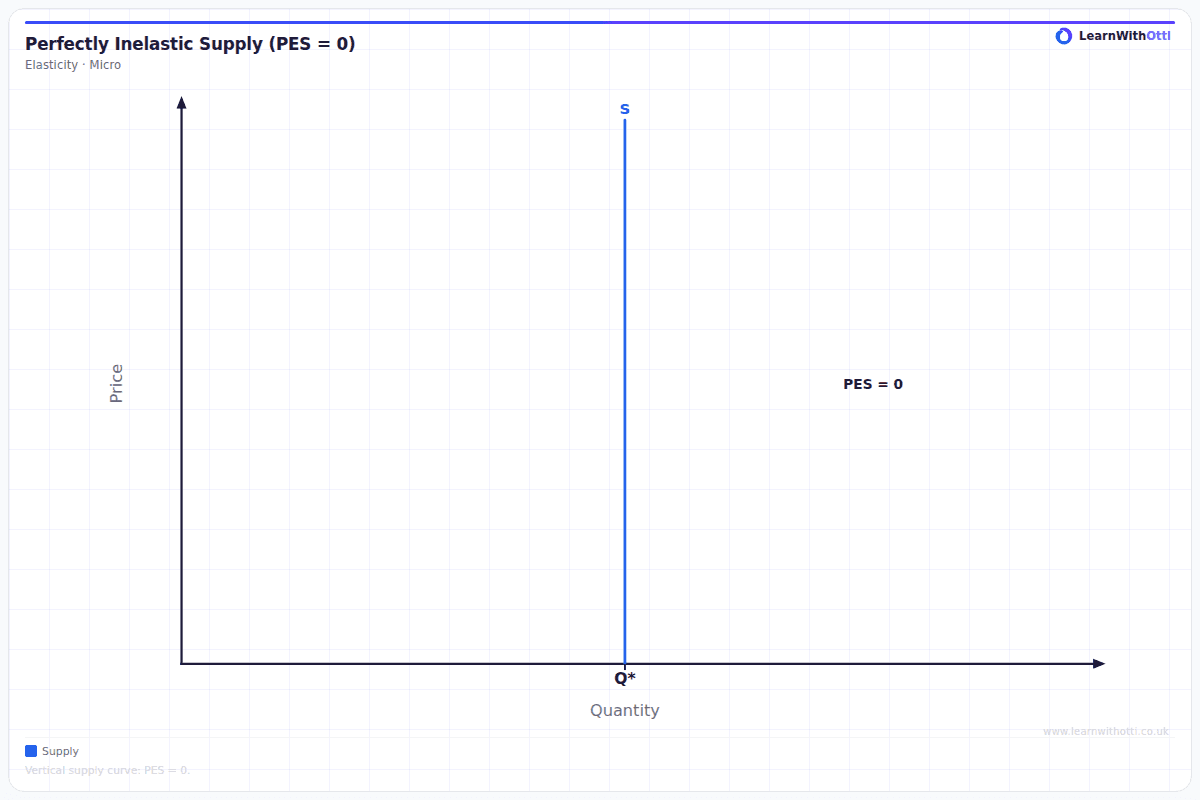
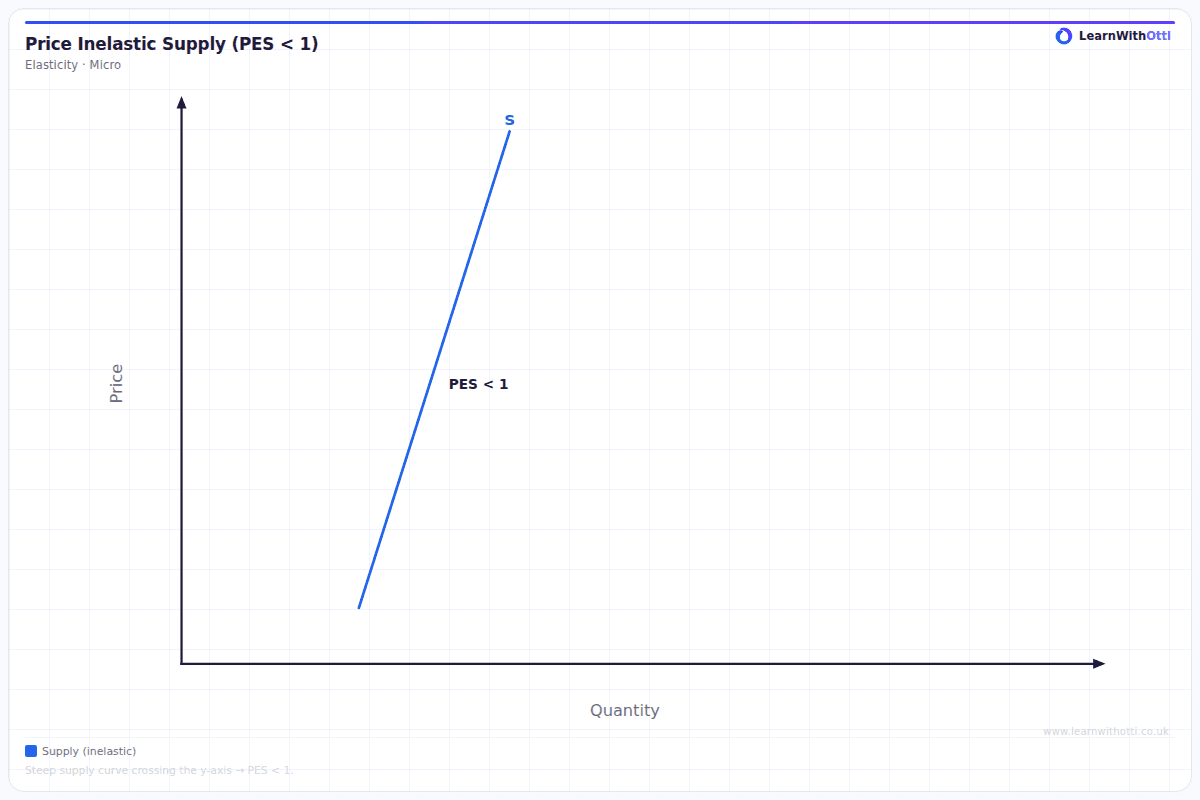
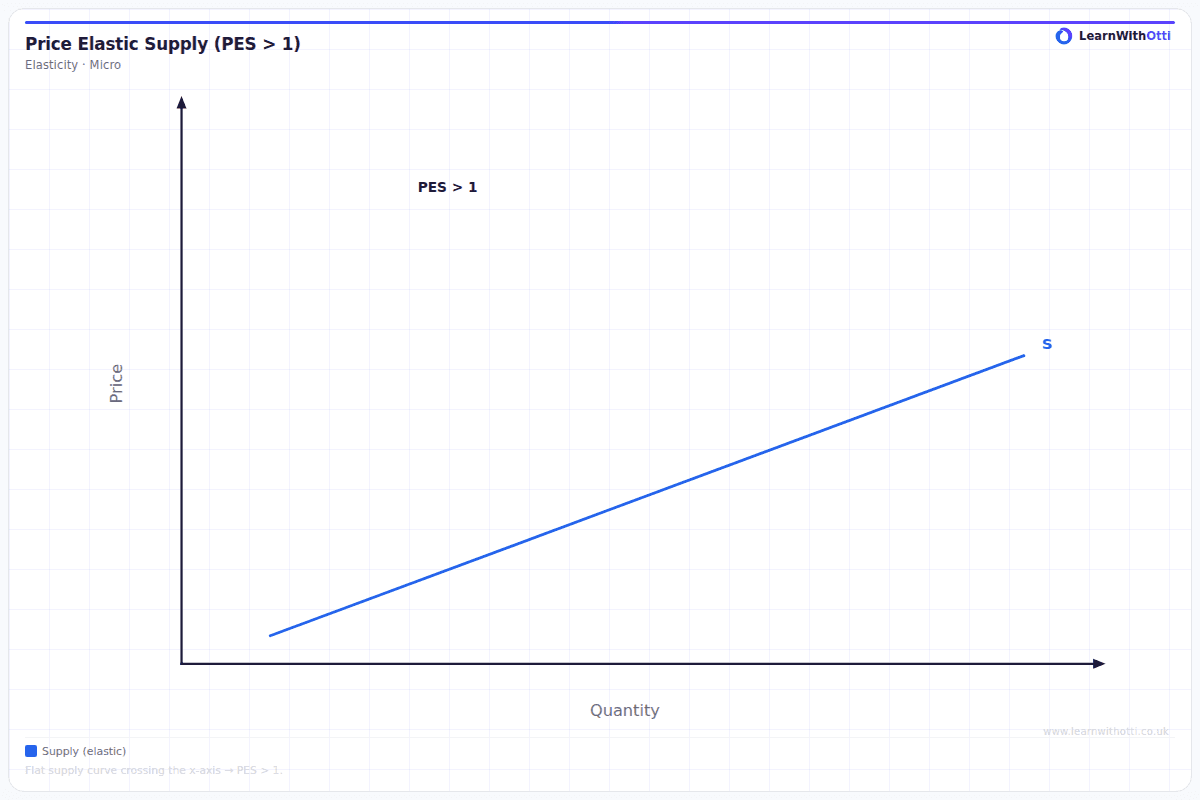
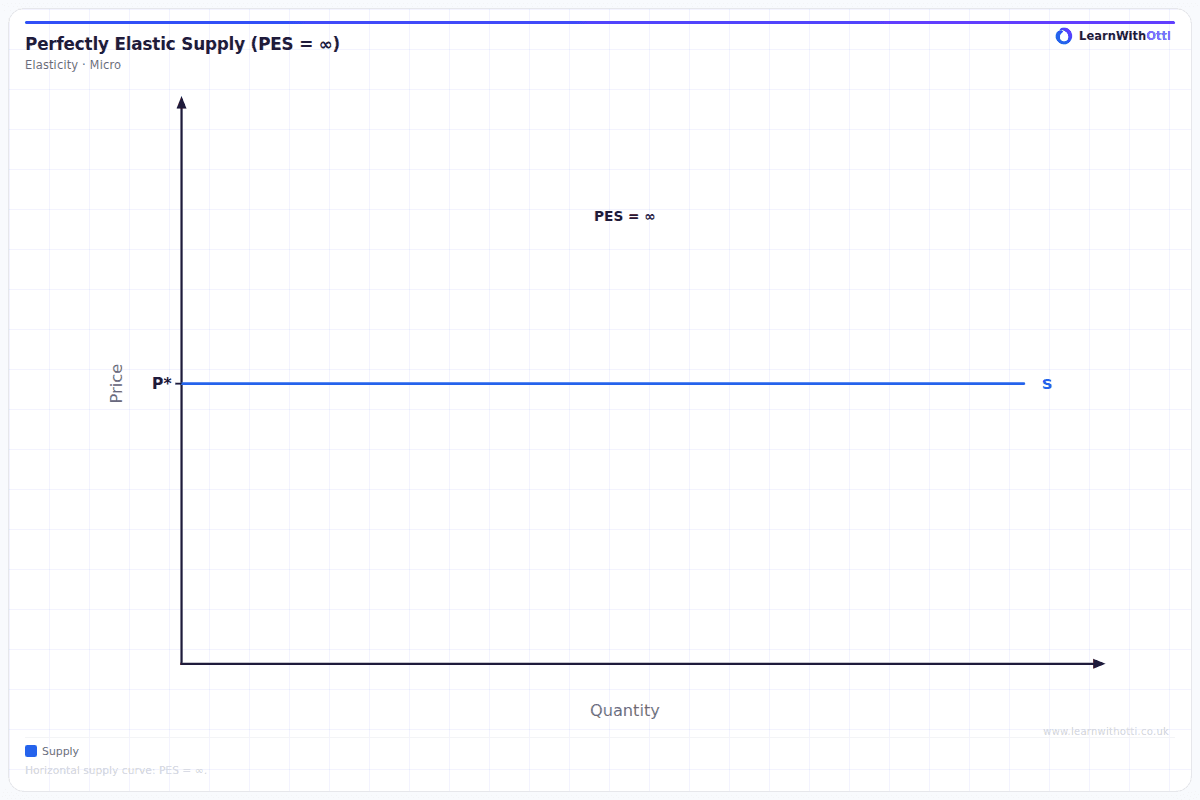
A useful geometric point: any straight-line supply curve drawn through the origin has a PES of exactly 1, whatever its gradient.
What determines PES
Time. The most important determinant by a distance. In the very short run (the momentary period) output is effectively fixed and PES is close to zero. In the short run at least one factor is fixed, so output can rise somewhat. In the long run all factors can be varied, new firms can enter, and supply becomes much more elastic.
This is why the same industry has different elasticities over different time periods.
Spare capacity. A firm operating below capacity can raise output quickly. One already at full capacity cannot. After a recession, spare capacity is widespread and supply is elastic.
Stocks. Goods that can be stored allow an immediate response from inventory. Perishables and services cannot be stockpiled, so supply is inelastic.
Factor mobility. If workers and machinery can switch easily between uses, supply is more elastic. Highly specialised equipment or skills make it inelastic.
Ease of entry. If new firms can enter quickly, industry supply is more elastic. Barriers to entry make it inelastic.
Production lags. Agriculture is the standard case: a crop takes a season to grow, so this year's output cannot respond to this year's price however high it rises. Supply is close to perfectly inelastic within the season.
Short run and long run
The distinction here is not about calendar time but about what can be varied:
- Short run: at least one factor of production is fixed, usually capital. Output can only be raised by using the variable factors more intensively.
- Long run: all factors can be varied. Firms can build new capacity and new firms can enter.
Key distinction: How long the short run lasts differs enormously between industries. For a market stall it may be days; for nuclear power, a decade. That is why the short run is defined by fixed factors rather than by a period of time.
Why PES matters
- Price volatility. Where supply is inelastic, a shift in demand causes a large price change and a small quantity change. This is why agricultural and oil prices swing so sharply.
- Speculation. Inelastic supply makes a market more attractive to speculators, since prices move more.
- Policy response time. A government trying to increase housing supply faces a long production lag, which is why housing policy works slowly.
Key terms
| Term | Meaning |
|---|---|
| Price elasticity of supply | Responsiveness of quantity supplied to a change in price |
| Short run | A period in which at least one factor of production is fixed |
| Long run | A period in which all factors of production can be varied |
| Spare capacity | Unused productive capability |
| Production lag | The delay between deciding to produce and output being available |
| Factor mobility | The ease with which resources switch between uses |
Common mistakes
- Dividing by the new value. The denominator is the original figure.
- Defining the short run as a fixed period. It is defined by at least one factor being fixed, and its length varies by industry.
- Forgetting that PES rises over time. Any analysis of supply response should distinguish the time period.
- Assuming a steeper curve always means lower elasticity. Gradient and elasticity are not the same thing: every straight-line supply curve through the origin has PES of 1.
- Confusing spare capacity with stocks. Spare capacity is unused productive capability; stocks are goods already made.
How this has been examined
In the AQA papers indexed on this site, this topic has appeared in one format:
- 1-mark multiple choice — asked 3 times across 3 series (2019 to 2025)
Where this goes next
Supply elasticity feeds directly into 4.1.3.5 The determination of equilibrium market prices, where it governs how much a demand shift moves price rather than quantity. The demand-side equivalent is 4.1.3.2 Price, income and cross elasticities of demand, and the factors that shift the supply curve are covered in 4.1.3.3 The determinants of the supply of goods and services. The short-run and long-run distinction introduced here is developed in 4.1.4.3 The law of diminishing returns and returns to scale and 4.1.4.4 Costs of production.
Otti is an AI tutor built for A-Level students. Ask it anything, practise exam questions, and get instant feedback written like an examiner would give it — not just right or wrong, but why.
Get one answer marked free