AQA A-Level Economics · Revision notes
4.1.6.6 The National Minimum Wage
Governments intervene heavily in labour markets, and a clear example in the UK is the legal minimum wage. Its effects depend on whether the labour market is competitive or dominated by a monopsony employer, and on the elasticity of demand for labour. This page covers the effects of the National Minimum Wage on labour markets and its advantages and disadvantages.
The National Minimum Wage
A minimum wage is a legal floor on hourly pay. In the UK, the National Living Wage applies to workers aged 21 and over, with lower rates for younger workers and apprentices.
The National Living Wage is the top rate of the National Minimum Wage, which also includes the lower rates.
The effects of a minimum wage on labour markets
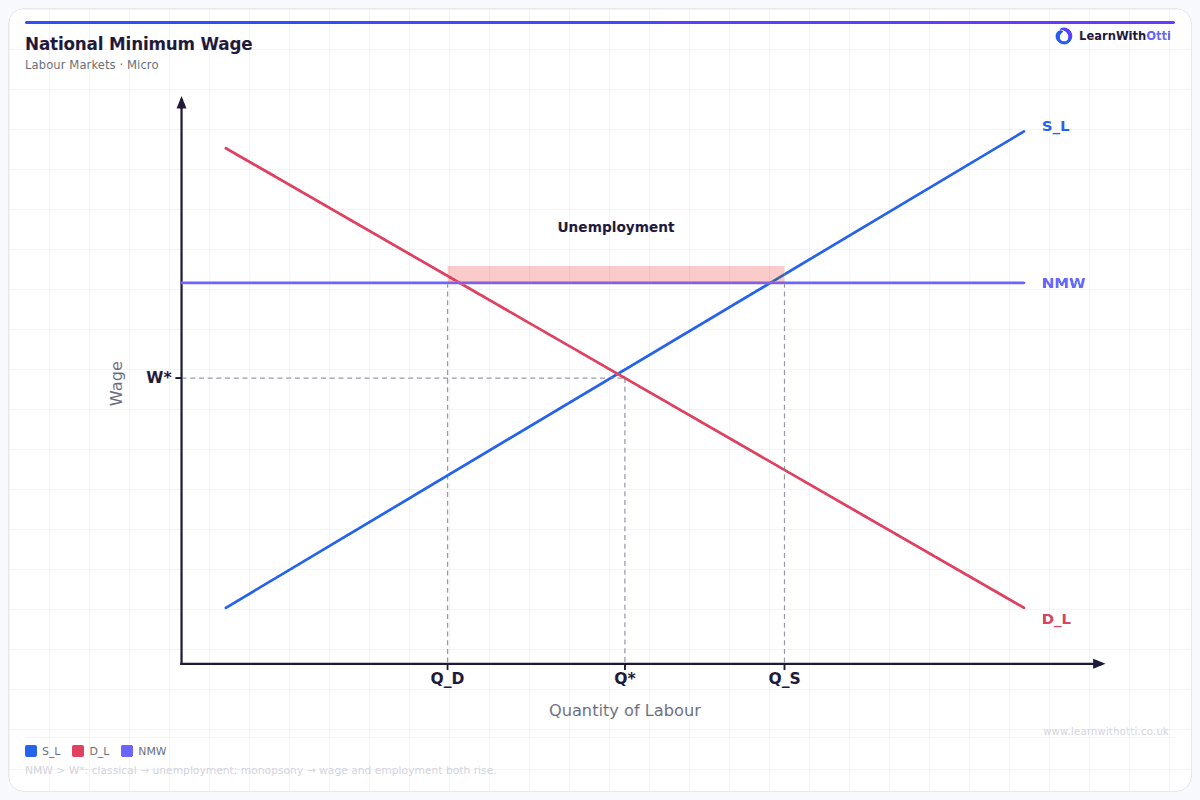
- In a competitive market, a minimum wage set above the equilibrium wage raises pay for those in work, but the quantity of labour demanded falls and the quantity supplied rises, creating unemployment.
- In a monopsony market, a minimum wage can raise both wages and employment, because it removes the employer's incentive to restrict hiring.
Real wage inflexibility (classical unemployment) occurs when real wages are held above the market-clearing level, for example by a minimum wage or trade union bargaining. At that wage, more people want to work than firms want to employ, so there is excess supply of labour.
In a monopsony, the employer no longer has to raise pay for its existing workers to hire one more, because they are already paid the minimum wage. If the minimum wage is set between the monopsony wage and the competitive wage, the employer hires more workers, up to the point where the minimum wage meets the supply curve of labour.
The significance of elasticity
- Minimum wages. A minimum wage causes fewer job losses where demand for labour is inelastic, such as in care work, where staff cannot easily be replaced by machines. Where demand is elastic, for example where self-service technology is a close alternative, job losses are larger.
Evaluation: If demand for labour is elastic, a rise in wages, such as from a minimum wage, causes a larger fall in employment.
Advantages and disadvantages of a national minimum wage
- Benefits: it reduces in-work poverty, can raise productivity by motivating workers, and reduces reliance on in-work benefits.
- Costs: possible job losses, especially among young and low-skilled workers, and higher costs for small firms.
Key terms
| Term | Meaning |
|---|---|
| National Living Wage | The UK's legal minimum hourly wage for workers aged 21 and over |
| National Minimum Wage | The UK's legal minimum hourly pay, made up of the National Living Wage and lower rates for younger workers and apprentices |
| Equilibrium wage | The wage at which the demand for labour equals the supply of labour |
| Wage elasticity of demand for labour | The responsiveness of the demand for labour to a change in the wage |
Common mistakes
- Assuming a minimum wage always causes unemployment. In a monopsony market it can raise employment.
- Forgetting elasticity. The effect of a wage change on employment depends on the elasticity of demand for labour.
- Drawing a minimum wage below equilibrium. It only has an effect if it is set above the market wage.
How this has been examined
In the AQA papers indexed on this site, this topic has appeared in three formats:
- 25-mark "Assess" essay — asked once (2025)
- 25-mark "Discuss" essay — asked once (2019)
- 1-mark multiple choice — asked once (2021)
Where this goes next
The competitive labour market model is covered in 4.1.6.3 The determination of relative wage rates and levels of employment in perfectly competitive labour markets, and the monopsony diagram in 4.1.6.4 The determination of relative wage rates and levels of employment in imperfectly competitive labour markets. Minimum prices in product markets are covered in 4.1.8.9 Government intervention in markets, and the link between low pay and poverty in 4.1.7.2 The problem of poverty and 4.1.7.3 Government policies to alleviate poverty and to influence the distribution of income and wealth.
Otti is an AI tutor built for A-Level students. Ask it anything, practise exam questions, and get instant feedback written like an examiner would give it — not just right or wrong, but why.
Get one answer marked free