AQA A-Level Economics · Revision notes
4.2.1.1 The Objectives of Government Economic Policy
What the specification covers
In our own words — not the official specification wording
What governments are trying to achieve when they manage the economy, and why those aims can pull against one another.
- The four things governments aim for: a growing economy, steady prices, as few people out of work as possible, and trade with the rest of the world in balance.
- Why pursuing one of these aims can work against another, at least in the near term.
Governments judge the performance of the economy against a set of macroeconomic objectives. Some have explicit numerical targets, such as the 2% inflation target set for the Bank of England. Others are broader aims that governments describe in their budgets and manifestos. This topic covers the four main objectives, the other objectives governments may pursue, and why the objectives can conflict, at least in the short run.
Why governments have objectives
Macroeconomic objectives give policy a direction. They let the public, businesses and financial markets judge whether policy is working, and they shape decisions about interest rates, taxation and government spending.
The objectives are related. Progress on one can help another, as when faster growth reduces unemployment. But objectives can also conflict, as when faster growth pushes up inflation. Those conflicts are introduced below and covered in full in 4.2.3.4 Possible conflicts between macroeconomic policy objectives.
Economic growth
What it means. Economic growth is an increase in real GDP. A common aim is sustained and sustainable growth: steady growth over time, rather than a boom followed by a bust, that does not damage the environment or the prospects of future generations.
Why it matters
- Higher real incomes and, usually, higher living standards.
- More jobs, as firms need more workers to produce more output.
- Higher tax revenue without raising tax rates, which can pay for public services.
How it is judged. Growth is measured by the percentage change in real GDP. The UK's long-run trend rate of growth has been estimated at around 2% a year, but it has been lower since the financial crisis of 2008. Real GDP per head is a better guide to living standards, because it allows for population growth. The measurement of growth is covered in 4.2.1.2 Macroeconomic indicators.
Low unemployment
What it means. The aim is to keep the number of people who are willing and able to work, but cannot find a job, as low as possible. Some unemployment is unavoidable, as people move between jobs, so the aim is low unemployment rather than zero.
Why it matters
- Unemployed workers are wasted resources, so output is below what the economy could produce.
- Unemployment means lost income, which causes hardship and can widen inequality.
- It costs the government money through benefits paid and taxes not received.
- Long periods out of work reduce skills and can damage health and confidence.
How it is judged. The unemployment rate is measured using the Labour Force Survey, which follows the International Labour Organization definition. The claimant count is an alternative measure. Both are covered in 4.2.3.2 Employment and unemployment.
Low and stable rate of inflation
What it means. In the UK, the government sets the Bank of England a target of 2% a year for inflation, measured by the Consumer Prices Index. The aim is a rate that is both low and stable, so that households and firms can plan with confidence.
Why it matters
- High inflation reduces the real value of incomes and savings, particularly for people on fixed incomes.
- Unpredictable inflation makes firms less willing to invest, because they cannot be sure of future costs and prices.
- If UK inflation is higher than in other countries, UK goods become less price competitive.
Why the target is not zero. A small positive rate gives a margin of safety against deflation, which can lead consumers to delay spending and raises the real burden of debt. How inflation is measured is covered in 4.2.1.3 Uses of index numbers.
Balance of payments equilibrium on current account
What it means. The current account records trade in goods and services, primary income and secondary income with the rest of the world. Equilibrium means the current account is roughly balanced over time, with no large or persistent deficit or surplus.
Why it matters
- A large and persistent current account deficit must be financed by borrowing from abroad or by selling assets to foreign investors. This may not be sustainable.
- A deficit may signal that domestic firms are not internationally competitive.
- A large surplus is not ideal either, because it means the economy is consuming less than it produces.
How it is judged. The current account balance is usually expressed as a percentage of GDP, which allows comparison over time and between countries. The UK has run a current account deficit in almost every year since the mid-1980s. The structure of the balance of payments is covered in 4.2.6.3 The balance of payments.
Other objectives
Alongside the four main objectives, governments may pursue other aims.
Balanced government budget
What it means. A balanced budget means government revenue, mainly from taxation, equals government spending over a year. If spending is greater than revenue, there is a budget deficit and the government must borrow. If revenue is greater than spending, there is a budget surplus.
Why it matters
- Deficits add to the national debt, and interest must be paid on that debt. Money spent on debt interest has an opportunity cost.
- High debt may make lenders less willing to lend, raising the cost of borrowing.
- Persistent deficits may reduce the government's room to respond to a future recession.
In practice, governments rarely aim for an exact balance every year. UK governments set fiscal rules, such as balancing day-to-day spending against revenue while borrowing to invest, and getting debt falling as a percentage of GDP. The Office for Budget Responsibility (OBR) produces independent forecasts of the public finances and judges whether the government is on track to meet its rules.
Protection of the environment
What it means. Governments increasingly aim to make sure that economic activity does not cause lasting damage to the environment. This includes cutting greenhouse gas emissions, reducing pollution and waste, and protecting natural resources.
Why it matters
- Growth that depletes resources or damages the climate may not be sustainable, so it reduces the living standards of future generations.
- Pollution harms health and imposes external costs on third parties.
In practice, the UK has a legally binding target to reach net zero greenhouse gas emissions by 2050.
Greater income equality
What it means. The aim is to narrow the gap between the incomes of high-income and low-income households. It does not mean that everyone should earn the same, but that the distribution of income should be judged fair.
Why it matters
- Wide inequality can mean that some households cannot afford essentials, even in a rich economy.
- It may reduce social mobility, if children from low-income families have fewer opportunities.
- It can weaken social cohesion and trust.
How it is pursued. Governments redistribute income through progressive taxes, such as income tax, and through benefits and the provision of public services such as education and health care. Whether greater equality is desirable, and how far it should go, involves value judgements. Some argue that some inequality is needed to provide incentives to work and take risks.
Summary of the objectives
| Objective | Typical UK aim or measure |
|---|---|
| Economic growth | Sustained growth in real GDP close to the trend rate |
| Low unemployment | A low unemployment rate on the Labour Force Survey measure |
| Low and stable inflation | 2% CPI inflation |
| Current account equilibrium | No large or persistent deficit or surplus as a percentage of GDP |
| Balanced government budget | Meeting the government's fiscal rules, with debt falling as a percentage of GDP |
| Protection of the environment | Net zero greenhouse gas emissions by 2050 |
| Greater income equality | A narrower gap between high and low incomes |
Changing priorities over time
The importance governments attach to each objective changes over time. In the decades after the Second World War, UK governments gave priority to full employment. After the high inflation of the 1970s, controlling inflation moved to the top of the list, and since 1997 the Bank of England has had operational independence to meet the inflation target set by the government. More recently, protection of the environment has risen up the agenda. Which objective comes first reflects the problems of the time and the value judgements of the government in power.
Conflicts between objectives
Some objectives support each other. Faster growth usually reduces unemployment and raises tax revenue, which helps the budget balance. But several important objectives pull in opposite directions, especially in the short run.
Economic growth and low inflation
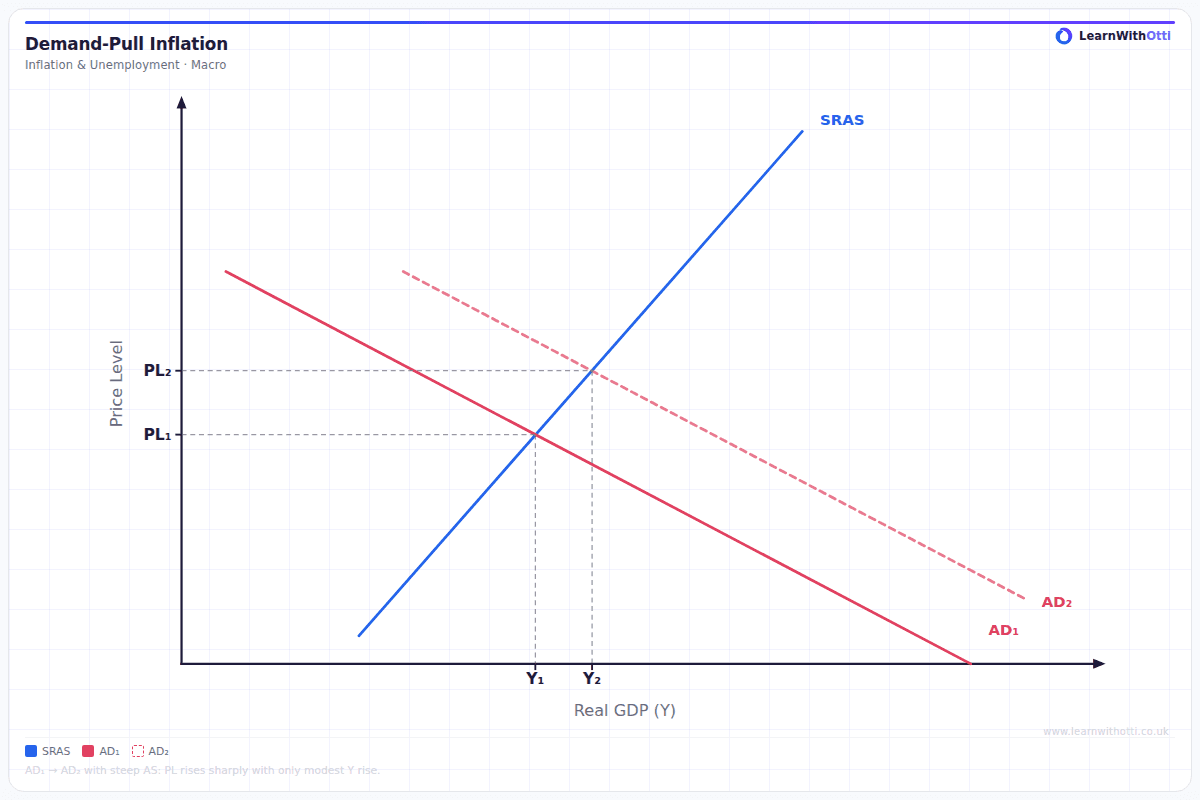
Key idea: If AD grows faster than the economy's productive capacity, spare capacity is used up. Firms compete for scarce workers and materials, costs rise and firms raise prices. Rapid growth close to full capacity leads to demand-pull inflation.
Controlling inflation may then require slower growth.
Economic growth and the current account
As incomes rise, households buy more goods and services, including imports. The UK has a high propensity to import, so fast growth tends to worsen the current account. If UK inflation also rises above that of other countries, UK exports become less price competitive.
Economic growth and protection of the environment
More output usually means more energy use, more resource depletion, more waste and more emissions. Growth can therefore conflict with environmental objectives such as net zero. Cleaner technology can reduce this conflict, but it does not remove it.
Low unemployment and low inflation
When unemployment is low, workers have more bargaining power and firms must offer higher wages to recruit. Rising wage costs are passed on as higher prices. This trade-off is shown by the short-run Phillips curve, covered in 4.2.3.4 Possible conflicts between macroeconomic policy objectives.
A balanced budget and growth or unemployment
Key idea: Cutting a budget deficit means cutting government spending or raising taxes. Both reduce AD in the short run, which slows growth and can raise unemployment. In a recession, automatic stabilisers push the budget into deficit, so trying to balance it at the same time would make the recession deeper.
Many of these conflicts are sharpest in the short run. If supply-side improvements raise the economy's productive capacity, output can grow without the same pressure on prices, which eases several conflicts at once.
Key terms
| Term | Meaning |
|---|---|
| Macroeconomic objective | A goal for the performance of the whole economy |
| Economic growth | An increase in real GDP |
| Sustainable growth | Growth that does not damage the prospects of future generations |
| Inflation target | The rate of inflation the central bank is required to aim for, 2% CPI in the UK |
| Current account equilibrium | A current account that is roughly balanced over time |
| Budget deficit | Government spending greater than government revenue in a year |
| Budget surplus | Government revenue greater than government spending in a year |
| Fiscal rules | Targets a government sets itself for borrowing and debt |
| Net zero | Balancing the greenhouse gases emitted with the amount removed from the atmosphere |
| Trade-off | Giving up progress on one objective to make progress on another |
Common mistakes
- Aiming for zero inflation or zero unemployment. The UK inflation target is 2%, not zero, and some frictional unemployment is always present.
- Confusing the budget balance with the current account. The budget balance is about government revenue and spending. The current account is about the UK's transactions with the rest of the world.
- Treating a current account deficit as automatically bad. A small deficit financed by long-term investment from abroad may be sustainable. What matters is its size and persistence.
- Describing growth without saying real. An increase in nominal GDP may only reflect higher prices.
- Listing objectives without explaining why they matter. Each objective should be linked to its effect on living standards, firms or the public finances.
- Assuming objectives always move together. Some support each other, but others conflict, especially in the short run.
- Stating a conflict without the mechanism. Saying that growth causes inflation is incomplete until it is linked to spare capacity being used up and costs rising.
How this has been examined
In the AQA papers indexed on this site, this topic has appeared in one format:
- 25-mark "Evaluate" essay — asked once (2022)
Where this goes next
The measures behind these objectives are covered in 4.2.1.2 Macroeconomic indicators, and each objective is examined in depth in 4.2.3.1 Economic growth and the economic cycle, 4.2.3.2 Employment and unemployment and 4.2.3.3 Inflation and deflation. The conflicts introduced here are the subject of 4.2.3.4 Possible conflicts between macroeconomic policy objectives, and the policies used to pursue the objectives are covered in 4.2.4.3 Central banks and monetary policy, 4.2.5.1 Fiscal policy and 4.2.5.2 Supply-side policies.
Otti is an AI tutor built for A-Level students. Ask it anything, practise exam questions, and get instant feedback written like an examiner would give it — not just right or wrong, but why.
Get one answer marked free