AQA A-Level Economics · Revision notes
4.1.8.7 Competition Policy
Firms with market power can raise prices, restrict output, reduce choice and pay their suppliers and workers less than they would in a competitive market. Competition policy aims to limit this by controlling mergers and banning anti-competitive behaviour. This topic covers the general principles of UK competition policy, an awareness of EU competition policy, and the benefits and costs of these policies. The regulation of natural monopolies, privatisation and deregulation are covered in 4.1.8.8 Public ownership, privatisation, regulation and deregulation of markets.
Why governments intervene
A profit-maximising monopolist produces where marginal revenue equals marginal cost. Compared with a competitive market, price is higher and output is lower.
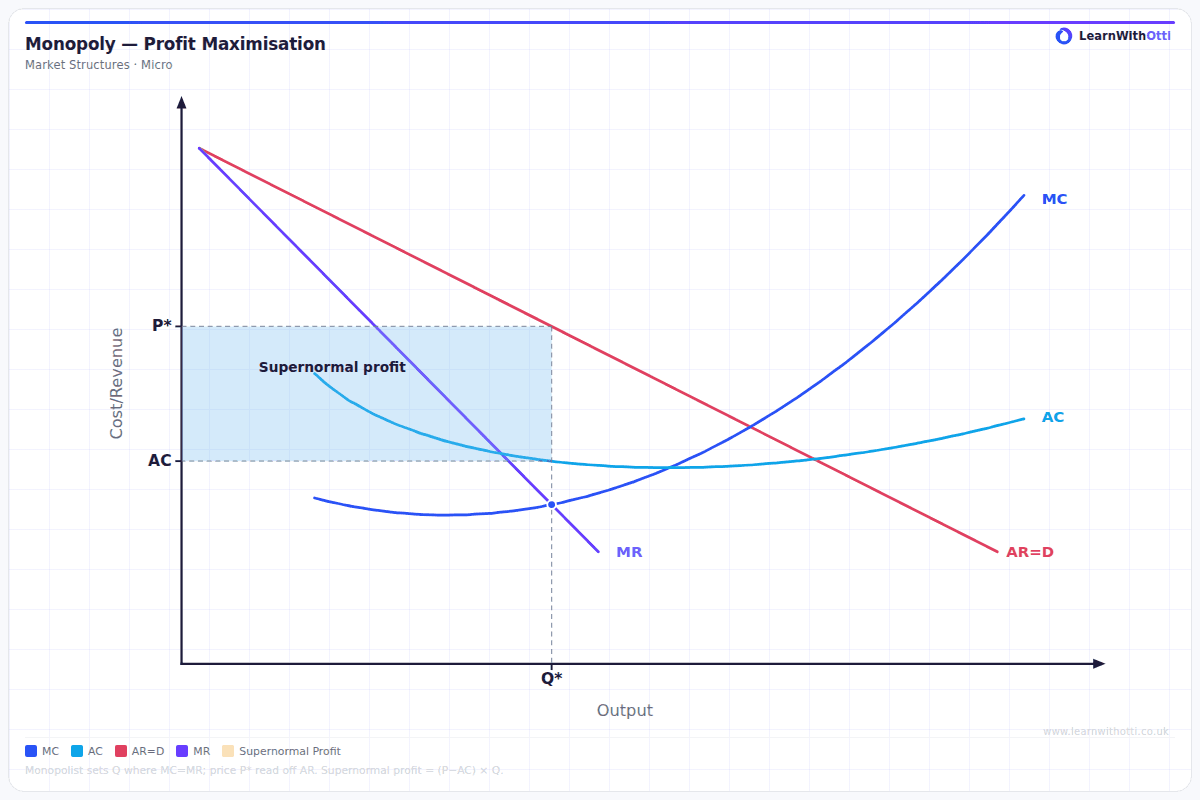
The problems with market power
- Allocative inefficiency. Price is above marginal cost, so consumers who value the good above its cost of production do not buy it. There is a welfare loss.
- Productive inefficiency. The firm may not produce at the lowest point on its average cost curve.
- X-inefficiency. Without the pressure of competition, costs may be higher than necessary.
- Less choice and lower quality for consumers.
- Monopsony power. A dominant buyer can push down the prices paid to suppliers or the wages paid to workers.
Evaluation: Market power can bring benefits too, such as economies of scale and supernormal profits that fund research and development. Intervention therefore tries to limit the harm without losing these gains.
In the UK, the main body is the Competition and Markets Authority (CMA), set up in 2014, alongside industry regulators such as Ofgem (energy), Ofwat (water), Ofcom (communications and post) and the Office of Rail and Road.
Government intervention to control mergers
A merger between two firms in the same market (horizontal integration) can reduce the number of competitors and increase market power. The CMA can investigate mergers that involve large firms or that would give the merged firm a large share of supply in the UK.
How merger control works
- Phase 1. The CMA carries out an initial review to decide whether the merger may lead to a substantial lessening of competition.
- Phase 2. If it may, the CMA carries out a more detailed investigation, looking at the effect on prices, choice, quality and innovation.
- Decision. The CMA can clear the merger, clear it subject to conditions, or block it.
Possible remedies
- Blocking the merger outright.
- Requiring the sale of part of the business, such as some stores or brands, so that competition is maintained.
- Behavioural conditions, such as promises to keep prices down or to supply rivals on fair terms.
UK examples
- In 2019, the CMA blocked the proposed merger of Sainsbury's and Asda, concluding it would lead to higher prices and lower quality for shoppers.
- In 2023, the CMA initially blocked Microsoft's takeover of Activision Blizzard over concerns about competition in cloud gaming, then cleared a restructured deal in which the cloud gaming rights were sold to another firm.
Merger control must weigh the loss of competition against possible gains, such as economies of scale that could lower costs and prices.
Anti-competitive behaviour
UK competition law also bans two kinds of behaviour:
- Cartels and other anti-competitive agreements, where firms agree to fix prices, share out markets or rig bids.
- Abuse of a dominant position, for example charging excessive prices or pricing below cost to drive rivals out of the market.
The CMA can investigate, order firms to stop and impose large fines.
Government intervention to protect suppliers and employees
Restrictions on the monopsony power of firms
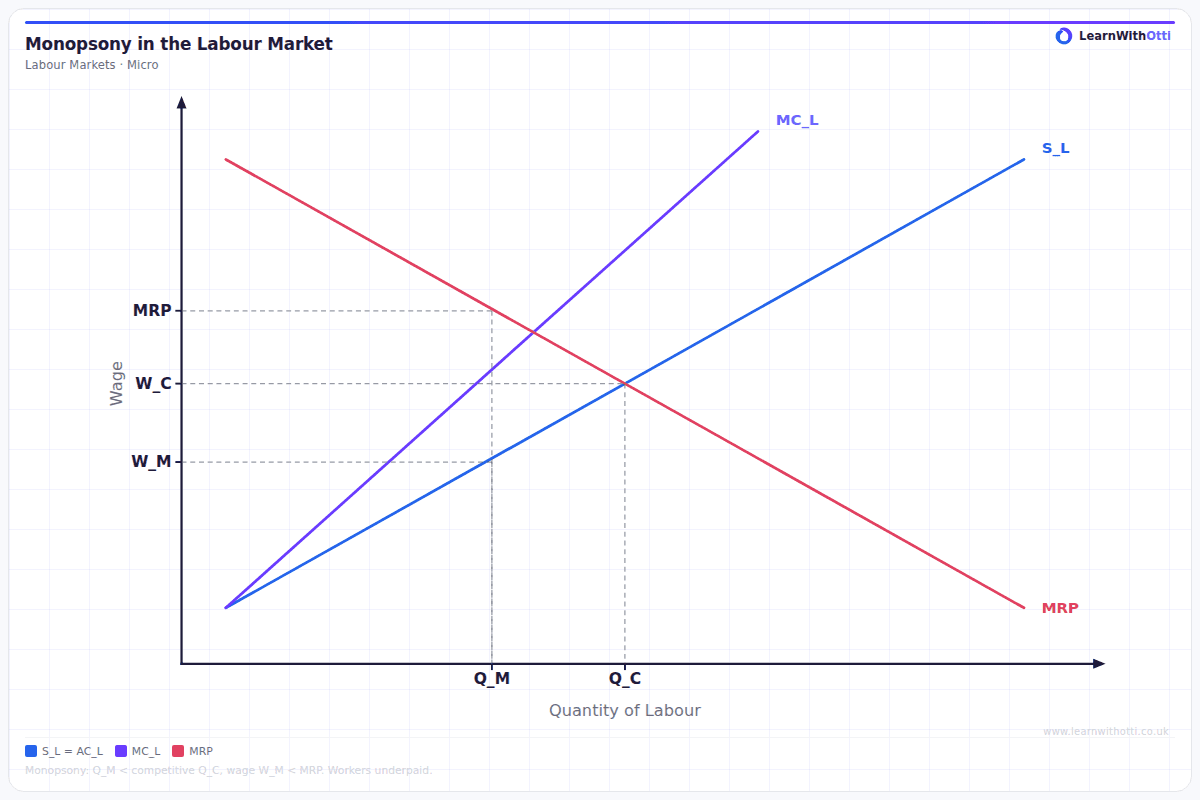
A monopsony is a single dominant buyer. It can use its power to push down the prices it pays suppliers or the wages it pays workers.
- Suppliers. The large supermarkets buy from thousands of farmers and food manufacturers. The Groceries Supply Code of Practice requires them to deal fairly with suppliers, for example by not changing agreements without notice, and the Groceries Code Adjudicator enforces it.
- Employees. A dominant employer in a local labour market can pay a wage below what workers would earn in a competitive market and employ fewer workers. A minimum wage can limit this power. Set at the right level, it can raise both wages and employment in a monopsony labour market.
EU competition policy
The European Commission enforces similar rules across the EU single market. It can block mergers between large firms, fine cartels and punish the abuse of a dominant position. It has fined large technology firms, such as Google, for abusing their dominance. Since Brexit, the CMA reviews deals that affect UK markets separately, so a large merger may need approval from both.
Benefits and costs of competition policy
Benefits
- Blocking mergers and punishing cartels stops firms gaining or abusing market power, so prices stay closer to the competitive level.
- Competition improves quality as well as price, because consumers can switch to a rival if the service is poor.
- Competition policy and deregulation increase the number of firms in a market, giving consumers more choice. The energy and telecoms markets in the UK opened up to many new suppliers after privatisation and deregulation.
Costs and limits
- Regulation has administrative and compliance costs, which may be passed on to consumers.
- Investigations are slow and costly for both the CMA and firms, and a competition authority may block a merger that would have brought real economies of scale.
- Regulatory capture. Over time, the regulator may come to act in the interests of the firms rather than consumers.
Evaluating competition policy
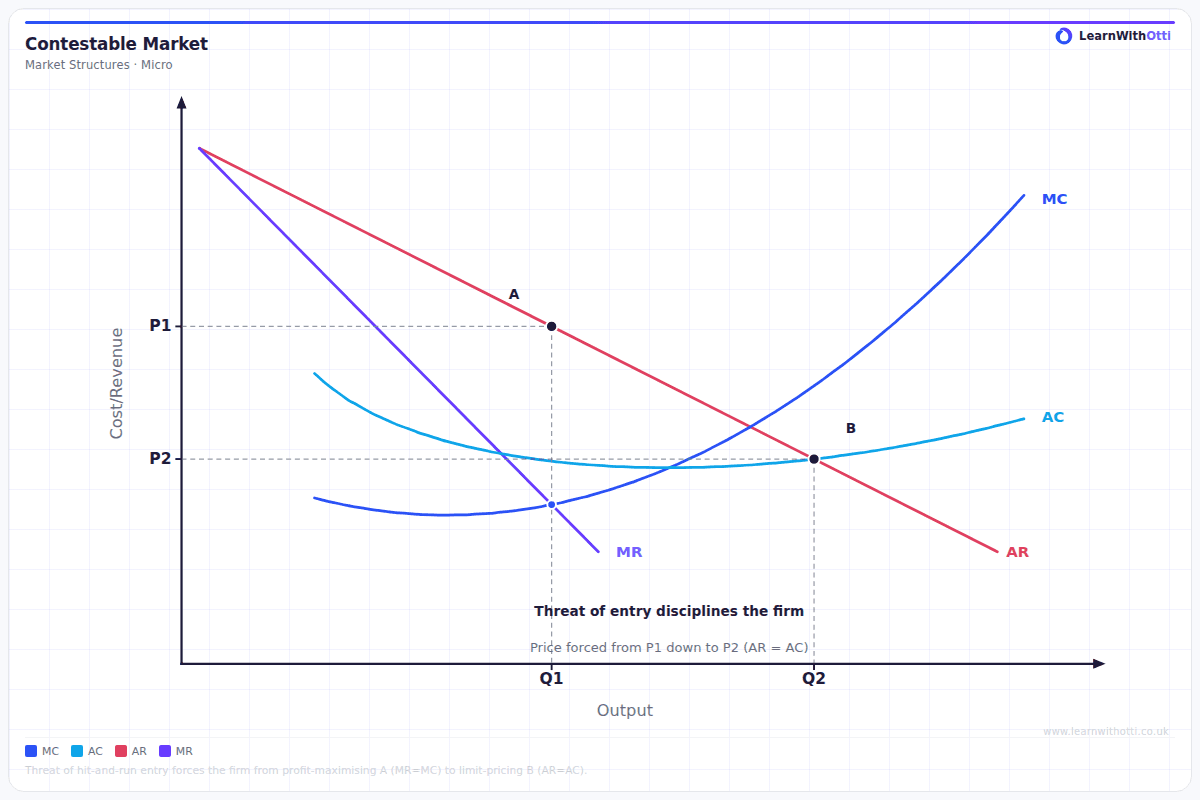
- Is the market contestable? If barriers to entry are low, the threat of entry may control prices without much regulation, as covered in 4.1.5.9 Contestable and non-contestable markets.
Key terms
| Term | Meaning |
|---|---|
| Competition and Markets Authority | The UK body that investigates mergers and anti-competitive behaviour |
| Substantial lessening of competition | The test the CMA uses to decide whether a merger should be blocked or remedied |
| Cartel | An agreement between firms to fix prices, share out markets or restrict output |
| Abuse of a dominant position | A firm with market power using it to exploit consumers or exclude rivals |
| Contestable market | A market with low barriers to entry and exit |
| Monopsony | A market with a single dominant buyer |
| Regulatory capture | When a regulator acts in the interests of the firms it regulates rather than consumers |
Common mistakes
- Treating all mergers as harmful. Some mergers bring economies of scale that lower costs, which is why the CMA can clear mergers subject to conditions.
- Confusing monopoly and monopsony. A monopoly is a dominant seller. A monopsony is a dominant buyer, of goods from suppliers or of labour from workers.
How this has been examined
In the AQA papers indexed on this site, this topic has appeared in three formats:
- 25-mark "Assess" essay — asked twice across 2 series (2018 to 2023)
- 25-mark "Evaluate" essay — asked once (2017)
- 1-mark multiple choice — asked once (2025)
Where this goes next
The market structures that create the need for competition policy are covered in 4.1.5.6 Monopoly and monopoly power and 4.1.5.5 Oligopoly, and the efficiency concepts used to judge them in 4.1.5.10 Market structure, static efficiency, dynamic efficiency and resource allocation. The regulation of natural monopolies, privatisation and deregulation are covered in 4.1.8.8 Public ownership, privatisation, regulation and deregulation of markets, and the risk that intervention makes things worse in 4.1.8.10 Government failure.
Otti is an AI tutor built for A-Level students. Ask it anything, practise exam questions, and get instant feedback written like an examiner would give it — not just right or wrong, but why.
Get one answer marked free