AQA A-Level Economics · Revision notes
4.1.8.8 Public Ownership, Privatisation, Regulation and Deregulation of Markets
Governments can change who owns a firm and the rules it operates under. This topic covers the arguments for and against public ownership, privatisation, the regulation of markets and deregulation, with UK examples, and the problem of regulatory capture. Competition policy towards mergers and anti-competitive behaviour is covered in 4.1.8.7 Competition policy.
Public ownership
Nationalisation is the transfer of a private firm into public ownership. The government may nationalise a firm to protect jobs, to keep an essential service running when a private firm fails, or to stop a monopoly exploiting consumers, suppliers and workers.
- Northern Rock was taken into public ownership in 2008 to protect savers and the banking system.
- Several rail operators have been brought into public ownership, beginning with the East Coast main line in 2018, and the government has committed to bring passenger rail services back into public ownership as contracts expire.
A nationalised firm does not face the profit motive, so it may be less efficient, and its losses fall on taxpayers.
A state-owned firm can also take account of external costs and benefits, and keep socially valuable but loss-making services running, such as rural rail lines. Against this, decisions may be driven by political pressure, and investment has to compete with other government spending.
Privatisation
Privatisation is the transfer of a state-owned firm to the private sector, usually by selling shares. Major UK privatisations included BT in 1984, British Gas in 1986, the water companies in 1989, the railways in the 1990s and Royal Mail in 2013.
- The profit motive gives the firm an incentive to cut costs and improve efficiency.
- If it is combined with deregulation, new competitors can enter the market.
- But a state monopoly may simply become a private monopoly, which is why many privatised industries need a regulator.
- Privatisation gives firms a profit motive, which can drive efficiency, but it also means profits are paid to shareholders rather than reinvested or used to lower prices.
- Competition policy and deregulation increase the number of firms in a market, giving consumers more choice. The energy and telecoms markets in the UK opened up to many new suppliers after privatisation and deregulation.
Regulation of markets
How regulators control natural monopolies
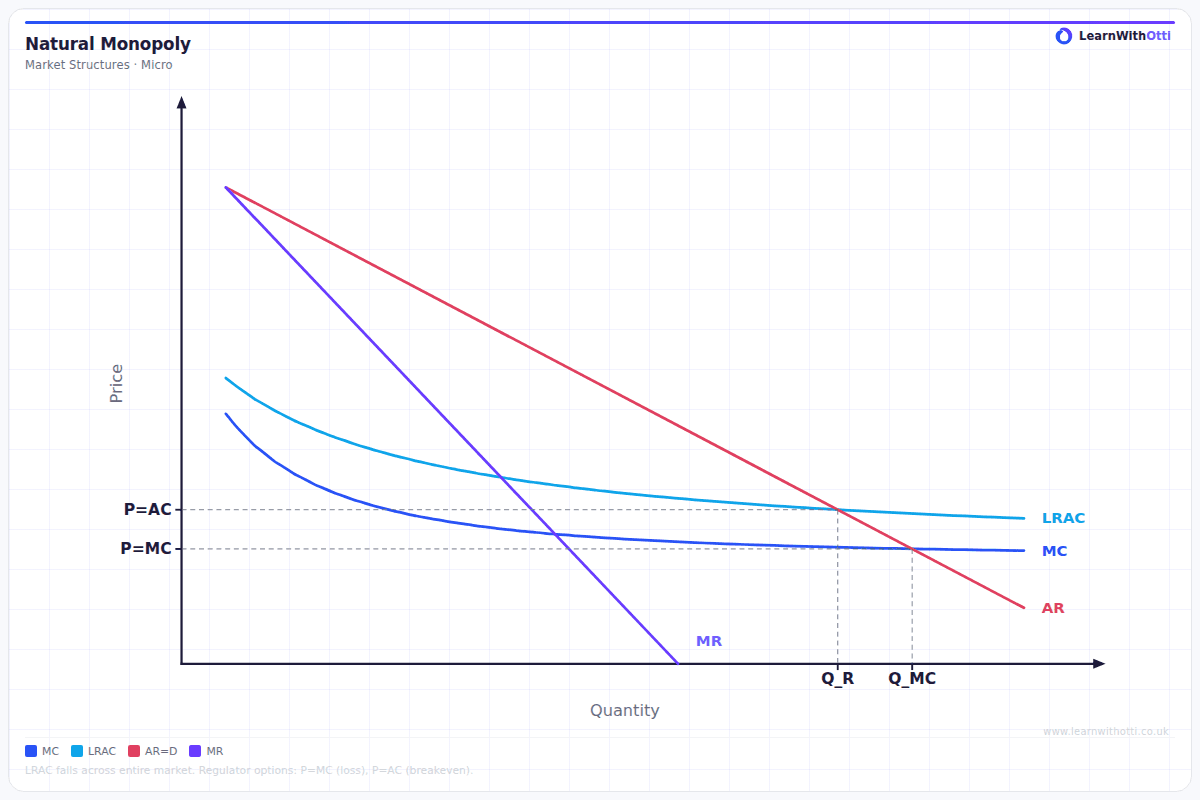
Some industries are natural monopolies.
Key idea: Because fixed costs are very high, as with water pipes, the electricity grid or rail track, one firm can supply the whole market at a lower average cost than two or more competing firms. Breaking up the monopoly would raise costs, so instead the government regulates it.
Price regulation
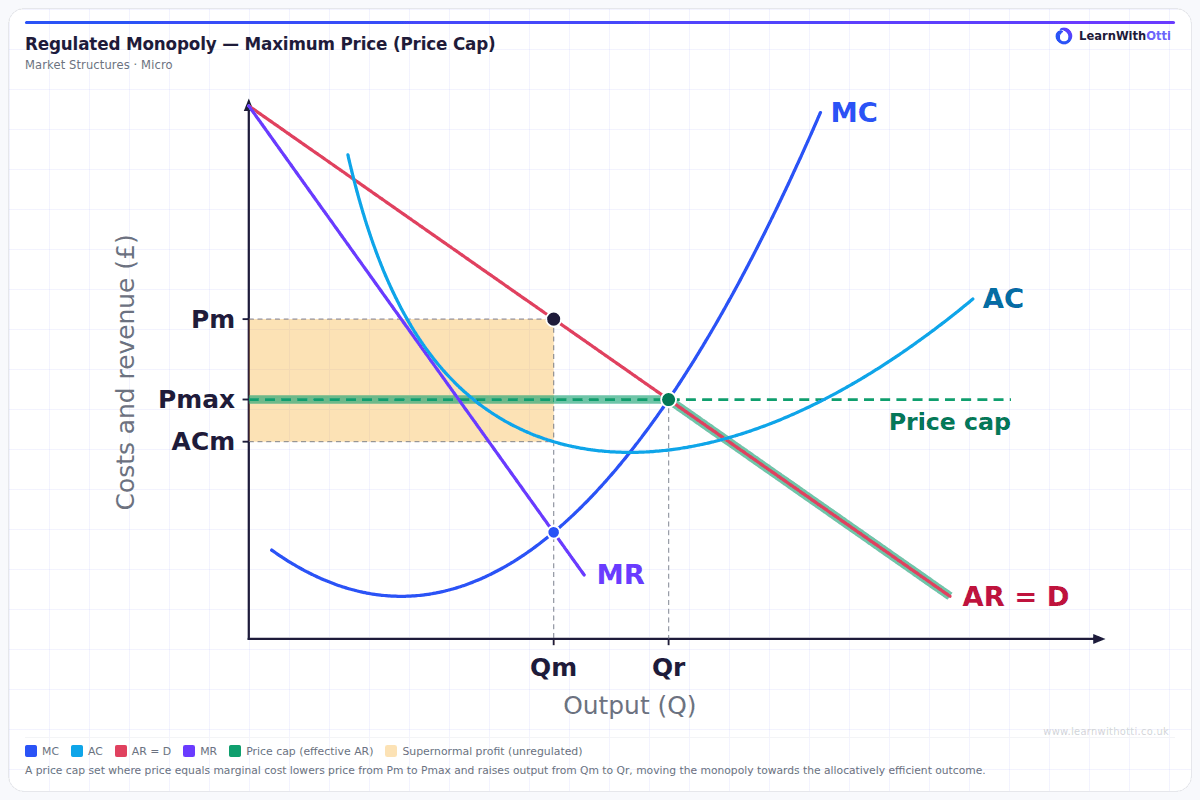
The regulator sets a limit on how much the firm can raise its prices. In the UK this has often taken the form of an RPI minus X price cap.
- RPI is the rate of inflation, measured by the Retail Prices Index. Many regulators now use CPI or a related measure instead.
- X is a percentage set by the regulator, reflecting the efficiency gains it expects the firm to make.
- If inflation is 3% and X is 1%, the firm can raise its prices by no more than 2% a year.
The cap gives the firm an incentive to cut costs. If it cuts costs faster than X, it keeps the extra profit until the next review. Regulators such as Ofwat review price limits every five years.
Where large investment is needed, the formula can be RPI plus K, where K allows prices to rise faster than inflation to pay for investment. This has been used in the water industry.
Profit regulation
The regulator limits the rate of return the firm can earn on the capital it has invested. Prices are set so that the firm covers its costs plus a fair return. This prevents excessive profits, but gives the firm little incentive to control costs, because higher costs can be passed on in higher prices. It may also encourage firms to over-invest in capital to increase the profit they are allowed to earn.
Quality standards
A monopoly facing a price cap could protect its profits by cutting quality. Regulators therefore set minimum standards, such as the reliability of supply, the cleanliness of drinking water, or how quickly complaints are dealt with. Firms that fall short can be fined or required to compensate customers.
Performance targets
Regulators set targets that firms must meet, often with financial penalties for missing them. Examples include punctuality targets for train operators, targets to reduce leaks and pollution incidents for water companies, and delivery targets for Royal Mail, which has been fined by Ofcom for missing them.
The effects of regulation
Prices
- A price cap such as RPI minus X limits how much a regulated firm can raise its prices each year. If X is positive, prices must rise by less than inflation, so real prices fall.
- Ofgem caps the unit price of gas and electricity on standard tariffs, and Ofwat sets limits on the bills water companies can charge.
- Consumers gain directly from lower prices than an unregulated monopolist would charge.
Limits
- If the price cap is set too low, the firm may not cover its costs, and may cut investment or leave the market.
- Prices for a natural monopoly cannot simply be forced down to marginal cost. Because average cost is still falling where demand meets marginal cost, a price equal to marginal cost would mean the firm makes a loss.
This is why regulators of natural monopolies such as water and the electricity grid usually aim for a price close to average cost, which allows a normal profit, rather than the allocatively efficient price.
Profit
- Under RPI minus X, a firm that cuts costs faster than X keeps the extra profit until the next review. This gives a strong incentive to become more efficient.
- However, if a firm earns large profits under a cap, it suggests that X was set too low, and consumers lose out until the next review.
Efficiency
- Firms that face no competition often let costs rise above the lowest possible level. This is X-inefficiency.
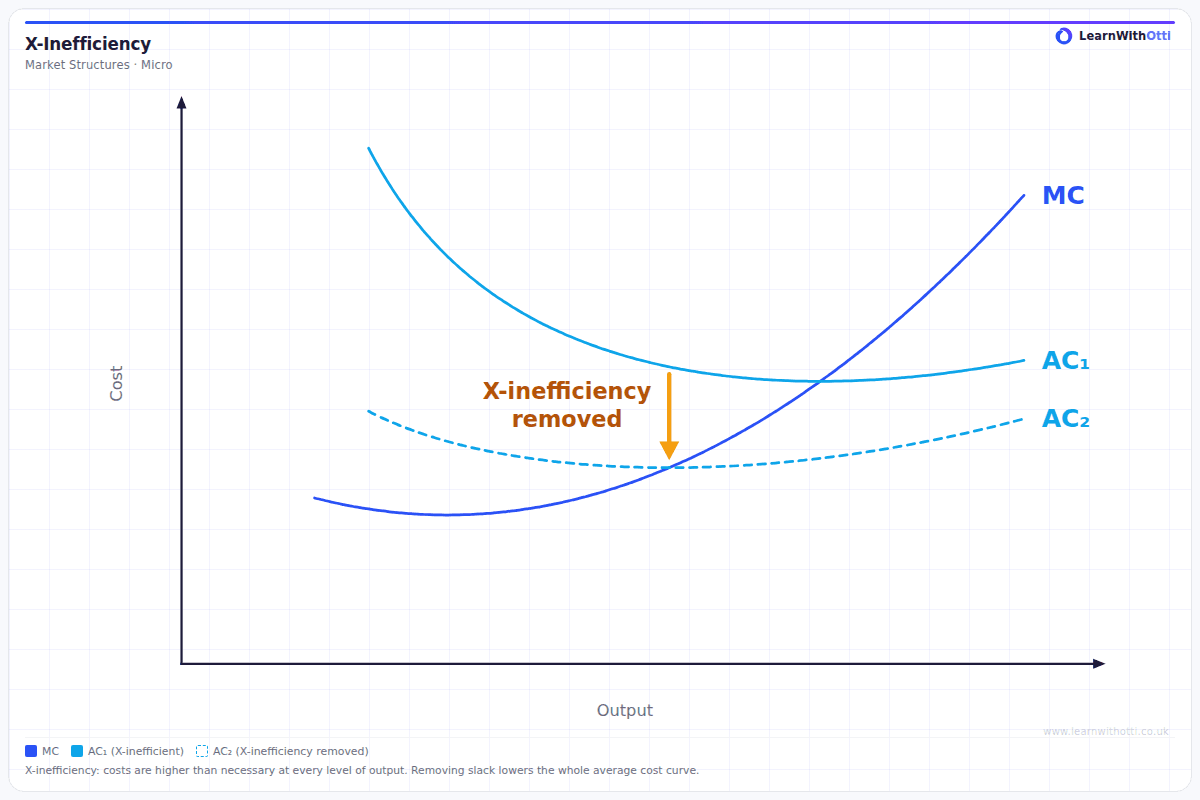
- Price caps, performance targets and the threat of competition all put pressure on firms to cut waste and move back down to the lowest average cost curve.
- Intervention can reduce dynamic efficiency if it cuts the profit that pays for investment and innovation. A firm that expects its profit to be capped may see little point in investing in new technology.
- On the other hand, competition forces firms to innovate to survive, and regulators can set targets for investment, as Ofwat does for water infrastructure.
Quality
- A firm under a tight price cap can protect its profit by cutting quality rather than costs. Fewer staff, less maintenance and slower repairs all reduce costs but harm consumers.
- Quality standards and performance targets are used to prevent this. Rail operators are judged on punctuality, and water companies face penalties for leaks and sewage discharges.
- Targets can backfire. Firms may hit the target in ways that do not improve the service, or neglect parts of the service that are not measured.
- Competition improves quality as well as price, because consumers can switch to a rival if the service is poor.
Deregulation
Rather than controlling firms with market power directly, the government can make markets more competitive, or more contestable. A contestable market is one with low barriers to entry and exit.
Key idea: Even if there are few firms, the threat of new entrants forces existing firms to keep prices close to average cost.
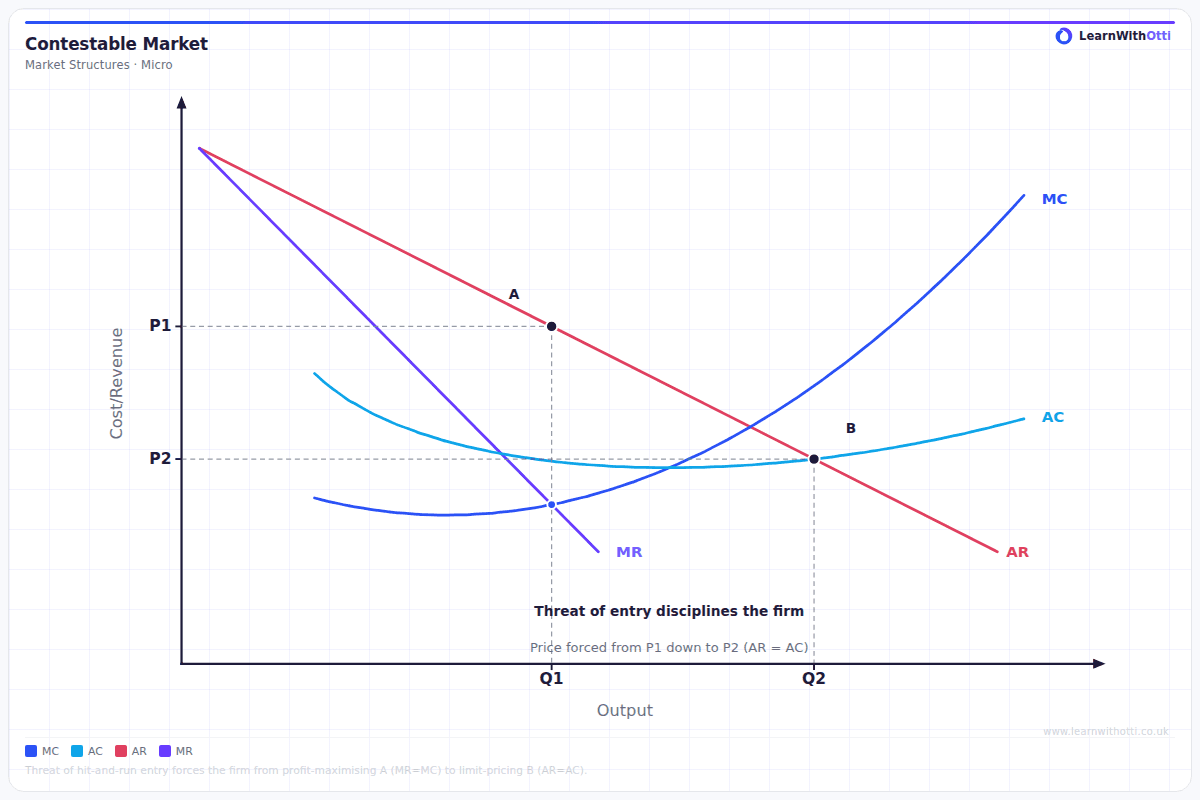
Deregulation removes legal barriers to entry, such as licences or legal monopolies, so that new firms can enter a market.
- Bus services outside London were deregulated in 1986.
- Royal Mail's legal monopoly on delivering letters was removed, opening the market to competitors.
- Airline routes within Europe were opened up to competition in the 1990s, helping the growth of low-cost airlines.
- Deregulation and privatisation can bring new firms into a market. Fares on many European air routes fell sharply after the airline market was opened to low-cost carriers.
Deregulation increases contestability, but some rules exist to protect safety, consumers or the environment, so removing them can have costs.
Competitive tendering for government contracts
The government invites private firms to bid for the right to supply a service, such as refuse collection, school meals, hospital cleaning or running a rail route. The contract goes to the firm offering the best value. Even where only one firm provides the service, competition for the contract can drive down costs. The risks are that firms cut quality to win contracts, and that contracts are hard to monitor.
Regulatory capture and other limits
Regulatory capture
- Regulatory capture happens when a regulator comes to act in the interests of the firms it regulates rather than consumers.
- It can happen because regulators rely on firms for information and expertise, because staff move between the regulator and the industry, and because firms lobby hard while consumers are spread out and poorly organised.
- A captured regulator may set a generous price cap, allow high profits or fail to punish poor performance. Critics have argued that water companies in England were allowed to build up large debts and pay high dividends while investment in infrastructure fell short and sewage discharges continued.
- Solutions include fixed terms for regulators, rules on staff moving to and from the industry, and publishing decisions so they can be challenged.
Asymmetric information
- The firm knows far more about its own costs, demand and ability to cut costs than the regulator does.
- This makes it hard to set the right value of X in a price cap or the right rate of return. Firms have an incentive to overstate their costs so that the regulator sets a more generous cap.
- It also makes quality hard to monitor. A firm can hide cuts to maintenance that only show up years later.
- Regulators try to reduce the gap by comparing the performance of similar firms against each other, and by requiring firms to publish detailed information.
Other limits
- Regulation has administrative and compliance costs, which may be passed on to consumers.
- Intervention can have unintended consequences, as when a tight cap leads to lower investment or firms leaving the market.
- These limits are examples of government failure, covered in 4.1.8.10 Government failure.
Evaluating the impact
- What type of market is it? In a natural monopoly, competition is not possible, so regulation of price and quality is the main option. In other markets, promoting competition may achieve more than regulation.
- Short run against long run. A tight cap lowers prices now but may reduce investment and quality in future.
- How good is the regulator's information? The impact depends on setting caps and targets at the right level.
- Is the market contestable? If barriers to entry are low, the threat of entry may control prices without much regulation, as covered in 4.1.5.9 Contestable and non-contestable markets.
- Who gains? Lower prices help consumers but reduce returns to shareholders and may reduce tax revenue from profits.
Key terms
| Term | Meaning |
|---|---|
| Nationalisation | The transfer of a private firm into public ownership |
| Privatisation | The transfer of a state-owned firm to the private sector |
| Natural monopoly | An industry where one firm can supply the market at a lower average cost than several firms |
| RPI minus X | A price cap allowing prices to rise by inflation less an efficiency factor, X |
| RPI plus K | A price cap allowing prices to rise faster than inflation to fund investment |
| Profit regulation | Limiting the rate of return a firm can earn on its capital |
| Performance target | A standard a regulated firm must meet, often with penalties for missing it |
| X-inefficiency | Costs above the lowest possible level, caused by a lack of competitive pressure |
| Deregulation | The removal of rules that restrict entry or competition |
| Competitive tendering | Private firms bidding for the right to supply a service to the government |
| Contestable market | A market with low barriers to entry and exit |
| Regulatory capture | When a regulator acts in the interests of the firms it regulates rather than consumers |
| Asymmetric information | When one side of a relationship knows more than the other, such as a firm knowing more about its costs than the regulator |
Common mistakes
- Confusing RPI minus X with a fixed price. The cap limits the annual change in price, not the price level itself.
- Getting the arithmetic wrong. With inflation of 4% and X of 1.5%, prices can rise by up to 2.5%, not fall.
- Assuming privatisation always increases competition. Without deregulation or regulation, a state monopoly may become a private monopoly.
- Assuming a price cap always helps consumers. If it is set too low, quality and investment may fall, and firms may leave the market.
- Forcing a natural monopoly to price at marginal cost. Average cost is above marginal cost where it meets demand, so the firm would make a loss.
- Ignoring quality. A firm under pressure on price can cut quality instead of costs.
- Describing regulatory capture without explaining why it happens. Link it to the regulator's reliance on the firm for information and to lobbying.
- Forgetting dynamic efficiency. Lower profits can mean less money for investment and innovation.
How this has been examined
In the AQA papers indexed on this site, this topic has appeared in four formats:
- 25-mark "Assess" essay — asked 3 times across 3 series (2017 to 2025)
- 25-mark "Discuss" essay — asked once (2023)
- 25-mark "Evaluate" essay — asked once (2019)
- 4-mark "Explain" data response — asked once (2025)
Where this goes next
Competition policy towards mergers and anti-competitive behaviour is covered in 4.1.8.7 Competition policy. Natural monopoly and the costs of market power are covered in 4.1.5.6 Monopoly and monopoly power, the threat of entry in 4.1.5.9 Contestable and non-contestable markets, and the types of efficiency in 4.1.5.10 Market structure, static efficiency, dynamic efficiency and resource allocation. When intervention makes things worse, the result is 4.1.8.10 Government failure, and privatisation and deregulation also appear as supply-side policies in 4.2.5.2 Supply-side policies.
Otti is an AI tutor built for A-Level students. Ask it anything, practise exam questions, and get instant feedback written like an examiner would give it — not just right or wrong, but why.
Get one answer marked free