Edexcel A-Level Economics · Revision notes
1.1.4 Production Possibility Frontiers
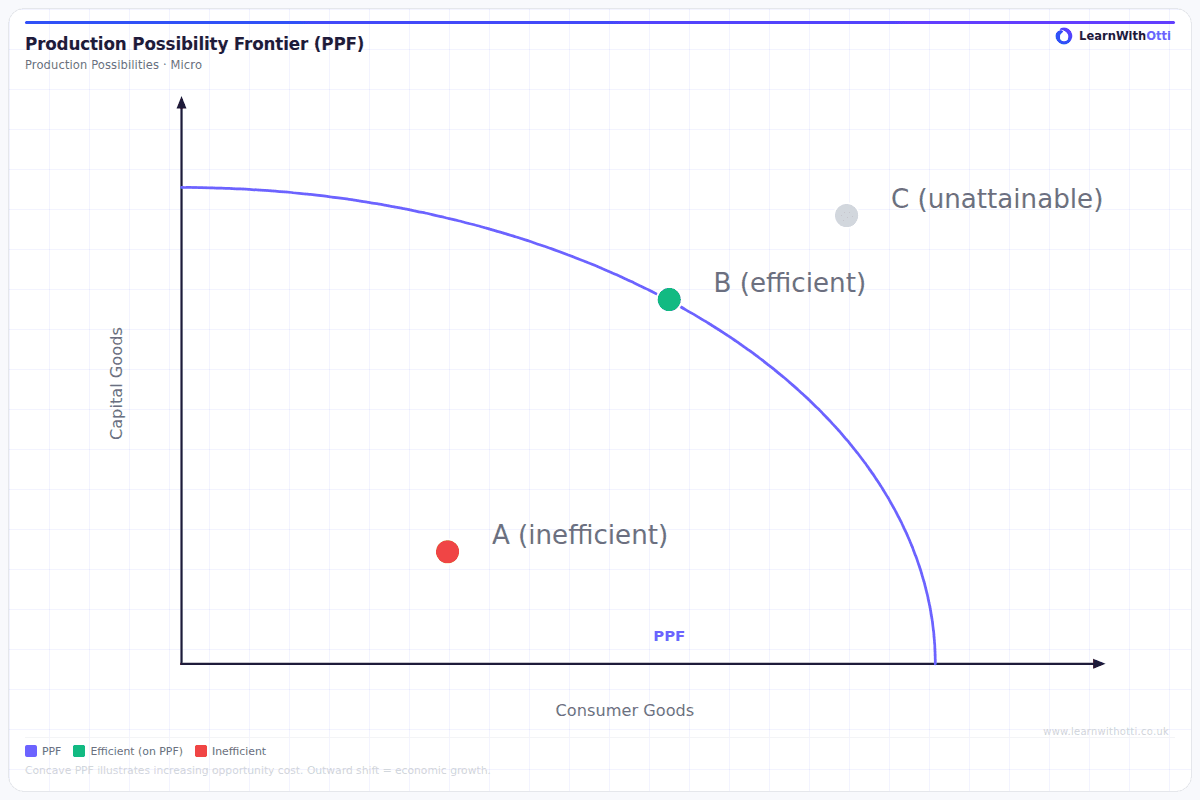
A production possibility frontier (PPF) shows the maximum combinations of two goods an economy can produce when all its resources are fully and efficiently employed. It is the simplest economic model there is, and it illustrates scarcity, choice and opportunity cost in a single diagram.
What the PPF depicts
The diagram plots the quantity of one good on each axis. The frontier is the boundary of what the economy can produce with its current resources and technology.
Maximum productive potential Every point on the frontier uses all available resources. To produce more of one good, the economy must produce less of the other.
Efficient and inefficient allocation
- Points on the frontier are productively efficient: no more of one good can be produced without giving up some of the other.
- Points inside the frontier are inefficient. Some resources are unemployed or poorly used, so more of both goods could be produced.
Possible and unobtainable production
- Points on or inside the frontier are attainable.
- Points outside the frontier are unobtainable with current resources and technology.
Economic growth or decline
- An outward shift of the frontier represents growth in productive potential.
- An inward shift represents a decline in potential, for example after a war or natural disaster destroys capital.
Opportunity cost through marginal analysis
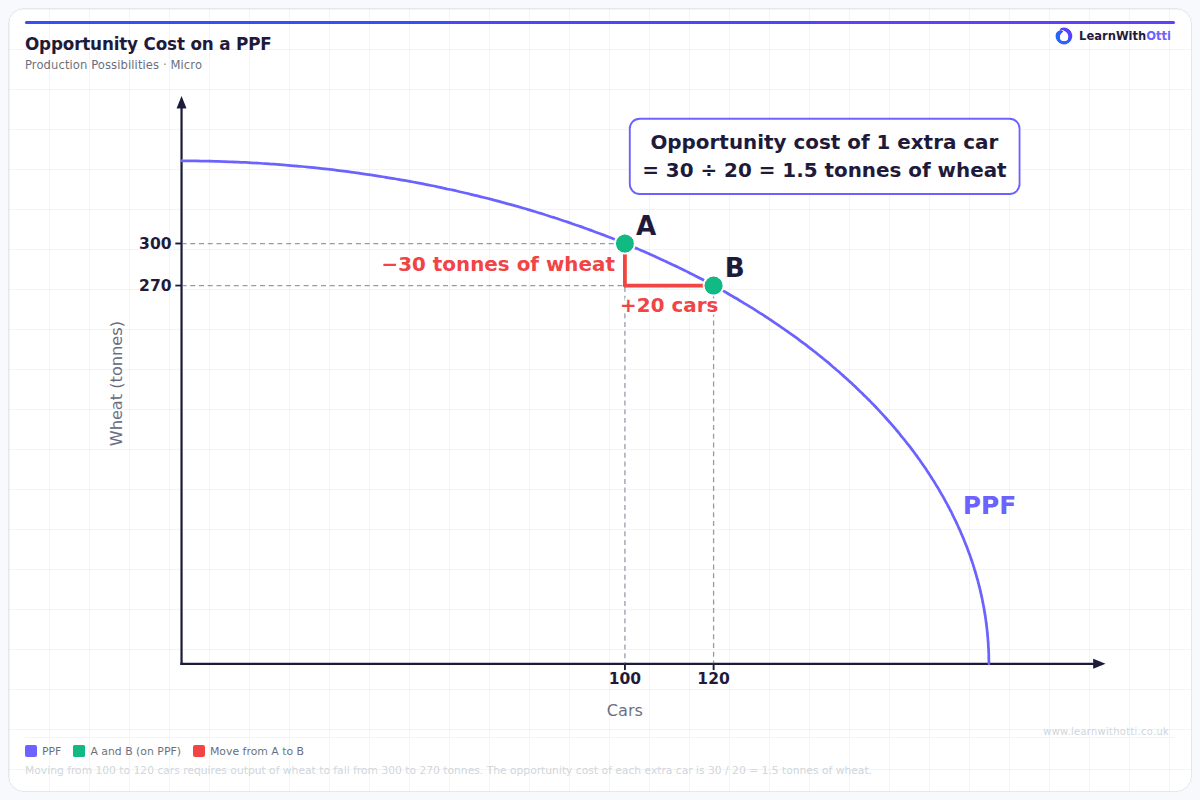
Moving along the frontier shows the opportunity cost of producing more of one good.
Opportunity cost of one more unit of X = units of Y given up / extra units of X gained
Suppose an economy produces cars and wheat. Moving from 100 to 120 cars requires output of wheat to fall from 300 to 270 tonnes. The opportunity cost of each extra car is 30 / 20 = 1.5 tonnes of wheat.
Why the frontier is usually bowed outwards (concave to the origin) Resources are not equally suited to producing both goods. When the economy first shifts resources into cars, it moves those best suited to car production and least useful in farming, so little wheat is lost. As more cars are produced, it must use land and workers far better suited to farming, so each extra car costs more wheat. This is increasing opportunity cost.
If resources were equally suited to both goods, opportunity cost would be constant and the frontier would be a straight line.
Movements along and shifts of the frontier
A movement along the frontier is a reallocation of resources between the two goods. The economy's productive potential has not changed. Causes include changes in consumer preferences or government priorities.
Key distinction: A movement from inside to the frontier means previously unemployed resources are being used. This is a recovery from recession, not an increase in potential.
A shift of the frontier changes what the economy is capable of producing. Outward shifts are caused by:
- an increase in the quantity of resources, such as a larger labour force through migration or discovery of natural resources;
- an improvement in the quality of resources, such as better education and training;
- technological progress, which raises the output from given resources;
- investment in capital goods.
Inward shifts are caused by the loss of resources, such as depletion of natural resources, emigration, or destruction of capital.
Asymmetric shifts. If technology improves in the production of only one good, the frontier pivots outwards along that good's axis only.
Capital goods and consumer goods
A particularly important PPF puts capital goods on one axis and consumer goods on the other.
- Capital goods are used to produce other goods: machinery, factories, infrastructure.
- Consumer goods are bought for their own sake by households: food, clothing, entertainment.
Key idea: This is a trade-off between the present and the future. An economy that devotes more resources to capital goods today sacrifices current consumption, but its frontier will shift further outwards in future, allowing more of both goods later.
An economy that consumes nearly everything it produces grows more slowly.
Key terms
| Term | Meaning |
|---|---|
| Production possibility frontier | The maximum combinations of two goods an economy can produce with given resources and technology |
| Productive efficiency | Producing on the frontier, so no more of one good can be made without less of the other |
| Opportunity cost | The amount of one good given up to produce more of another |
| Increasing opportunity cost | Each extra unit of a good costs more of the other good, giving a bowed-out frontier |
| Capital goods | Goods used to produce other goods |
| Consumer goods | Goods consumed for their own sake |
| Economic growth | An outward shift of the PPF, representing a rise in productive potential |
Common mistakes
- Calling a move from inside to the frontier "economic growth". That uses existing capacity; growth in potential is an outward shift.
- Dividing the wrong way round. The opportunity cost of one more car is wheat lost divided by cars gained.
- Explaining the bowed shape with "diminishing returns" alone. The reason is that resources are not equally suited to both goods.
- Shifting the whole frontier for a change in one industry. A technology improvement in one good pivots the frontier along one axis only.
- Treating every point on the frontier as equally desirable. All are productively efficient; which one society prefers is a separate question.
How this has been examined
In the Edexcel papers indexed on this site, this topic has appeared in four formats:
- 1-mark multiple choice — asked 3 times across 3 series (2018 to 2023)
- 2-mark calculation — asked twice across 2 series (2018 to 2023)
- 2-mark "Explain" data response — asked once (2018)
- 2-mark "Explain" short answer — asked once (2023)
Every appearance has been at a tariff of 1 or 2 marks.
Where this goes next
The frontier puts the ideas in 1.1.3 The economic problem into a diagram. Specialisation, which allows output beyond what each producer could achieve alone, is in 1.1.5 Specialisation and the division of labour. Outward shifts reappear as long-run growth in 2.5.1 Causes of growth, and the frontier is the basis of comparative advantage in 4.1.2 Specialisation and trade.
Otti is an AI tutor built for A-Level students. Ask it anything, practise exam questions, and get instant feedback written like an examiner would give it — not just right or wrong, but why.
Get one answer marked free