Edexcel A-Level Economics · Revision notes
2.5.1 Causes of growth
Economic growth can come from the economy making fuller use of the resources it already has, or from an increase in the resources and know-how it has to work with. Telling these apart is the key to this topic. It covers the factors that could cause growth, the distinction between actual and potential growth, and why international trade matters for export-led growth.
Actual and potential growth
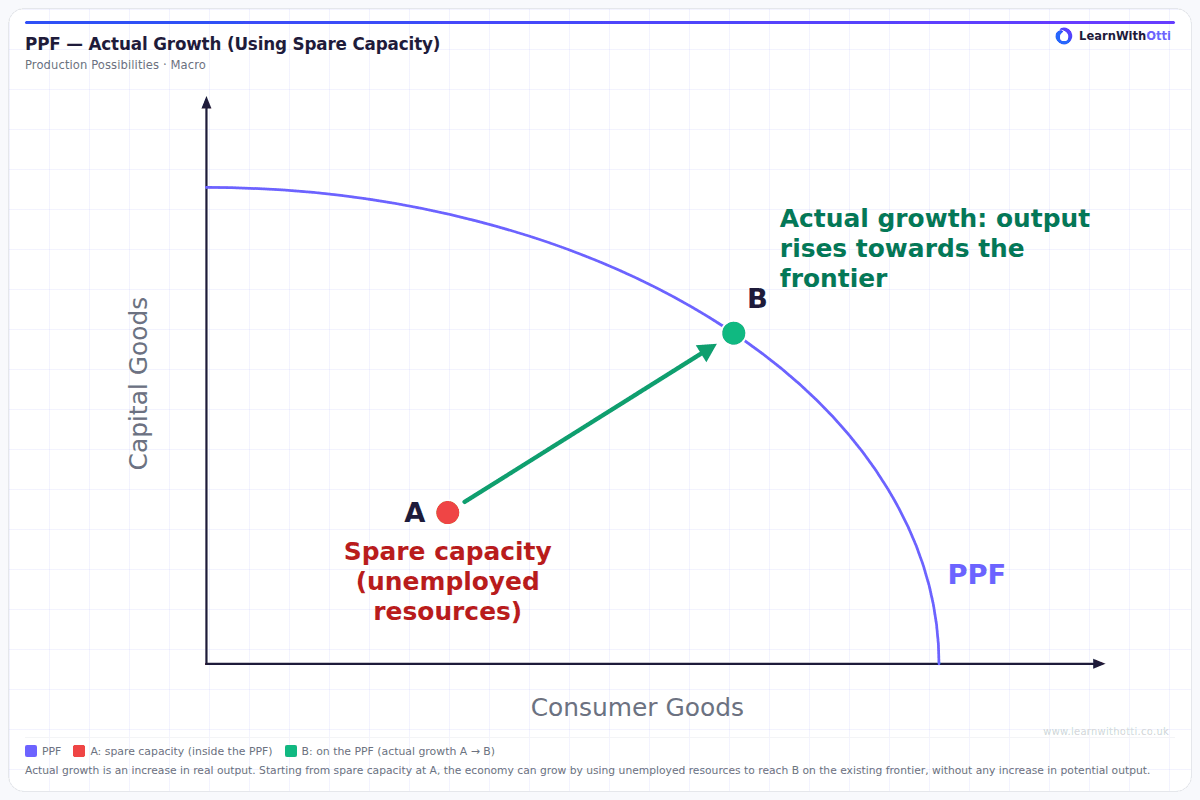
Actual growth is an increase in real GDP: the economy actually produces more goods and services than before. It is measured by the percentage change in real GDP.
Potential growth is an increase in the economy's productive capacity: the maximum output it could produce if all its factors of production were fully and efficiently employed. It is shown by an outward shift of the production possibility frontier (PPF), or a rightward shift of long-run aggregate supply (LRAS).
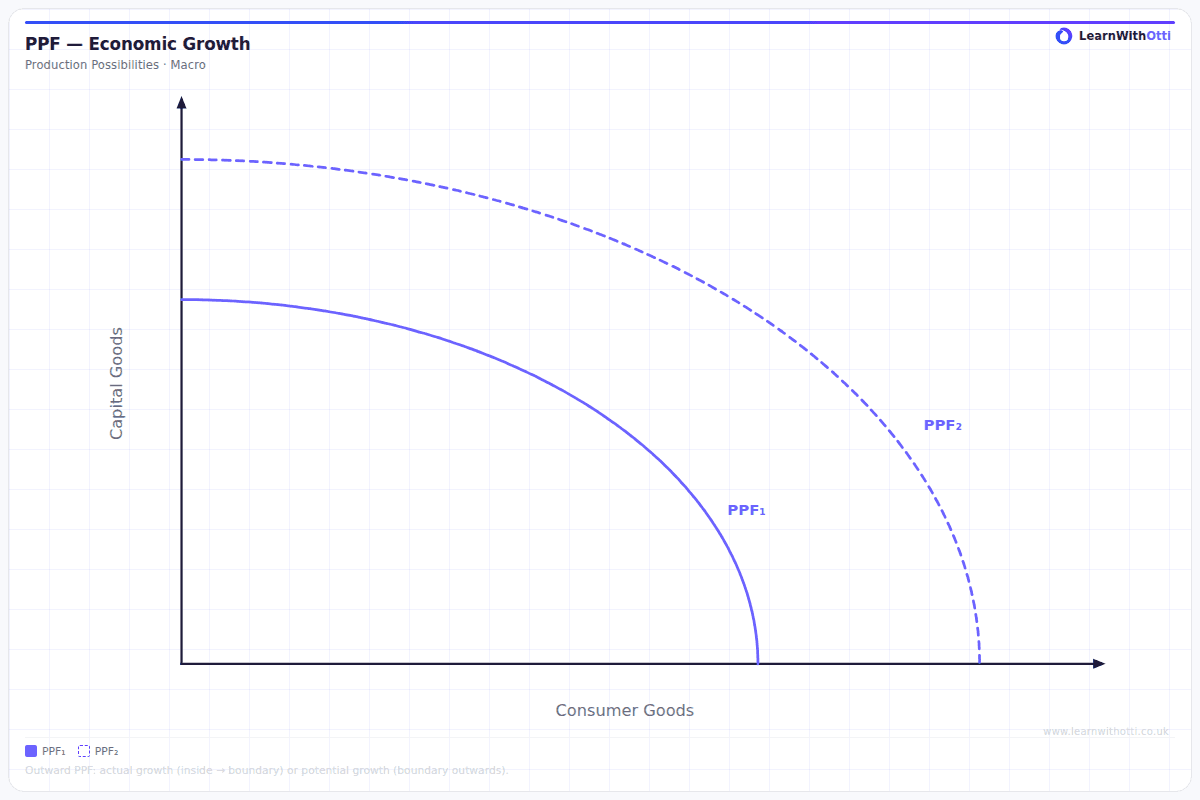
The two can happen separately.
- Actual growth without potential growth. An economy coming out of a recession, with unemployed workers and idle factories, can grow quickly by putting those resources back to work.
- Potential growth without actual growth. New technology or a larger workforce can raise productive capacity, but if spending is weak, the extra capacity sits unused.
Watch out: On a PPF this is a movement from a point inside the frontier towards the frontier itself. Capacity has not changed.
Key idea: The distinction matters because actual growth that comes from using spare capacity eventually runs out. Once the economy reaches full capacity, further increases in demand mainly raise the price level. Sustained growth over the long run needs potential growth.
Factors which could cause economic growth
Demand-side causes of actual growth
An increase in any component of aggregate demand (AD) can raise real output, as long as there is spare capacity:
- Consumption, for example when households become more confident or interest rates fall.
- Investment, for example when firms expect higher future sales.
- Government Expenditure, for example on public services or infrastructure.
- Net trade, for example when demand for UK exports from foreign consumers rises.
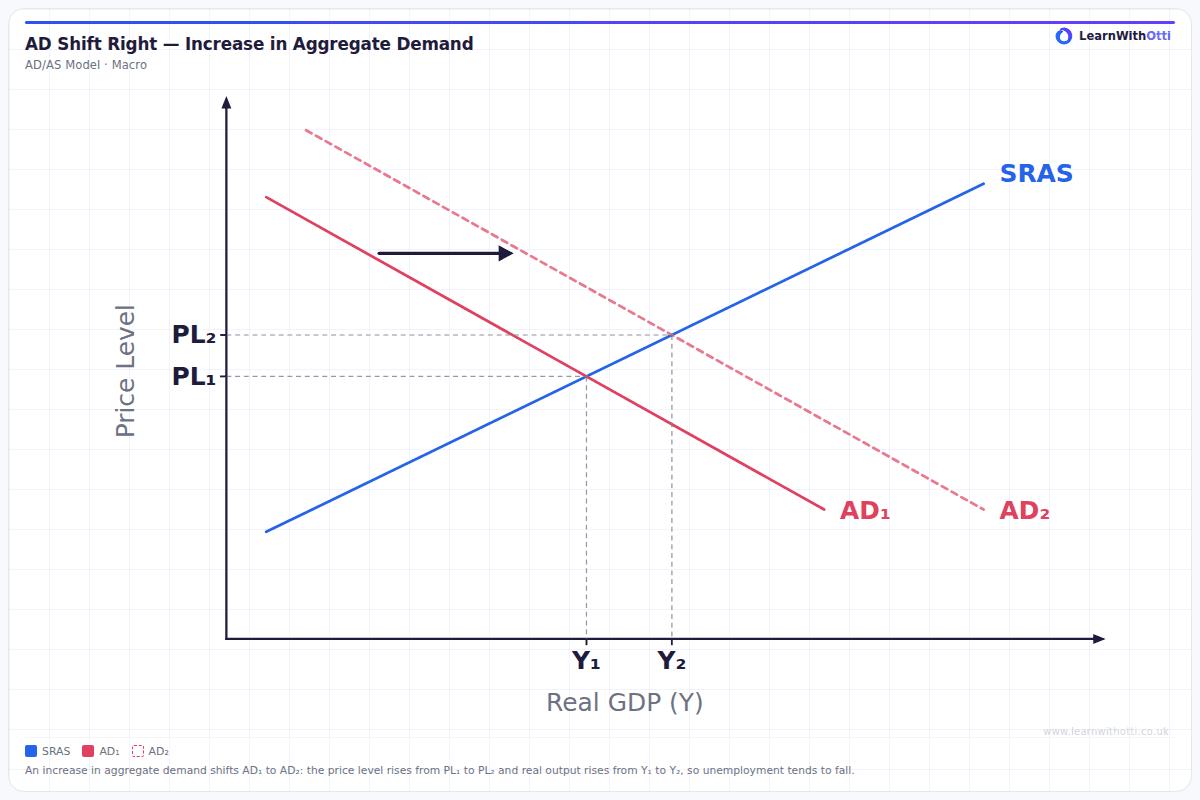
A rise in AD increases real output and the price level. When there is plenty of spare capacity, most of the effect is on output rather than prices. Through the multiplier, the final rise in national income is larger than the initial increase in spending.
Supply-side causes of potential growth
Potential growth comes from an increase in the quantity or quality of the factors of production.
- More labour. A growing population, net inward migration of working-age people and higher participation in the labour force all increase the number of workers.
- Better-quality labour. Education, training and better health raise productivity, the output per worker. This is investment in human capital.
- More and better capital. Investment in machinery, buildings and infrastructure, such as transport and broadband networks, allows each worker to produce more.
- Technology and innovation. New products and new methods of production allow more output from the same inputs. Advances in computing, automation and artificial intelligence are recent examples.
- Enterprise. Entrepreneurs who start firms and bring new ideas to market raise the economy's capacity, so policies that encourage enterprise can support growth.
- Natural resources. The discovery of new resources raises capacity. The development of North Sea oil and gas from the 1970s added to UK productive capacity.
- Efficiency of markets. Stronger competition and less unnecessary regulation encourage firms to cut costs and innovate.
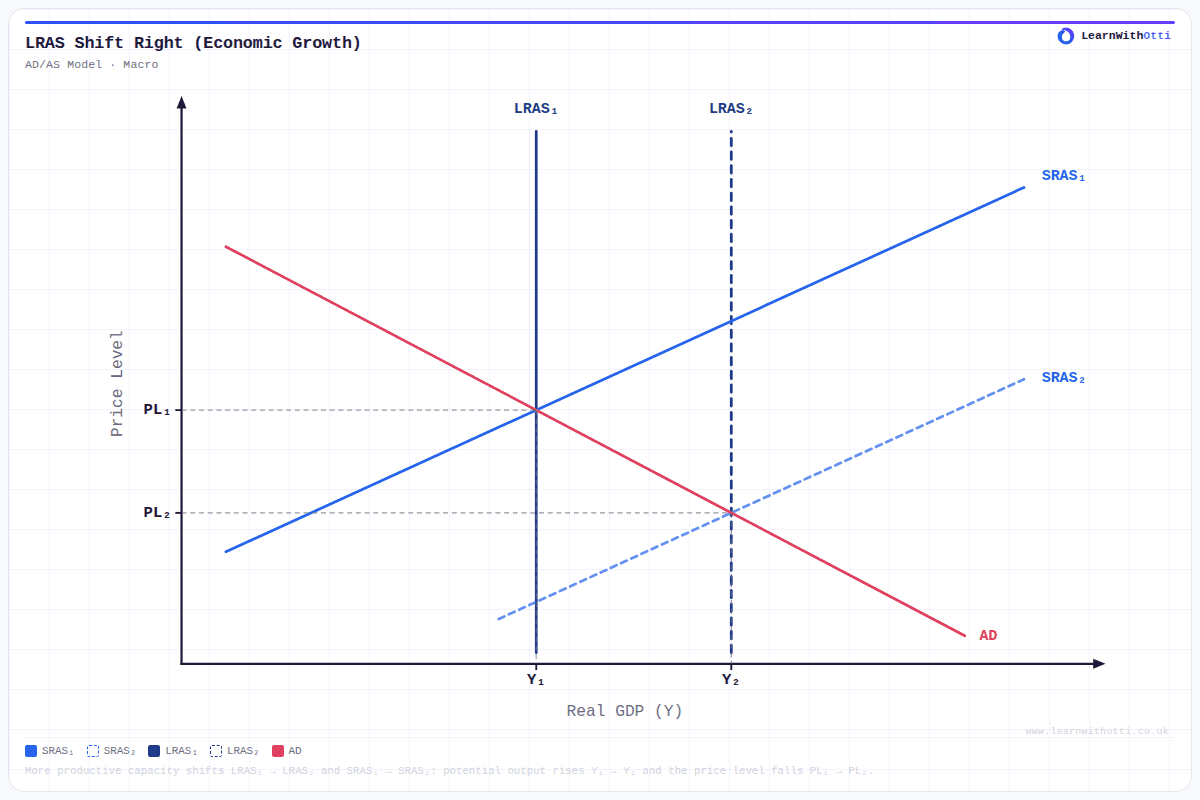
Key idea: Investment does two jobs. Spending on new capital is a component of AD, so it raises actual growth in the short run. It also adds to the capital stock, so it shifts LRAS to the right and raises potential growth in the long run.
This is why low investment is often seen as a weakness in an economy's growth prospects.
The importance of international trade for export-led growth
Export-led growth happens when rising exports are the main driver of an increase in real GDP.
International trade can boost growth in several ways:
- Exports are an injection. Spending by foreign consumers and firms on UK goods and services adds to AD through net trade, and the multiplier increases the final effect on national income.
- Larger markets. Selling to the rest of the world lets firms grow beyond the size of the domestic market, so they benefit from economies of scale and lower average costs.
- Specialisation. Trade lets countries specialise in what they produce most efficiently, raising total output.
- Competition. Exposure to foreign competition pushes domestic firms to become more efficient and to innovate.
- Access to imports and investment. Trade gives firms access to cheaper raw materials, components and capital goods, and it attracts inward investment by multinational firms, which can bring new technology and skills.
China's rapid growth from the late 1970s onwards was driven to a large extent by manufactured exports, and Germany has long relied on exports of cars and machinery. The UK's exports are dominated by services, such as financial, professional and business services.
Limits of export-led growth
- Dependence on other economies. If major trading partners go into recession, demand for exports falls. The global financial crisis of 2008 to 2009 caused a sharp fall in world trade.
- Exchange rates. A rise in the value of the currency makes exports more expensive for foreign consumers and can weaken export growth.
- Protectionism. Tariffs and other trade barriers imposed by other countries reduce access to export markets.
- Imbalances. Export-led growth in one country means rising imports somewhere else, which can lead to trade tensions.
Key terms
| Term | Meaning |
|---|---|
| Actual growth | An increase in real GDP |
| Potential growth | An increase in the economy's productive capacity |
| Productive capacity | The maximum output an economy can produce with its resources fully and efficiently employed |
| Productivity | Output per worker or per hour worked |
| Human capital | The skills, knowledge and experience of the workforce |
| Export-led growth | Growth in real GDP driven mainly by rising exports |
Common mistakes
- Using "growth" without saying which kind. Make clear whether you mean actual growth (more output) or potential growth (more capacity).
- Shifting the PPF outward for a fall in unemployment. Putting unemployed resources to work is a movement towards the PPF, not a shift of it.
- Treating any rise in AD as long-run growth. A rise in AD raises real output only if there is spare capacity. Sustained growth needs LRAS to shift right.
- Forgetting that investment affects both AD and LRAS.
- Assuming exports always deliver growth. Export-led growth depends on demand in other economies, the exchange rate and access to markets.
How this has been examined
In the Edexcel papers indexed on this site, this topic has appeared in four formats:
- 25-mark "Evaluate" synoptic essay — asked twice across 2 series (2017 to 2021)
- 12-mark "Discuss" data response — asked once (2025)
- 4-mark "Explain" data response — asked once (2024)
- 1-mark multiple choice — asked once (2023)
Where this goes next
How growth is measured is set out in 2.1.1 Economic growth, and the factors that shift LRAS in 2.3.3 Long-run AS. The gap between actual and potential output is covered in 2.5.2 Output gaps, and policies to raise potential growth in 2.6.3 Supply-side policies. The gains from trade are developed in 4.1.2 Specialisation and trade, and growth in developing economies in 4.3.2 Factors influencing growth and development.
Otti is an AI tutor built for A-Level students. Ask it anything, practise exam questions, and get instant feedback written like an examiner would give it — not just right or wrong, but why.
Get one answer marked free