Edexcel A-Level Economics · Revision notes
2.4.1 National income
National income is the total income earned in an economy over a period of time. The circular flow of income is the simplest model of how that income moves around the economy, and it underpins everything that follows in this part of Theme 2. This topic also covers the distinction between income and wealth.
The circular flow of income
The simplest version of the model has two groups of economic agents:
- Households, who own the factors of production (land, labour, capital and enterprise) and consume goods and services.
- Firms, who hire the factors of production and use them to produce goods and services.
They meet in two markets. In the factor market, households sell the use of their factors of production to firms. In the goods and services market, firms sell their output to households. Two flows move in opposite directions through these markets.
The real flow (inner loop on the diagram)
- Households supply factors of production to firms: their labour, and the use of their land and capital.
- Firms supply goods and services to households.
The money flow (outer loop on the diagram)
- Firms pay households for the factors of production, in the form of wages, rent, interest and profit. This is household income.
- Households spend that income on the goods and services firms produce. This is spending, or expenditure.
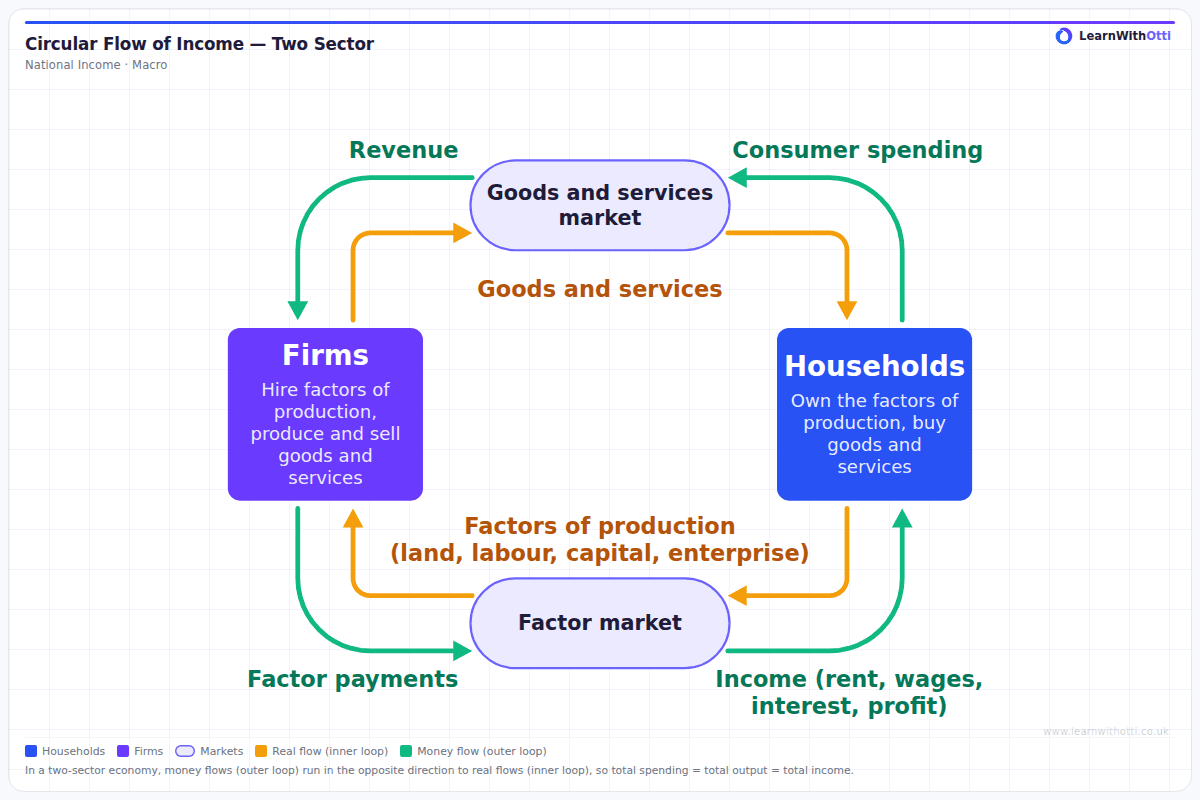
In this simple model, all income is spent, so the money flowing from households to firms is exactly equal to the money flowing from firms to households. The flow continues around the circle at the same level.
Three ways of measuring national income
Because the flow is circular, the same total can be measured at three points:
- National income: the total of all incomes earned (wages, rent, interest and profit).
- National output: the total value of all goods and services produced.
- National expenditure: the total amount spent on those goods and services.
In principle, all three are equal:
National income = national output = national expenditure
Key idea: Every pound spent on output becomes someone's income, and every unit of output is valued at what is spent on it.
In practice, the three measures give slightly different figures because of gaps and errors in the data, and statisticians adjust them so they agree.
Income and wealth
Income and wealth are often confused, but they measure different things.
- Income is a flow: money received over a period of time, such as a salary of £30,000 a year, interest on savings, or rent from a property.
- Wealth is a stock: the value of assets owned at a point in time, such as a house, savings, shares or a pension fund.
The two are linked:
- Wealth can generate income. Savings earn interest, shares pay dividends, and property earns rent.
- Income that is saved adds to wealth over time.
A person can have a high income and little wealth, such as a young professional renting a home, or a low income and substantial wealth, such as a retired person who owns their house outright.
Key distinction: The distinction matters for the economy as a whole. A change in wealth, such as a rise in house prices, can change household spending even if incomes have not changed.
It also matters when measuring inequality, because wealth is distributed far more unequally than income.
Key terms
| Term | Meaning |
|---|---|
| National income | The total income earned in an economy over a period of time |
| Circular flow of income | A model showing how income and spending flow between households and firms |
| Real flow | The flow of factors of production and goods and services |
| Money flow | The flow of income and spending |
| Income | A flow of money received over a period of time |
| Wealth | A stock of assets owned at a point in time |
Common mistakes
- Confusing income and wealth. Income is a flow over time; wealth is a stock at a point in time.
- Drawing the flows in the wrong direction. Factors of production flow from households to firms; incomes flow from firms to households.
- Forgetting the real flow. The circular flow includes goods, services and factors of production, not just money.
- Assuming the simple model describes the real economy. It leaves out saving, taxes, government spending and trade, which are added in the next topic.
How this has been examined
In the Edexcel papers indexed on this site, this topic has appeared in three formats:
- 4-mark "Explain" data response — asked once (2017)
- 2-mark "Explain" short answer — asked once (2019)
- 1-mark multiple choice — asked twice across 2 series (2021 to 2022)
Where this goes next
The simple circular flow is extended with saving, taxation, government spending and trade in 2.4.2 Injections and withdrawals. The equilibrium level of national output is covered in 2.4.3 Equilibrium levels of real national output, and the way an injection changes national income in 2.4.4 The multiplier. The measurement of national income and growth is in 2.1.1 Economic growth, and wealth inequality in 4.2.2 Inequality.
Otti is an AI tutor built for A-Level students. Ask it anything, practise exam questions, and get instant feedback written like an examiner would give it — not just right or wrong, but why.
Get one answer marked free