Edexcel A-Level Economics · Revision notes
1.4.1 Government intervention in markets
When a market fails, the government can intervene to move output closer to the social optimum. There is no single best tool. Each method works through a different channel (prices, legal limits, information or direct provision), each suits some market failures better than others, and each has its own costs and risks. This topic covers the purpose of intervention, how each method works, the evidence from UK examples, and how to judge whether a method is likely to succeed.
The purpose of intervention
Free markets fail when the price mechanism allocates resources inefficiently. Government intervention aims to correct this:
- Negative externalities, such as pollution or passive smoking. The market over-produces or over-consumes because the costs to third parties are ignored. Intervention aims to reduce output towards the social optimum.
- Positive externalities, such as vaccinations or training. The market under-produces or under-consumes because the benefits to third parties are ignored. Intervention aims to increase output.
- Public goods, such as street lighting or flood defences. The free rider problem means the market may not provide them at all. Intervention aims to make sure they are provided.
- Information gaps, such as the long-term harm of sugary drinks or the benefits of saving for a pension. Consumers make choices they would not make with full information. Intervention aims to close the gap or offset its effects.
Intervention can also have equity aims, such as keeping essential goods affordable or protecting low-income households. These can conflict with efficiency aims, as the sections on indirect taxes and maximum prices show.
Key idea: The target is the social optimum. In every case the aim is the level of output where marginal social cost equals marginal social benefit (MSC = MSB). Intervention is worthwhile if it moves the market closer to that point at a cost lower than the welfare gain it creates.
Indirect taxation
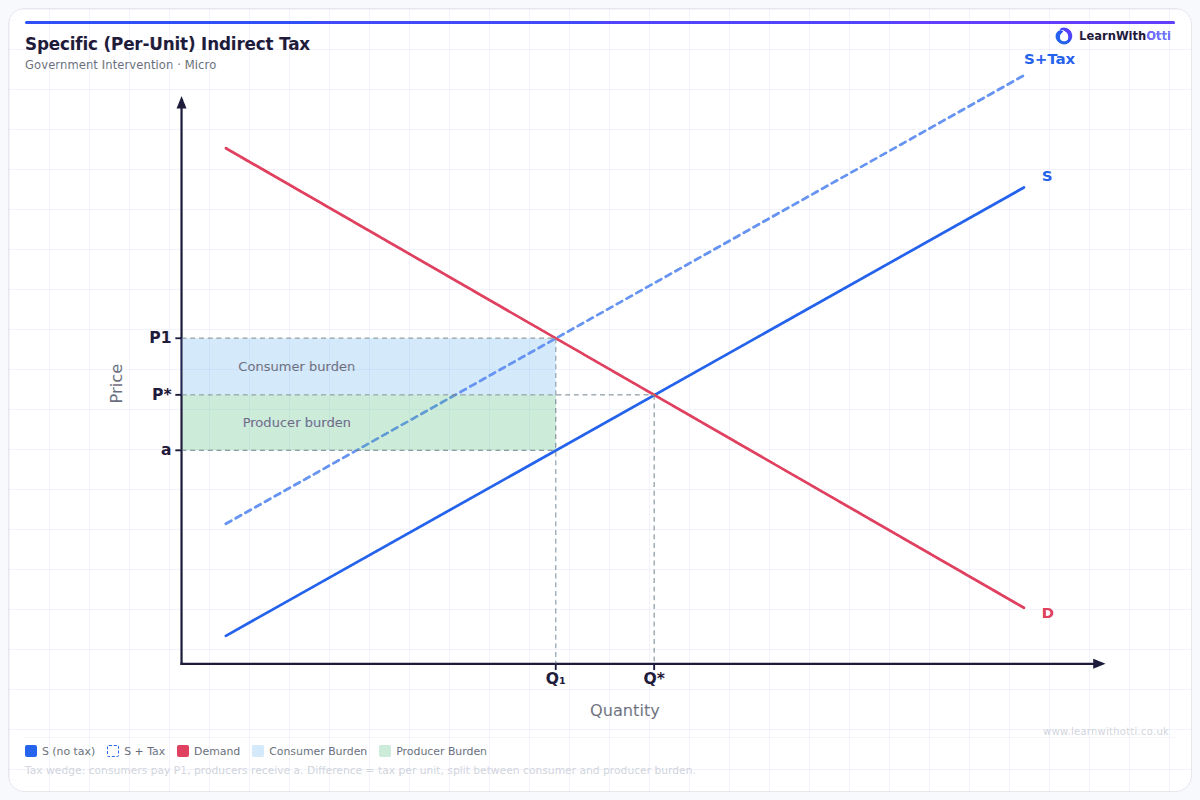
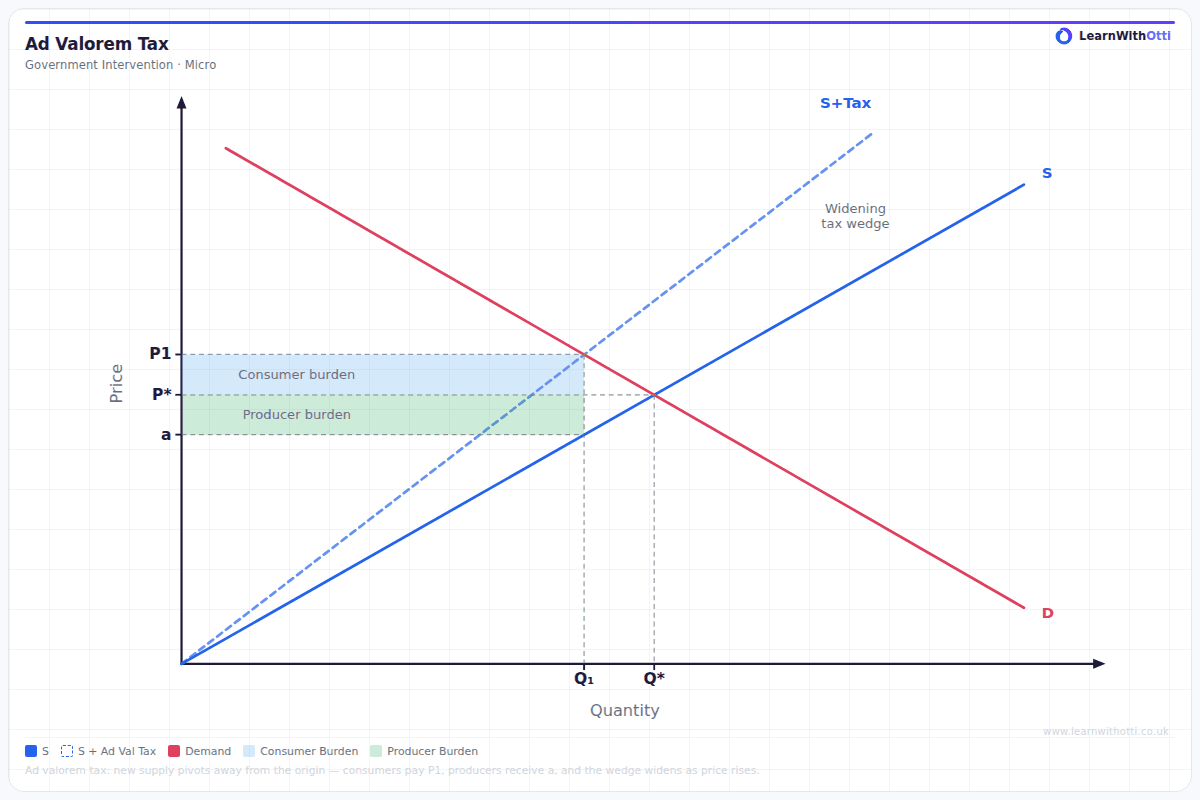
An indirect tax is a tax on spending. The producer pays it to the government and treats it as an extra cost of production. The supply curve shifts upwards (to the left), price rises and the quantity bought and sold falls.
Specific and ad valorem taxes
- A specific tax is a fixed amount per unit, whatever the price. Fuel duty is charged as a set amount per litre. The supply curve shifts up by the same vertical distance at every quantity, so the new supply curve is parallel to the old one.
- An ad valorem tax is a percentage of the price. VAT is charged at 20% on most goods and services in the UK. Because the tax is a percentage, it adds more in pence to expensive units than to cheap ones, so the gap between the two supply curves widens as price rises.
How a tax corrects a negative externality
With a negative production externality, firms produce where marginal private cost (MPC) equals marginal private benefit (MPB) and ignore the external cost. Output is above the social optimum, and there is a welfare loss on the units where marginal social cost is greater than marginal social benefit.
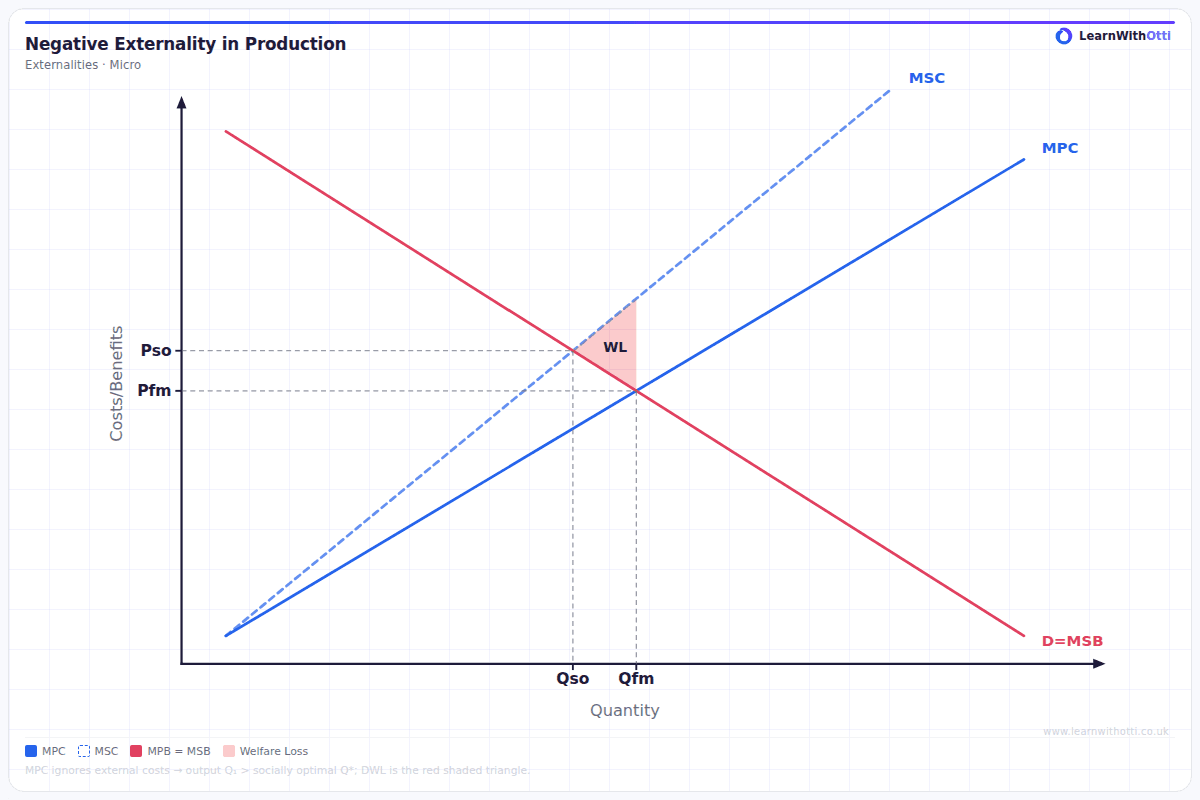
If the government sets a tax equal to the marginal external cost at the social optimum, the firm's cost curve rises from MPC to MSC. The firm now pays the full cost of its activity, so the external cost is internalised. Output falls to the social optimum and the welfare loss is removed. This is the polluter pays principle.
How much consumers pay: price elasticity of demand
How much of the tax is passed on to consumers depends on the price elasticity of demand (PED):
- If demand is price inelastic, firms can pass most of the tax on as a higher price. Consumers pay most of the tax, and the quantity bought falls only a little.
- If demand is price elastic, firms cannot raise the price much without losing many sales. Producers pay most of the tax, and the quantity bought falls by more.
This matters for policy.
Evaluation: Many goods with external costs, such as cigarettes, alcohol and fuel, have price inelastic demand. A tax on them raises a lot of revenue but reduces consumption only a little, unless it is set very high.
The incidence of taxes is worked through with numbers in 1.2.9 Indirect taxes and subsidies.
UK examples
- Soft Drinks Industry Levy (2018). Producers pay a charge per litre on soft drinks, with a higher rate for drinks with more sugar. Because the charge depends on sugar content, many manufacturers cut the sugar in their drinks to pay less or nothing at all. A well-designed tax can change what firms produce, not just what consumers buy.
- Landfill Tax (1996). Charged per tonne of waste sent to landfill. It raises the cost of dumping waste and makes recycling relatively cheaper.
- Tobacco duty. Tobacco is heavily taxed, partly to reduce smoking and partly because inelastic demand makes it a reliable source of revenue.
Evaluation of indirect taxes
Strengths:
- It works through the price mechanism, so consumers and firms still choose for themselves.
- It internalises the externality, so the polluter pays.
- It raises revenue, which can be spent on dealing with the harm, such as health care or cleaner technology.
- It gives firms a lasting incentive to cut the harmful activity, as the sugar levy showed.
Weaknesses:
- The external cost is hard to measure. It is difficult to put a money value on damage to health or the environment, so the tax may be set too high or too low.
- Inelastic demand means consumption may fall only a little, so the externality is reduced by less than intended.
- It is regressive. Indirect taxes take a larger share of income from low-income households than from high-income households, which can widen inequality.
- Illegal markets and avoidance. Very high taxes encourage smuggling and buying abroad, as with tobacco.
- Effects on firms and jobs. Higher costs can reduce output and employment in the industry, and can make UK firms less competitive against foreign firms that do not pay the tax.
- Reliance on the revenue. If a tax raises a lot of money, the government may be reluctant to see consumption of the good fall too far.
Subsidies
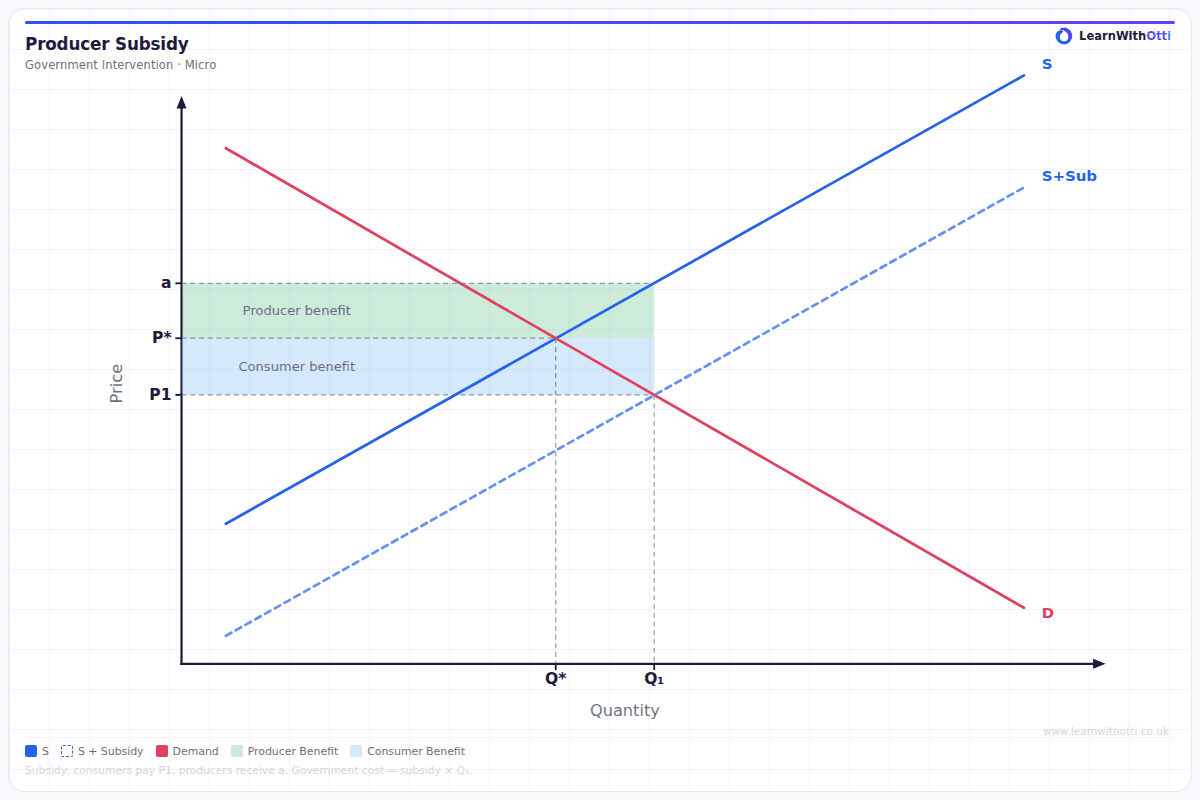
A subsidy is a payment from the government, usually to producers, that lowers the cost of production. The supply curve shifts downwards (to the right), price falls and the quantity bought and sold rises.
How a subsidy corrects a positive externality
With a positive externality, the market settles where MPC = MPB and ignores the external benefit. Output is below the social optimum, and there is a welfare loss from the units that are not produced even though their marginal social benefit is greater than their marginal social cost.
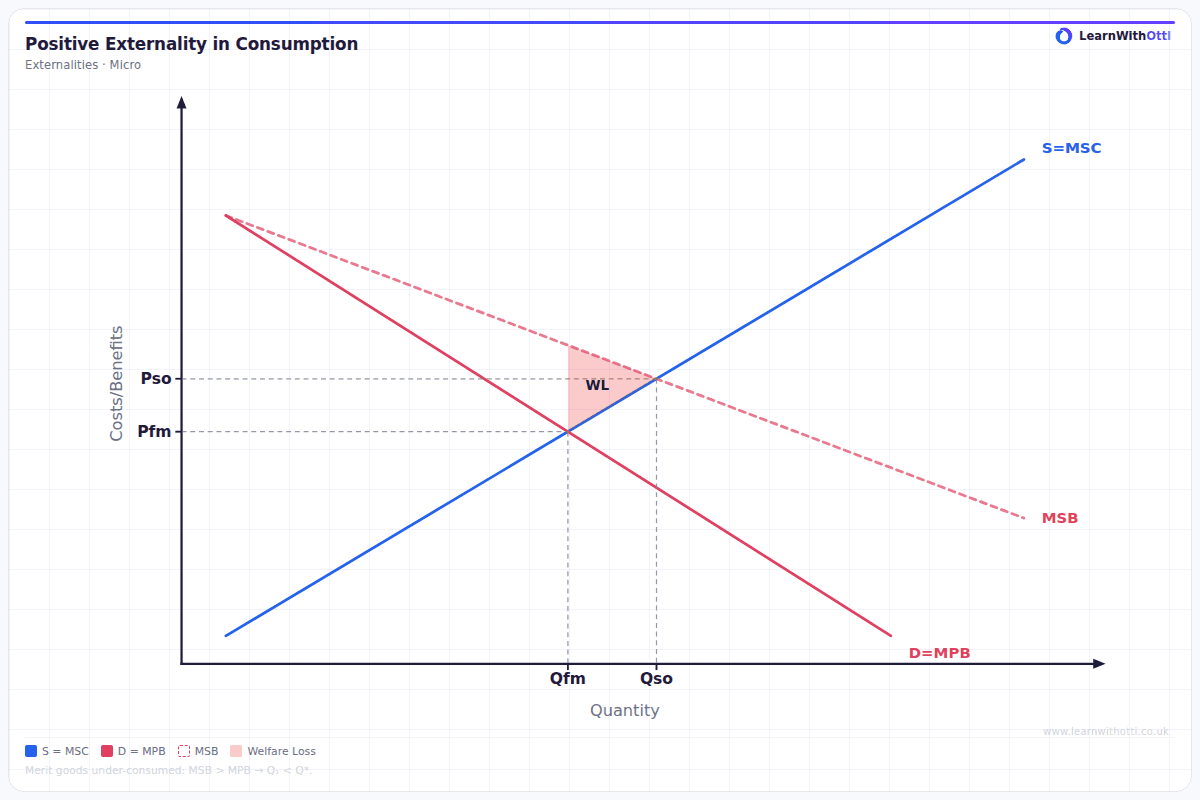
If the government pays a subsidy equal to the marginal external benefit at the social optimum, price falls and quantity rises to the social optimum, removing the welfare loss.
How much consumers gain: price elasticity of demand
- If demand is price inelastic, most of the subsidy is passed on to consumers as a lower price, but the quantity bought rises only a little.
- If demand is price elastic, the price falls by less, but the quantity bought rises by more.
UK examples
- Bus fare cap. In England, single bus fares were capped at £2 from January 2023 and at £3 from January 2025, with the government paying bus operators to cover the lost revenue. The aim is to increase bus use, which reduces congestion and emissions.
- Renewable energy. Contracts for Difference guarantee renewable electricity generators a fixed price, with the government making up the difference when the market price is lower and the generator paying back the difference when it is higher. This encourages investment in wind and solar power.
- Apprenticeships. The government pays most of the cost of apprenticeship training for many employers, because the skills benefit other firms and the wider economy, not just the firm that pays for the training.
Evaluation of subsidies
Strengths:
- It raises output and consumption of goods with external benefits towards the social optimum.
- Lower prices make goods more affordable, which can help low-income households.
- It can speed up the adoption of new technology, such as renewable energy, so that its costs fall faster over time.
Weaknesses:
- Opportunity cost. Money spent on a subsidy cannot be spent on other things, such as schools or hospitals, or must be paid for through higher taxes or borrowing.
- The external benefit is hard to measure, so the subsidy may be too large or too small.
- Inelastic demand means consumption rises only a little.
- Not fully passed on. Part of the subsidy may end up as extra profit for producers rather than lowering the price.
- Paying for what would have happened anyway. Some consumers would have bought the good without the subsidy, so part of the spending achieves nothing extra.
- Dependency. Firms that rely on a subsidy may have less incentive to cut costs or innovate, and subsidies are hard to remove once firms and voters expect them.
Maximum prices
A maximum price (price ceiling) is a legal upper limit on the price of a good. To have any effect it must be set below the equilibrium price. Its main aim is equity: keeping essential goods affordable.
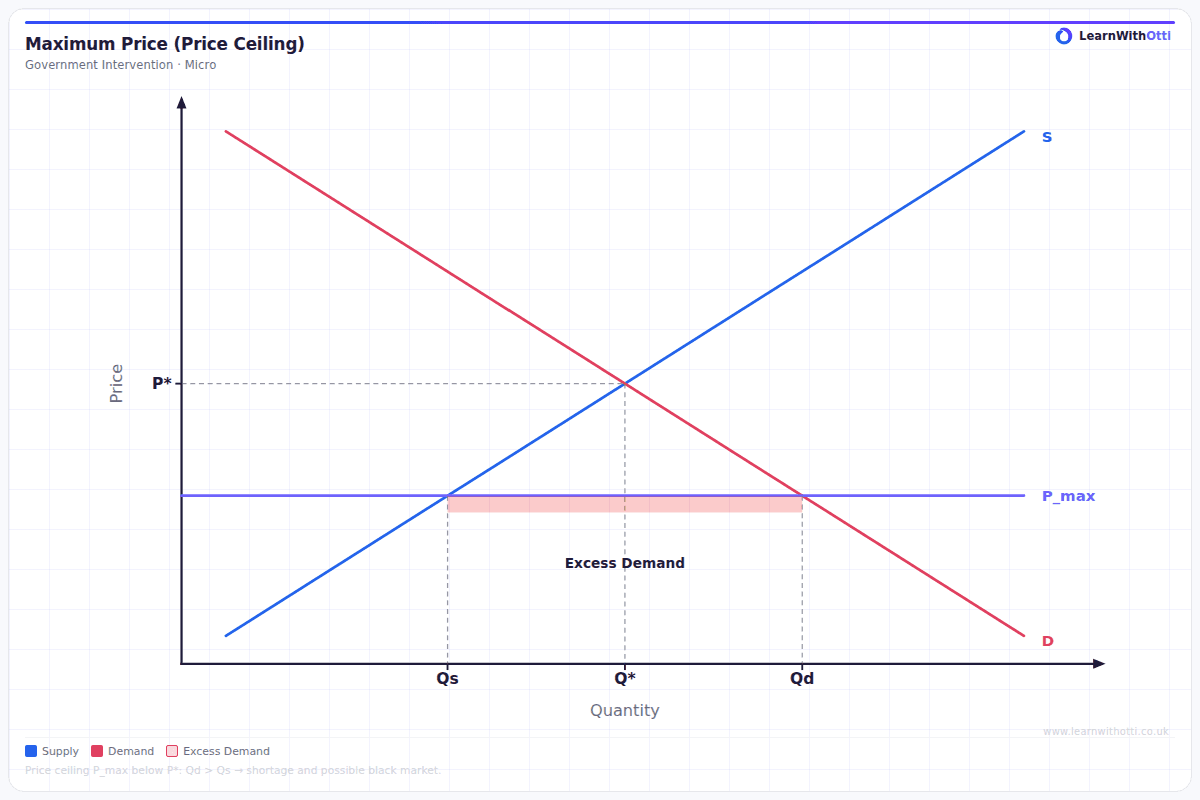
At the maximum price, quantity demanded rises and quantity supplied falls. Quantity demanded is greater than quantity supplied, so there is excess demand, also called a shortage. Fewer units are traded than at equilibrium.
UK examples
- Energy price cap. Since 2019, Ofgem has set a limit on the price suppliers can charge per unit of gas and electricity on standard tariffs. It is reviewed every quarter to reflect wholesale costs. When wholesale prices rose sharply in 2022, the Energy Price Guarantee introduced by the government went further, holding down household prices and paying suppliers the difference. This combined a maximum price with a subsidy.
- Rent controls. Scotland froze and then capped rent increases for existing tenants between 2022 and 2024.
Consequences of a shortage
- Rationing. Goods are allocated by queuing, waiting lists or "first come, first served" rather than by price.
- Illegal markets. Some buyers are willing to pay more than the maximum price, so goods may be resold illegally above it.
- Lower quality. Producers may cut quality or investment to protect their profits. Landlords facing rent controls may spend less on maintenance, or sell up and leave the rental market.
- Winners and losers. Consumers who get the good at the lower price gain, but those who cannot get it at all are worse off.
Evaluation of maximum prices
- It helps the consumers who get the good, and protects households from sudden price rises on essentials.
- The size of the shortage depends on how far below equilibrium the price is set, and on the price elasticity of demand and of supply. If supply is price elastic, quantity supplied falls by a lot and the shortage is larger.
- The shortage may grow over time, as producers leave the market or stop investing. Rent controls can reduce the supply of rented housing in the long run.
- The government needs good information about costs. Set too low, the maximum price causes a large shortage. Set too close to equilibrium, it achieves little.
Minimum prices
A minimum price (price floor) is a legal lower limit on the price of a good. To have any effect it must be set above the equilibrium price. Its aims are to reduce consumption of a harmful good, or to raise and stabilise the incomes of producers.
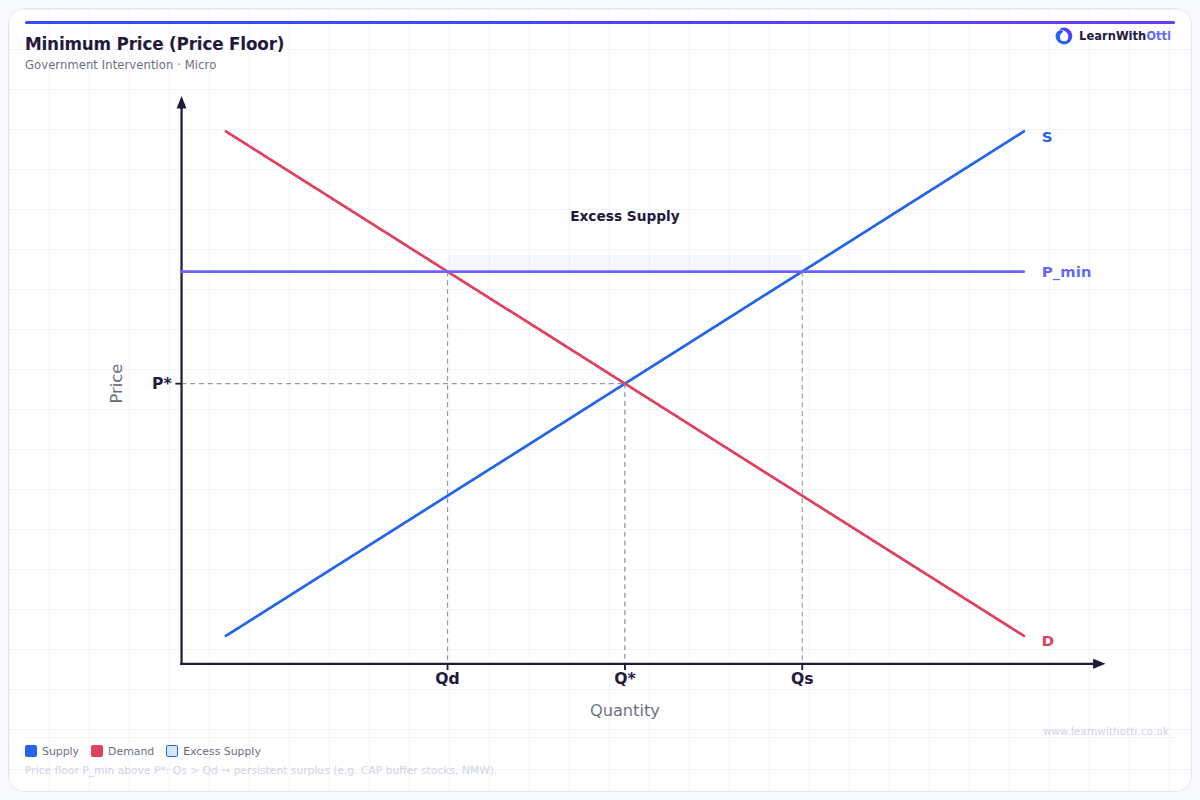
At the minimum price, quantity supplied rises and quantity demanded falls. Quantity supplied is greater than quantity demanded, so there is excess supply, also called a surplus.
Examples
- Minimum unit pricing for alcohol. Scotland introduced a minimum price of 50p per unit of alcohol in 2018 and raised it to 65p in 2024. Wales introduced minimum unit pricing in 2020. It raises the price of the cheapest, strongest drinks the most, which are bought disproportionately by heavy drinkers, and has little effect on most drinks sold in pubs and restaurants. An evaluation by Public Health Scotland estimated that it reduced deaths caused directly by alcohol by around 13%.
- Guaranteed minimum prices for farmers. The European Union used to guarantee minimum prices for products such as butter, grain and wine through its Common Agricultural Policy. The EU bought and stored the surpluses, creating the "butter mountains" and "wine lakes" of the 1980s.
- The National Minimum Wage is a minimum price in the labour market, covered in 3.5.3 Wage determination in competitive and non-competitive markets.
Evaluation of minimum prices
- It targets the problem precisely. Minimum unit pricing raises the price of cheap, strong alcohol without raising the price of most other drinks, so moderate drinkers are barely affected.
- Inelastic demand limits the effect. Heavy drinkers and smokers often have price inelastic demand, so a higher price reduces consumption by less than hoped and may mean they spend more of their income on the good.
- It is regressive. Low-income households spend a larger share of their income on the cheapest goods, so they are hit hardest.
- Surpluses are costly. When a minimum price is used to support the incomes of producers, the government may have to buy the surplus. Storing it costs money, and selling it cheaply abroad hurts producers in other countries.
- It can protect inefficient producers. A guaranteed price above equilibrium reduces the pressure on producers to cut costs, so resources stay in the industry when they might be better used elsewhere.
Key distinction: The extra revenue goes to sellers, not the government. Unlike a tax, a minimum price raises the money that retailers and producers receive. Their profits rise, and the government has no extra revenue to spend on the harm.
Tradable pollution permits
Tradable pollution permits are a market-based way of limiting pollution, often called cap and trade.
How the scheme works
- The government sets a cap on the total amount of pollution allowed in a year, such as tonnes of carbon dioxide.
- It creates permits up to that cap. Each permit allows the holder to emit one unit of pollution. Permits are given out free or sold at auction.
- Firms must hold a permit for every unit they emit, and are fined heavily if they emit more than their permits allow.
- Firms can buy and sell permits. Firms that can cut pollution cheaply cut more and sell their spare permits. Firms that find cutting pollution expensive buy permits instead.
- Over time the government reduces the cap, so the total amount of pollution falls.
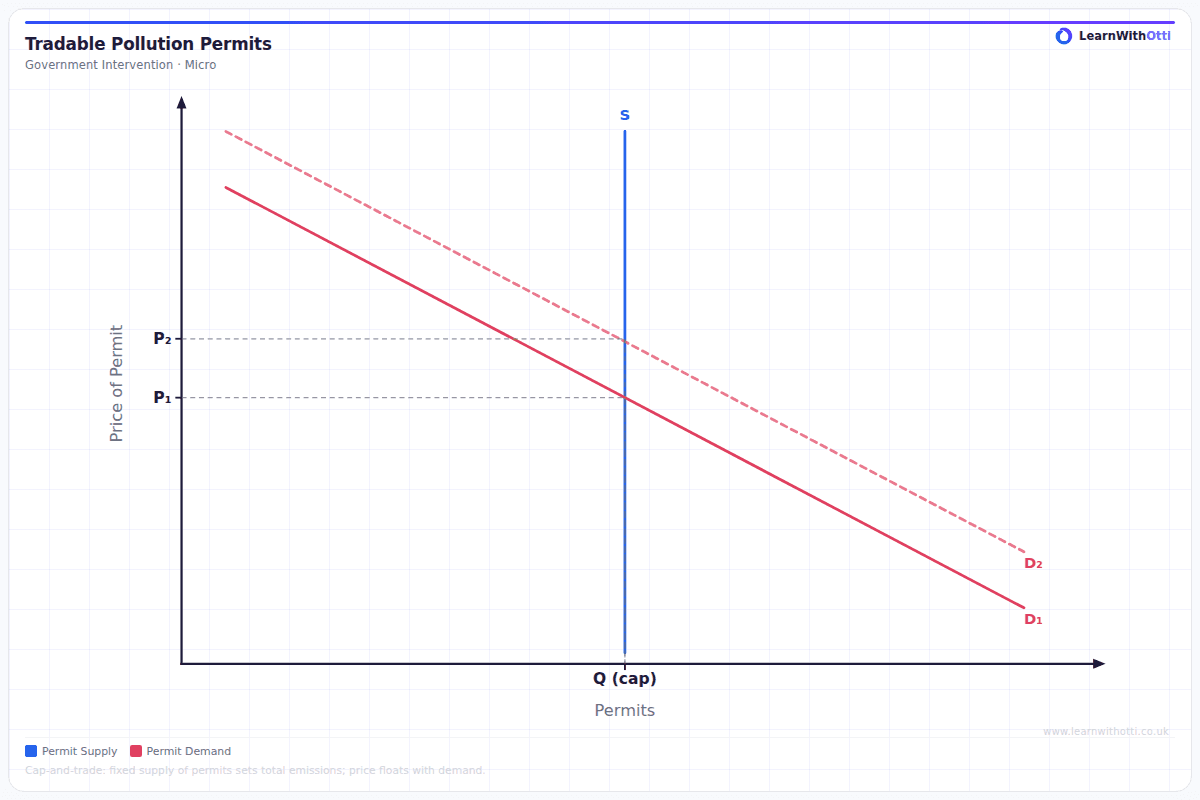
Key idea: The supply of permits is fixed by the cap, so the supply curve is vertical. The price of a permit is set by demand from firms. If demand rises, for example because the economy grows, the price of permits rises rather than the amount of pollution.
Why trading lowers the cost of cutting pollution
Suppose two firms each emit 100 tonnes and each is given 75 permits, so the cap is 150 tonnes and 50 tonnes must be cut. Firm A can cut pollution for £20 a tonne. Firm B would have to pay £80 a tonne.
- Without trading, each firm cuts 25 tonnes. The total cost is £500 for Firm A plus £2,000 for Firm B, which is £2,500.
- With trading at a permit price of £50, Firm A cuts 50 tonnes and sells its 25 spare permits to Firm B, which does not need to cut at all. The same 50 tonnes are cut, but the total cost is only £1,000.
Both firms gain. Firm A is paid £50 for each extra tonne it cuts, which costs it £20. Firm B pays £50 a tonne instead of £80. Pollution falls by the same amount at the lowest possible cost.
Tightening the cap
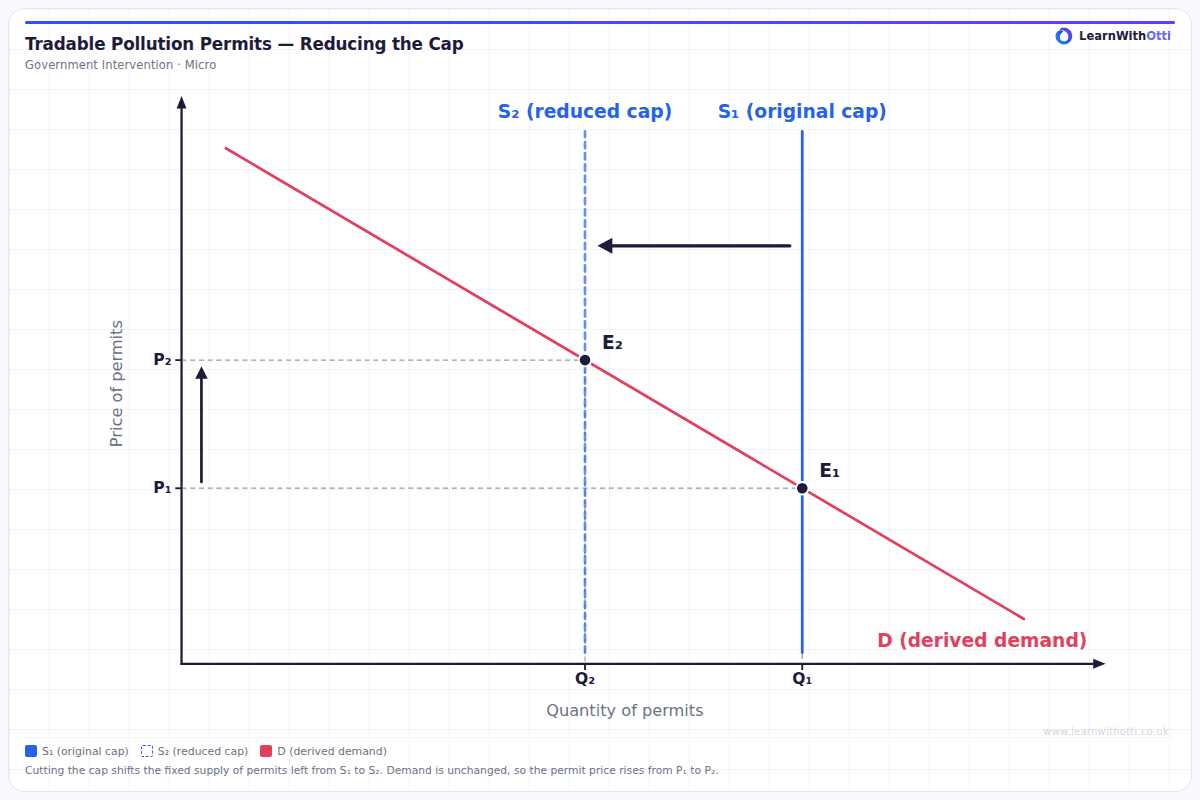
Reducing the cap shifts the vertical supply curve to the left. The price of permits rises, which strengthens the incentive for every firm to invest in cleaner technology.
UK example
The UK Emissions Trading Scheme began in 2021, replacing UK membership of the EU scheme after Brexit. It covers power generation, heavy industry and flights within the UK and to the European Economic Area, and the cap is reduced each year in line with the UK target of net zero emissions by 2050.
The EU scheme shows what can go wrong. In its first phase, from 2005 to 2007, too many permits were given out. With more permits than firms needed, the price fell to almost zero and firms had no reason to cut emissions.
Evaluation of tradable pollution permits
Strengths:
- Certainty about the amount of pollution. The cap fixes the total, which a tax cannot do.
- Pollution is cut where it is cheapest, so the target is met at the lowest cost to the economy.
- A lasting incentive to innovate. Every tonne a firm cuts frees up a permit it can sell.
- Revenue. If permits are auctioned, the government raises money that can be spent on cleaner energy.
- The cap can be tightened over time as cleaner technology becomes cheaper.
Weaknesses:
- Setting the cap is difficult. Too generous, and the permit price collapses, as in the first phase of the EU scheme. Too tight, and costs rise sharply for firms and their customers.
- Uncertainty about the price. Firms cannot be sure what permits will cost in future, which makes planning investment harder.
- Monitoring and enforcement are costly. Emissions from every firm must be measured, and fines must be large enough to deter cheating.
- Carbon leakage. Firms may move production to countries with weaker rules, so global pollution does not fall and UK jobs are lost.
- Only suited to some pollution. The scheme works for large firms whose emissions can be measured, such as power stations, but not for millions of households or small firms.
- Free permits can reward polluters. If permits are handed out free based on past emissions, the firms that polluted most receive the most valuable permits.
State provision of public goods
Public goods are non-rival (one person using the good does not reduce the amount available to others) and non-excludable (people who do not pay cannot be stopped from benefiting). Because people can benefit without paying, many will choose not to pay. This is the free rider problem. A private firm cannot make a profit, so the market provides too little of the good, or none at all. This is sometimes called a missing market.
How state provision works
The government decides how much of the good to provide and pays for it from taxation. Because everyone pays through taxes, the free rider problem is overcome.
- Direct provision. The government produces the good itself, as with national defence and the police.
- Paying private firms to supply it. The government can fund the good but contract a private firm to build or run it. Many flood defences and street lighting schemes are built by private contractors and paid for by local or central government.
Examples
- National defence. Everyone in the country is protected, whether they pay or not.
- Street lighting. Once a street is lit, everyone using it benefits.
- Flood defences. A flood barrier protects every property behind it. The Thames Barrier protects much of London from tidal flooding.
The government also provides some goods that are not pure public goods, such as education and health care, free at the point of use. These goods have large external benefits and would be under-consumed if left to the market.
Evaluation of state provision
Strengths:
- It overcomes the free rider problem, so goods that the market would not provide at all are provided.
- Equity. Everyone benefits regardless of income.
- Economies of scale. One national provider can be cheaper than many small ones, as with defence.
Weaknesses:
- How much to provide? With no market price, there is no signal of how much people value the good. The government has to estimate the benefits, for example through cost-benefit analysis, and may provide too much or too little.
- Opportunity cost. Taxes spent on public goods cannot be spent on other services, and higher taxes may reduce the incentive to work.
- Inefficiency. State providers do not face competition or the profit motive, so they may have less incentive to keep costs down.
- Political pressure. Decisions may reflect what wins votes in the short run rather than what is best in the long run. This can lead to 1.4.2 Government failure.
- Contracting out has risks. When private firms are paid to supply public goods, the contracts must be well designed and monitored, or costs can rise and quality can fall.
Provision of information
When market failure is caused by an information gap, the most direct response is to close the gap. If consumers know the true costs and benefits of a good, their demand should move closer to the demand they would have with full information, and the market should move closer to the social optimum.
How the government provides information
- Public information campaigns. The government pays for advertising to change behaviour, such as campaigns on the dangers of smoking or drink driving.
- Compulsory labelling. Firms must give buyers information. Cigarettes are sold in plain packaging with large health warnings. Large restaurants, cafes and takeaways in England must show calorie counts on their menus. New homes and many appliances carry an energy efficiency rating.
- Ratings and inspections. Food hygiene ratings for restaurants and Ofsted reports on schools give the public information they could not easily gather themselves.
- Rules on financial products. Lenders must show the annual percentage rate (APR) so that borrowers can compare the true cost of loans.
Evaluation of provision of information
Strengths:
- It tackles the cause of the failure, rather than its symptoms.
- Consumers stay free to choose. Unlike a ban, it does not stop anyone from buying the good.
- It can be cheap compared with taxes, subsidies or state provision, especially when firms are required to provide the information themselves.
- It can change behaviour over the long term, as attitudes to smoking and drink driving have shown.
Weaknesses:
- People may ignore it. Information has little effect on habits and addictions, and consumers do not always act rationally even when they have the facts. These ideas are covered in 1.2.10 Alternative views of consumer behaviour.
- Results are slow and uncertain. It can take years for attitudes to change, and it is hard to measure what a campaign achieved.
- Campaigns have an opportunity cost, and may not reach the people most at risk.
- Too much information can confuse. Complicated labels may be skipped or misread.
- It does not deal with externalities. Information helps consumers protect themselves, but it does not make them take account of the costs their choices impose on third parties.
Regulation
Regulation uses rules backed by law, rather than prices, to change what firms and consumers do. Breaking the rules leads to fines, loss of a licence or prosecution.
Types of regulation
- Bans. Some goods or activities are made illegal. Smoking in enclosed public places was banned in England in 2007, and the sale of single-use disposable vapes was banned in June 2025.
- Age limits. Alcohol, tobacco and vapes cannot legally be sold to under-18s.
- Limits and standards. Firms must keep pollution below set limits, new cars must meet emissions standards, and new buildings must meet energy efficiency standards.
- Licences. Only licensed firms may sell alcohol, run a taxi or provide financial advice.
- Industry regulators. Bodies such as Ofgem (energy), Ofwat (water) and the Financial Conduct Authority set and enforce rules for particular industries. Their role in controlling firms with market power is covered in 3.6.1 Government intervention.
How regulation corrects market failure
- With a negative externality, a limit or ban directly cuts the quantity produced or consumed, moving it towards the social optimum.
- With an information gap, rules protect consumers who cannot judge quality for themselves, for example by requiring that only qualified people can work as doctors, electricians or gas engineers.
- When the harm is very serious, such as toxic chemicals or dangerous drugs, the social optimum may be zero, and a ban is the most effective response.
Evaluation of regulation
Strengths:
- Certainty. A ban or a limit delivers a known outcome, which matters most when the harm is severe.
- Simple to understand. Everyone knows what is allowed and what is not.
- Fast to act. A rule can take effect quickly, without waiting for prices to change behaviour.
- Works when demand is inelastic. A tax may barely reduce consumption of an addictive good, but a ban or age limit applies whatever the price.
Weaknesses:
- Monitoring and enforcement are costly. Inspectors and courts cost money, and some rule-breaking will never be detected.
- Fines may be too small. If the fine is less than the profit from breaking the rule, firms may simply pay it.
- Illegal markets. Bans can push trade underground, where it is untaxed, unregulated and often more dangerous.
- One size fits all. The same rule applies to every firm, even though some could cut pollution far more cheaply than others, so the target is not met at the lowest cost.
- Compliance costs fall hardest on small firms and may be passed on to consumers as higher prices.
- Regulatory capture. A regulator may come to act in the interests of the firms it regulates rather than consumers.
Key distinction: No incentive to do better than the standard. Once a firm meets the limit, it gains nothing by cutting pollution further, unlike under a tax or a permit scheme.
Choosing between methods
| Method | Best suited to | Effect on the government budget | Main weakness |
|---|---|---|---|
| Indirect tax | Negative externalities | Raises revenue | Little effect if demand is price inelastic, and regressive |
| Subsidy | Positive externalities | Costs money | Opportunity cost, and may fund what would have happened anyway |
| Maximum price | Keeping essentials affordable | Little direct cost | Creates a shortage |
| Minimum price | Demerit goods, protecting producer incomes | Costly if the surplus must be bought | Creates a surplus, and extra revenue goes to sellers |
| Tradable permits | Pollution from large firms | Raises revenue if permits are auctioned | Hard to set the cap, and costly to monitor |
| State provision | Public goods | Costs money | No price signal for how much to provide |
| Provision of information | Information gaps | Usually low cost | People may ignore it |
| Regulation | Severe harms, information gaps | Enforcement costs | No incentive to beat the standard, and illegal markets |
Questions to ask about any intervention
- Does it match the cause of the failure? Information is the natural response to an information gap, but does nothing about an externality.
- Can the government measure the problem? Taxes and subsidies need a money value for external costs and benefits. Permits need the right cap. Getting these wrong can make things worse.
- How elastic is demand? Price-based methods work best when demand is price elastic. With inelastic demand, regulation may achieve more.
- What does it cost? Count the cost of administration and enforcement, and the opportunity cost of any spending.
- Who gains and who loses? Consider the effect on low-income households, on jobs in the industry, and on firms competing with foreign firms.
- What happens in the long run? Consumers and firms adjust over time. Demand usually becomes more elastic, and firms find ways around rules.
- Could a combination work better? Governments rarely rely on one method. Smoking in the UK is tackled with high taxes, a ban in enclosed public places, age limits, plain packaging and health campaigns together.
If intervention makes the allocation of resources worse rather than better, the result is government failure.
Key terms
| Term | Meaning |
|---|---|
| Social optimum | The output where marginal social cost equals marginal social benefit |
| Indirect tax | A tax on spending, paid by producers to the government, which raises the cost of production |
| Specific tax | An indirect tax charged as a fixed amount per unit |
| Ad valorem tax | An indirect tax charged as a percentage of the price |
| Internalising an externality | Making the producer or consumer pay for, or receive, the external cost or benefit they create |
| Polluter pays principle | The idea that those who cause pollution should pay for the damage it does |
| Subsidy | A payment from the government that lowers the cost of production |
| Maximum price | A legal upper limit on price, set below equilibrium, which causes excess demand |
| Minimum price | A legal lower limit on price, set above equilibrium, which causes excess supply |
| Tradable pollution permits | Permits to emit pollution up to a fixed cap, which firms can buy and sell |
| Carbon leakage | Firms moving production to countries with weaker environmental rules |
| Free rider problem | People benefiting from a good without paying for it, so the market does not provide it |
| State provision | The government supplying a good directly, or paying firms to supply it, funded by taxation |
| Regulation | Rules backed by law that restrict or require certain behaviour |
| Regulatory capture | When a regulator acts in the interests of the firms it regulates rather than consumers |
Common mistakes
- Drawing a maximum price above equilibrium, or a minimum price below it. Neither would have any effect. A maximum price must be below equilibrium and a minimum price above it.
- Shifting the demand curve for an indirect tax. The tax is paid by producers, so it is the supply curve that shifts.
- Drawing an ad valorem tax as a parallel shift. A percentage tax adds more at higher prices, so the gap between the supply curves widens.
- Assuming a tax always solves the problem. Its effect depends on price elasticity of demand and on measuring the external cost correctly.
- Confusing a minimum price with a tax. Both raise the price, but a tax raises revenue for the government, while a minimum price gives the extra revenue to sellers.
- Listing methods without linking them to a failure. Each method should be matched to the market failure it corrects, and explained using a diagram where one applies.
- Giving only advantages. Every method has costs, including administration, enforcement and opportunity cost, and good analysis weighs them against the benefits.
- Forgetting that intervention can fail. Poorly designed intervention can make the allocation of resources worse.
How this has been examined
In the Edexcel papers indexed on this site, this topic has appeared in seven formats:
- 25-mark "Evaluate" essay — asked twice across 2 series (2017 to 2023)
- 25-mark "Evaluate" synoptic essay — asked once (2019)
- 15-mark "Discuss" data response — asked once (2024)
- 12-mark "Discuss" data response — asked once (2020)
- 8-mark "Examine" data response — asked once (2018)
- 4-mark "Explain" data response — asked twice across 2 series (2020 to 2024)
- 1-mark multiple choice — asked once (2022)
It has appeared at every tariff from 1 to 25 marks.
Where this goes next
The market failures this intervention responds to are covered in 1.3.2 Externalities, 1.3.3 Public goods and 1.3.4 Information gaps. The incidence of taxes and subsidies is worked through in 1.2.9 Indirect taxes and subsidies. When intervention makes things worse, the result is 1.4.2 Government failure, intervention in labour markets is covered in 3.5.3 Wage determination in competitive and non-competitive markets, and intervention to control firms with market power is covered in 3.6.1 Government intervention.
Otti is an AI tutor built for A-Level students. Ask it anything, practise exam questions, and get instant feedback written like an examiner would give it — not just right or wrong, but why.
Get one answer marked free