Edexcel A-Level Economics · Revision notes
4.3.3 Strategies influencing growth and development
If development is held back by many factors, it follows that there are many possible strategies to promote it. They fall broadly into two camps: those that rely on free markets and those that rely on government action. Most countries use a mix. This topic covers the main strategies, their strengths and weaknesses, and the role of international organisations.
Market-orientated strategies
These strategies aim to let markets work more freely, on the view that competition, trade and private enterprise drive growth.
Trade liberalisation. Reducing tariffs, quotas and other barriers to trade allows a country to specialise according to comparative advantage, gain access to larger markets and import cheaper goods and technology. Competition from imports also puts pressure on domestic firms to become more efficient. India cut many of its tariffs as part of reforms from 1991, and its growth rate rose in the following decades.
- Limitation: domestic industries may be wiped out before they can compete, causing structural unemployment.
- Limitation: countries may become locked into exporting primary products, where their comparative advantage currently lies, rather than developing higher-value industries.
- Limitation: lower tariffs reduce government revenue, which matters more in developing countries, where tariffs are often a large share of tax income.
Promotion of foreign direct investment (FDI). Encouraging multinational firms to build factories and operations brings capital, jobs, technology and management skills. It also helps to fill the savings gap and the foreign currency gap without the country taking on debt. China attracted large amounts of FDI from the 1980s through special economic zones such as Shenzhen.
- Limitation: profits may be sent back to the firm's home country, so less of the income stays in the economy.
- Limitation: multinationals may exploit low wages and weak environmental rules, and governments may compete to attract them by offering tax breaks.
- Limitation: many jobs are low-skilled, and if key decisions are made abroad, there may be little transfer of technology to local firms.
Removal of government subsidies. Cutting subsidies, for example on fuel or food, frees government money for investment and removes price distortions. Fuel subsidies in particular are costly and benefit richer households, who use more fuel, more than the poor.
- Limitation: it can hit the poorest hardest, because a sudden rise in the price of food or fuel takes a large share of low incomes.
- Limitation: it can cause political unrest. When Nigeria removed its fuel subsidy in 2023, petrol prices rose sharply and there were widespread protests.
Floating exchange rate systems. Allowing the currency to float lets the exchange rate adjust to correct trade imbalances and removes the need to hold large foreign currency reserves. A depreciation can make exports more competitive without the government having to intervene.
- Limitation: volatile exchange rates create uncertainty for traders and investors.
- Limitation: a sharp depreciation raises the cost of imported fuel, food and machinery, and increases the burden of debts owed in foreign currency.
Microfinance schemes. Small loans to people, often women, who cannot borrow from banks, so they can start or expand small businesses. The Grameen Bank in Bangladesh is a well-known example, and its founder, Muhammad Yunus, was awarded the Nobel Peace Prize in 2006. Loans are often made to groups, whose members support each other, which helps to keep repayment rates high.
- Limitation: loans are small, so they rarely fund businesses large enough to employ others.
- Limitation: interest rates can be high, and some borrowers fall into debt by taking out new loans to repay old ones. Over-lending led to a crisis in Andhra Pradesh, India, in 2010.
Privatisation. Transferring state-owned firms to the private sector aims to improve efficiency through the profit motive and competition. It also raises one-off revenue for the government and can attract foreign investment and expertise.
- Limitation: a privatised monopoly may raise prices, and the gains may go to a small wealthy group or foreign owners.
- Limitation: essential services may become unaffordable for the poor. The privatisation of water in Cochabamba, Bolivia, in 2000 led to sharp price rises and protests, and it was reversed.
Interventionist strategies
These strategies rely on government action to correct market failures that hold back development.
Development of human capital. Spending on education, training and health care raises productivity and allows people to take up better jobs. Education and health are merit goods that the market under-provides, especially where families cannot afford fees. Heavy investment in education helped South Korea move from a poor agricultural economy to an advanced industrial one.
- Limitation: it is expensive and takes many years to pay off.
- Limitation: educated workers may emigrate to richer countries for higher pay (the brain drain).
- Limitation: it only raises growth if there are jobs that use the skills, otherwise graduates may end up unemployed or in low-skilled work.
Protectionism. Tariffs and quotas shield new domestic industries from foreign competition until they can compete, the infant industry argument. Protected firms have time to grow and gain economies of scale, and imports of consumer goods fall, which helps the current account. South Korea and Taiwan protected some industries in the early stages of their development.
- Limitation: protected firms may never become efficient, because they face no pressure to cut costs. Import substitution policies in much of Latin America from the 1950s to the 1970s produced many high-cost industries that could not compete.
- Limitation: consumers pay higher prices, and other countries may retaliate.
Managed exchange rates. The central bank influences the exchange rate, for example keeping it low to make exports competitive. China managed the value of its currency for many years to support its export-led growth.
- Limitation: it requires large reserves of foreign currency, which many developing countries do not have.
- Limitation: an undervalued currency raises the cost of imports, and it can provoke accusations of unfair trade from trading partners.
Infrastructure development. Building roads, ports, power and communications lowers costs for firms and connects people to markets. It raises the productivity of private investment, and it is needed for other strategies, such as attracting FDI, to work.
- Limitation: it is costly and may be funded by debt. Sri Lanka could not repay the loans for its Hambantota port and leased it to a Chinese company for 99 years in 2017.
- Limitation: large projects are vulnerable to corruption, and they may not be maintained once built.
Promoting joint ventures with global companies. Partnerships between domestic firms and multinationals help transfer technology and skills while keeping some ownership and profit at home. For many years China required foreign carmakers to form joint ventures with Chinese firms, such as Volkswagen with SAIC, and Chinese firms learned from their partners.
- Limitation: the multinational partner may hold most of the bargaining power.
- Limitation: the multinational may limit the technology it shares, to protect its competitive advantage.
Buffer stock schemes. An agency buys a commodity when its price is low and sells it when the price is high, to keep the price within a target range and stabilise producers' incomes. Stable prices make it easier for farmers and governments to plan investment.
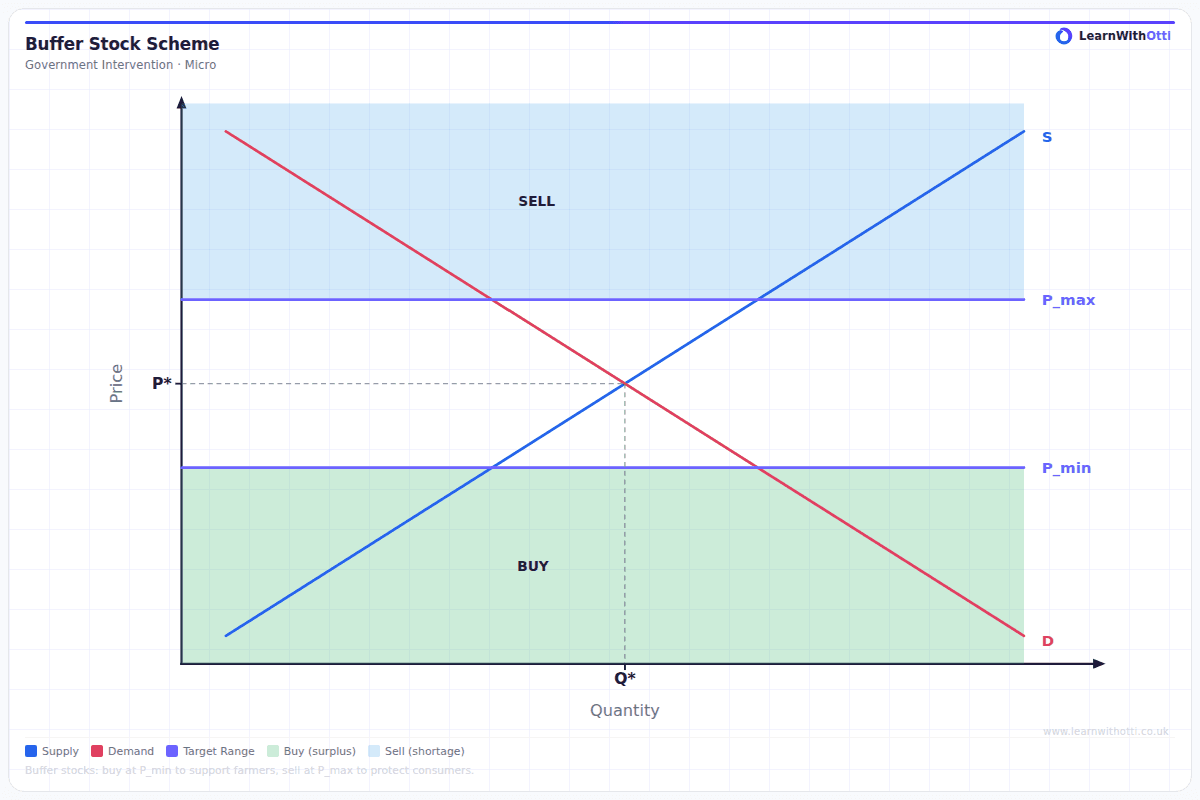
- Limitation: schemes are costly to run, because the agency has to buy, store and insure the commodity.
- Limitation: if the target price is set too high, the agency keeps buying and builds up large stocks until it runs out of money. The International Tin Agreement collapsed in 1985 for this reason.
- Limitation: perishable goods cannot be stored for long, so the scheme works only for durable commodities.
Other strategies
Industrialisation: the Lewis model. The Lewis model describes a dual economy with a large, low-productivity agricultural sector and a small industrial sector.
Key idea: Surplus workers in agriculture, whose contribution to output is close to zero, can move into industry without reducing farm output.
Firms in industry pay a wage slightly above subsistence, make profits and reinvest them, so the industrial sector grows and absorbs more workers. The movement of hundreds of millions of rural workers into factories in Chinese cities is often seen as an example.
- Limitation: industrial profits may not be reinvested, but sent abroad or spent on luxuries.
- Limitation: urban unemployment can rise as people move to cities faster than jobs appear, leading to slums.
- Limitation: the assumption of surplus labour may not hold, and modern industry may use capital rather than labour, creating fewer jobs.
Development of tourism. Tourism earns foreign currency, creates jobs and encourages infrastructure. It suits countries with natural attractions, such as the Maldives or Kenya, and it can grow without heavy capital investment.
- Limitation: much of the spending may go to foreign-owned hotels and airlines, known as leakage.
- Limitation: jobs can be seasonal and low-paid, and tourism can damage the environment.
- Limitation: demand is income elastic and sensitive to shocks, as the collapse in travel during the Covid-19 pandemic showed.
Development of primary industries. Some countries grow by developing agriculture, mining or energy where they have a comparative advantage. Botswana used its diamond revenues, managed with strong institutions, to fund education and infrastructure.
- Limitation: this increases primary product dependency and exposure to volatile prices.
- Limitation: resource wealth can encourage corruption and conflict, and a booming export sector can push up the exchange rate and harm other exporters. This is sometimes called the resource curse.
Fairtrade schemes. Consumers pay a premium for products that guarantee producers a minimum price and fund community projects. Producers get a more stable income and are often helped to work together in cooperatives.
- Limitation: only a small share of producers benefit, because only part of their output is sold on Fairtrade terms.
- Limitation: the guaranteed price may discourage moving into other activities, and certification costs can be high for small farmers.
Aid. Transfers from richer countries, as grants, loans or technical help, can fund health, education and infrastructure. Aid can fill the savings and foreign currency gaps, and emergency aid saves lives after disasters.
- Limitation: aid may be tied to buying from the donor country, which raises costs.
- Limitation: it can be lost to corruption, and it may create dependency, reducing the pressure on governments to raise their own tax revenue.
- Limitation: aid budgets can be cut when donor countries face their own pressures. The UK cut its aid target from 0.7% to 0.5% of national income in 2021.
Debt relief. Cancelling or reducing a country's debts frees money for spending on development rather than interest payments. The Heavily Indebted Poor Countries (HIPC) initiative cancelled debts for many low-income countries, mostly in Africa.
- Limitation: it may encourage further borrowing, a form of moral hazard.
- Limitation: the freed money is not always spent on development, and conditions attached to relief can force cuts in public spending.
International institutions and NGOs
The World Bank provides long-term loans, grants and expertise for development projects, such as infrastructure, education and health, mainly to low and middle-income countries.
The International Monetary Fund (IMF) provides short-term loans to countries facing balance of payments problems and gives economic advice. Its loans have often come with conditions, such as cutting government spending or liberalising markets, which have been criticised for hurting the poor.
Non-government organisations (NGOs) are charities and voluntary organisations, such as Oxfam and Save the Children. They work directly with communities on small-scale projects, provide emergency relief and campaign on issues such as debt and fair trade. They often reach people that governments do not, but their resources are limited.
Key terms
| Term | Meaning |
|---|---|
| Market-orientated strategy | A development strategy that relies on free markets, trade and private enterprise |
| Interventionist strategy | A development strategy that relies on government action |
| Microfinance | Small loans to people without access to banks |
| Infant industry | A new industry that may need protection until it can compete |
| Lewis model | A model of development in which surplus labour moves from agriculture to industry |
| Buffer stock scheme | Buying and selling a commodity to keep its price within a target range |
| Tied aid | Aid given on condition that it is spent on goods from the donor country |
| NGO | A non-government organisation, such as a charity, working on development |
Common mistakes
- Describing strategies without evaluating them. Every strategy has limitations, and its success depends on the country.
- Treating market and interventionist strategies as opposites. Most successful countries have combined them.
- Confusing the World Bank with the IMF. The World Bank funds long-term development; the IMF deals mainly with short-term balance of payments problems.
- Assuming aid always helps. Its effect depends on how it is given and used.
How this has been examined
In the Edexcel papers indexed on this site, this topic has appeared in eight formats:
- 25-mark "Evaluate" synoptic essay — asked 3 times across 3 series (2017 to 2022)
- 15-mark "Discuss" data response — asked 3 times across 3 series (2018 to 2023)
- 12-mark "Discuss" data response — asked 4 times across 4 series (2018 to 2025)
- 10-mark "Assess" data response — asked twice across 2 series (2021 to 2023)
- 8-mark "Examine" data response — asked once (2020)
- 5-mark calculation — asked once (2021)
- 5-mark "Explain" data response — asked twice across 2 series (2020 to 2022)
- 4-mark "Explain" data response — asked once (2020)
Where this goes next
The barriers these strategies aim to overcome are covered in 4.3.2 Factors influencing growth and development, and the measures used to judge success in 4.3.1 Measures of development. Trade liberalisation and protectionism draw on 4.1.2 Specialisation and trade and 4.1.6 Restrictions on free trade, and exchange rate systems on 4.1.8 Exchange rates.
End of topic 4.3
Quiz yourself on 4.3 Emerging and developing economies
10 multiple-choice questions drawn from the 35 we have on the whole of topic 4.3, with instant feedback on every answer.
Start the 4.3 quiz →Otti is an AI tutor built for A-Level students. Ask it anything, practise exam questions, and get instant feedback written like an examiner would give it — not just right or wrong, but why.
Get one answer marked free