Edexcel A-Level Economics · Revision notes
2.2.4 Government expenditure (G)
Government expenditure is spending by central and local government on goods and services, such as paying nurses and teachers, buying medicines and building roads. It makes up around 21% of UK GDP. Unlike consumption and investment, it is decided by government rather than by millions of private decisions, which makes it a tool of policy as well as a component of demand.
What counts as G in aggregate demand
The G in AD = C + I + G + (X − M) includes only spending that directly buys goods and services:
- Current spending: day-to-day spending on public services, such as salaries of public sector workers and the running costs of hospitals and schools.
- Capital spending: spending on long-lasting assets, such as roads, railways, school buildings and hospitals.
Key distinction: It does not include transfer payments, such as state pensions, Universal Credit and Child Benefit. These move money from taxpayers to recipients without buying any output in return. They affect AD indirectly, by raising the disposable income of the people who receive them, which then shows up in consumption.
This distinction matters because total government spending, including transfers, is far larger than the G component of AD.
Influence 1: the trade cycle
Government spending changes automatically as the economy moves through the trade cycle, without any new decision by government.
In a downturn:
- unemployment rises, so spending on unemployment-related benefits rises;
- incomes fall, so more households qualify for means-tested support;
- tax revenue falls at the same time, because incomes and spending are lower.
In a boom:
- unemployment falls, so benefit spending falls;
- tax revenue rises as incomes and spending grow.
These changes are called automatic stabilisers. They support demand in a downturn and restrain it in a boom, which helps smooth the trade cycle.
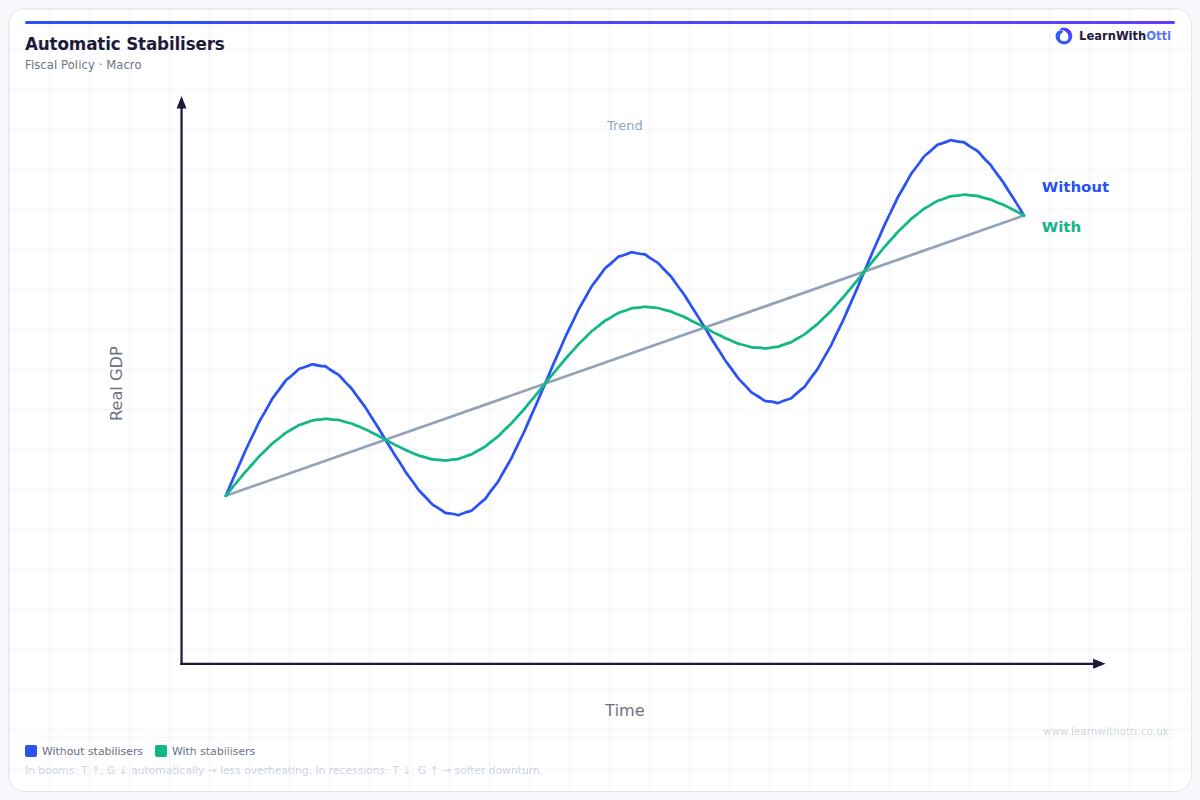
Strictly, most of the extra spending in a downturn is on transfer payments rather than on G itself. Its effect on aggregate demand comes through consumption: households that receive benefits keep spending, so AD falls by less than it otherwise would.
Influence 2: fiscal policy
Key distinction: Fiscal policy is the use of government spending and taxation to influence the economy. Unlike automatic stabilisers, it involves a deliberate decision, usually announced in the Budget.
- Expansionary fiscal policy increases government spending (or cuts taxes) to raise aggregate demand, typically in a recession. Spending on infrastructure projects is a common example.
- Contractionary fiscal policy cuts government spending (or raises taxes) to reduce aggregate demand or reduce government borrowing.
Government decisions about Government Expenditure are also shaped by:
- Political priorities, such as commitments to spend more on health, defence or the green transition.
- Demographic pressures. An ageing population raises spending on health care and social care.
- The state of the public finances. High government debt and borrowing costs can force spending restraint, as in the UK's austerity period after 2010.
- Unexpected events, such as the pandemic in 2020, when government spending rose sharply to support the economy.
Why government spending matters for AD
A change in G shifts aggregate demand directly. Because one person's spending is another person's income, an initial increase in government spending can lead to a larger final increase in national income. This is the multiplier effect, covered later in this theme.
Government spending can also affect the supply side. Capital spending on infrastructure, education and health can raise productivity and the economy's productive capacity in the long run.
Key terms
| Term | Meaning |
|---|---|
| Government expenditure (G) | Spending by government on goods and services, counted in AD |
| Current spending | Day-to-day spending on running public services |
| Capital spending | Spending on long-lasting public assets, such as roads and hospitals |
| Transfer payment | A payment for which no good or service is provided in return, such as a pension or benefit |
| Automatic stabilisers | Changes in spending and tax revenue that happen automatically over the trade cycle |
| Fiscal policy | Deliberate changes in government spending and taxation to influence the economy |
Common mistakes
- Including transfer payments in G. Benefits and pensions are not part of G; they affect AD through consumption.
- Confusing automatic stabilisers with fiscal policy. Stabilisers happen without a new decision; fiscal policy is a deliberate choice.
- Assuming more government spending always raises AD by the same amount. The effect depends on the size of the multiplier and on any offsetting effects on private spending.
- Ignoring the supply side. Capital spending can raise productive capacity as well as demand.
How this has been examined
This topic has not appeared as a standalone question in the Edexcel papers indexed on this site.
Government spending is examined mainly through fiscal policy and the public finances, which build directly on what this topic sets up.
Where this goes next
Government spending is one of the four components in 2.2.1 The characteristics of AD, and an injection in 2.4.2 Injections and withdrawals. Its effect on national income is magnified by 2.4.4 The multiplier. Fiscal policy as a tool is covered in 2.6.2 Demand-side policies, and the wider picture of government spending in 4.5.1 Public expenditure and 4.5.3 Public sector finances.
Otti is an AI tutor built for A-Level students. Ask it anything, practise exam questions, and get instant feedback written like an examiner would give it — not just right or wrong, but why.
Get one answer marked free