Edexcel A-Level Economics · Revision notes
2.3.3 Long-run AS
Long-run aggregate supply (LRAS) shows the economy's productive capacity: the most it can produce when all its factors of production are fully and efficiently employed. Economists disagree about its shape, and that disagreement shapes their views on policy. This topic covers the two views and the factors that shift LRAS.
The classical LRAS curve
Classical (free market) economists draw LRAS as a vertical line at the full-capacity level of output.
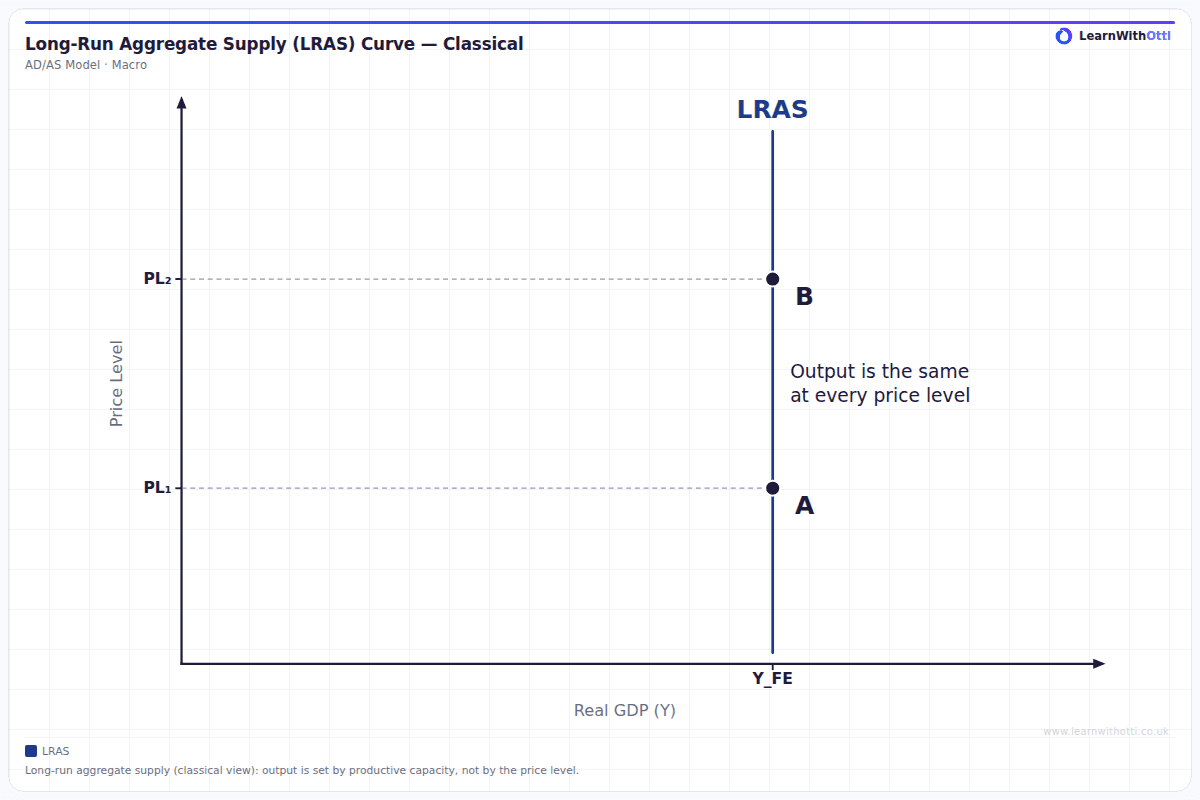
The reasoning is that, in the long run, wages and prices are fully flexible. If output is below capacity, unemployment pushes wages down, costs fall, and the economy returns to full capacity. If output is above capacity, wages are bid up until output falls back.
Key idea: The implication is that, in the long run, real output is determined by the economy's productive capacity alone. A change in aggregate demand affects only the price level.
To raise output permanently, the economy needs more or better factors of production.
The Keynesian LRAS curve
Keynesian economists draw LRAS with three sections.
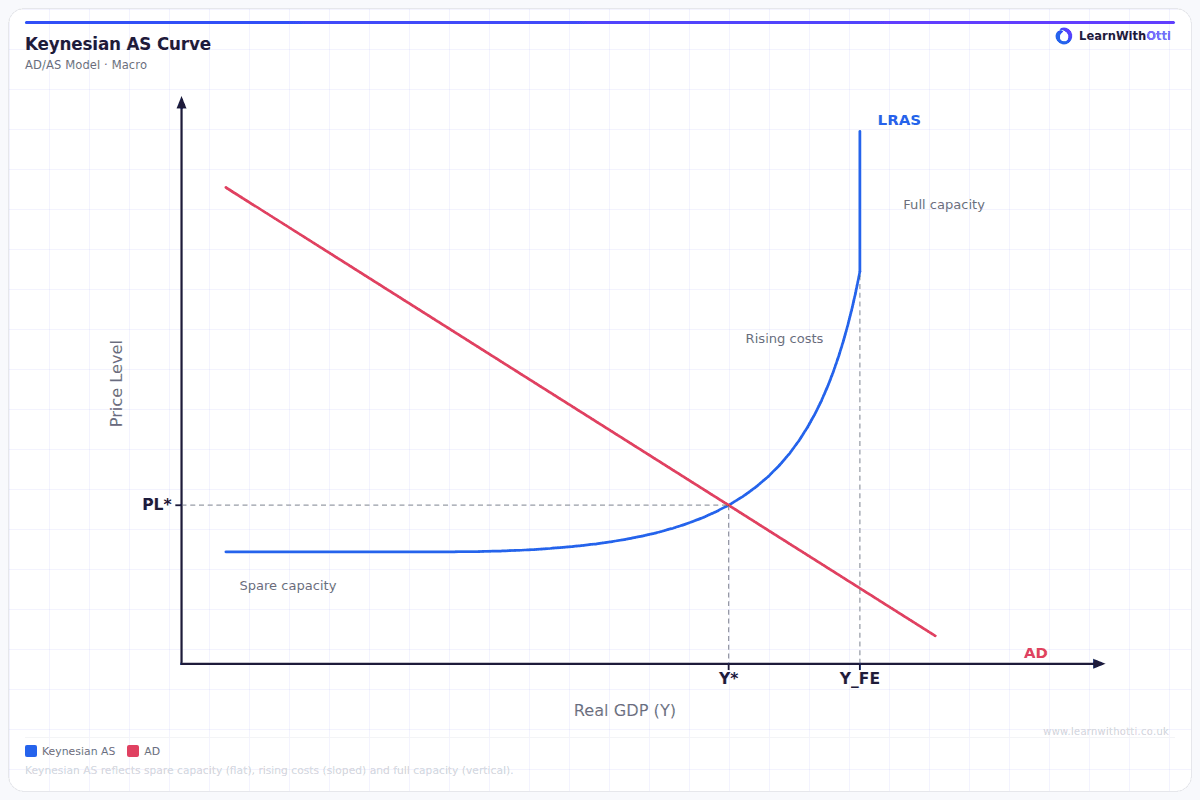
- A horizontal section at low output. There is a large amount of spare capacity, with unemployed workers and idle machinery, so output can rise without any upward pressure on prices.
- An upward-sloping section. As output rises, some resources become scarce. Bottlenecks appear in particular industries and skills, so further increases in output push up costs and prices.
- A vertical section at full capacity. The economy cannot produce any more, so any further rise in demand only raises the price level.
Keynesians argue that wages do not fall easily, so an economy can remain below full capacity for a long time. On this view, a rise in aggregate demand in a recession can increase output and employment with little inflation.
Factors influencing LRAS
Key idea: LRAS shifts when the quantity or quality of the factors of production changes. A rightward shift means the economy's productive capacity has grown.
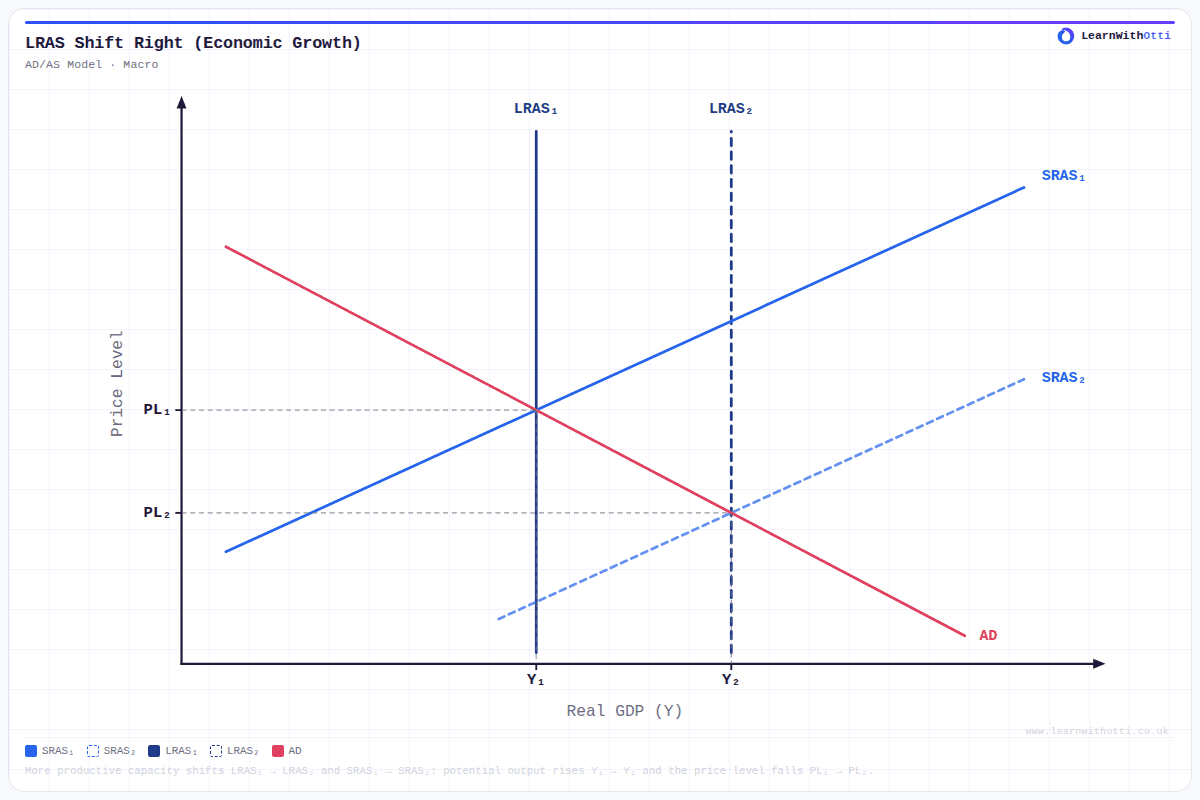
Technological advances. New technology allows more output from the same inputs. Advances in computing, automation and artificial intelligence raise the potential output of the economy.
Changes in relative productivity. Productivity is output per worker or per hour. If workers become more productive, through better management, more capital per worker or better organisation, the economy can produce more and LRAS shifts right.
Changes in education and skills. A more highly educated and skilled workforce, the economy's human capital, is more productive and more adaptable.
Evaluation: Investment in schools, universities, apprenticeships and training shifts LRAS to the right, though the effect takes years to appear.
Changes in government regulations. Excessive or poorly designed regulation raises costs and discourages enterprise. Reducing unnecessary regulation can increase productive capacity. However, some regulation protects workers, consumers and the environment, so removing it has costs too.
Demographic changes and migration. The size and age structure of the population determine the size of the labour force. Net inward migration of working-age people increases the labour force and shifts LRAS right. An ageing population, with more people retiring, can reduce it.
Competition policy. Strong competition encourages firms to cut costs and innovate. Policies that open up markets and prevent anti-competitive behaviour raise efficiency across the economy and shift LRAS right.
Why LRAS matters
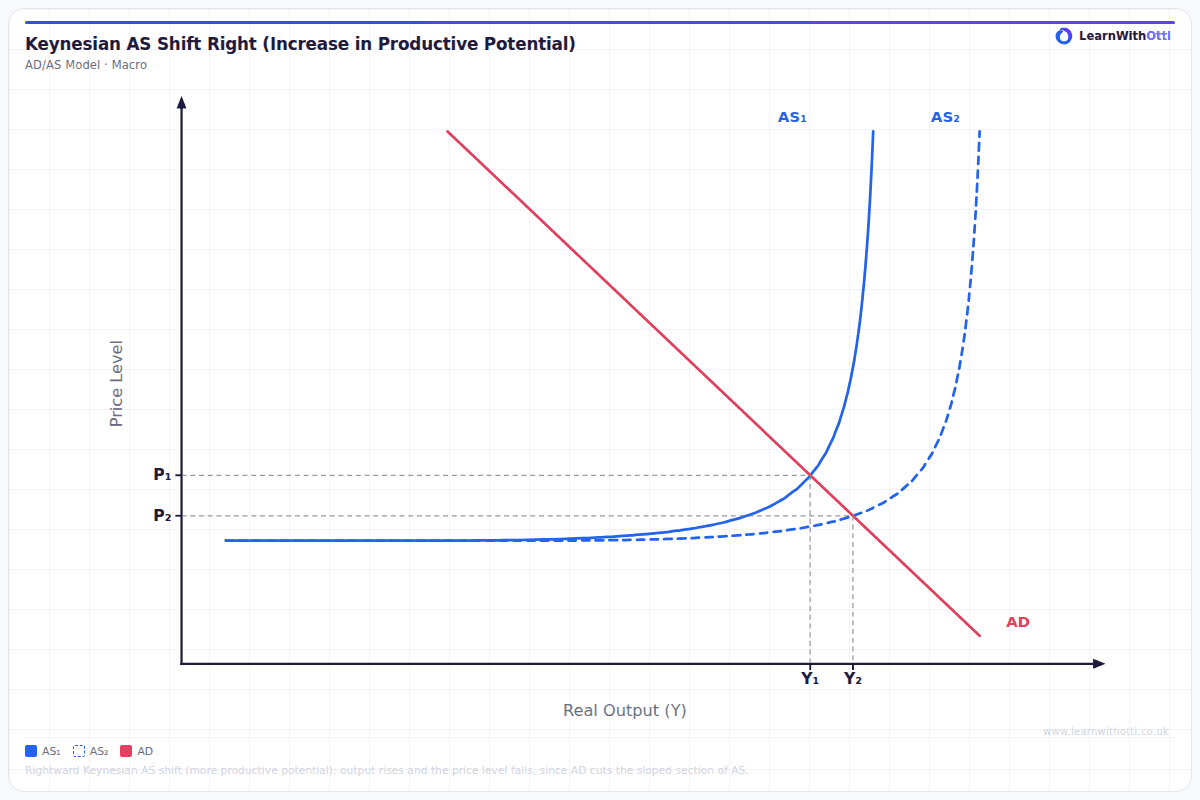
An increase in LRAS is the source of long-run economic growth. It allows the economy to produce more without generating inflation, and it raises potential living standards. Policies designed to increase LRAS are known as supply-side policies.
Key terms
| Term | Meaning |
|---|---|
| Long-run aggregate supply | The economy's productive capacity when all factors are fully employed |
| Productive capacity | The maximum output an economy can sustain with its resources |
| Spare capacity | Unused resources that could be brought into production |
| Bottleneck | A shortage of particular resources that pushes up costs as output rises |
| Productivity | Output per worker or per hour worked |
| Human capital | The skills, knowledge and experience of the workforce |
Common mistakes
- Drawing only one shape of LRAS. Both the classical and Keynesian views matter, and the difference drives their policy conclusions.
- Shifting LRAS for a short-run cost change. A rise in oil prices shifts SRAS; only changes in productive capacity shift LRAS.
- Ignoring time lags. Education, infrastructure and technology take years to raise productive capacity.
- Treating deregulation as always positive. Some regulations protect workers and the environment.
How this has been examined
In the Edexcel papers indexed on this site, this topic has appeared in five formats:
- 25-mark "Evaluate" synoptic essay — asked once (2020)
- 8-mark "Examine" data response — asked once (2020)
- 4-mark "Explain" data response — asked once (2021)
- 2-mark "Explain" short answer — asked once (2021)
- 1-mark multiple choice — asked once (2021)
It has appeared at every tariff from 1 to 25 marks.
Where this goes next
The relationship between SRAS and LRAS is introduced in 2.3.1 The characteristics of AS. LRAS shifts drive long-run growth in 2.5.1 Causes of growth, and the gap between actual and potential output is covered in 2.5.2 Output gaps. Policies aimed at increasing LRAS are examined in 2.6.3 Supply-side policies.
End of topic 2.3
Quiz yourself on 2.3 Aggregate supply (AS)
10 multiple-choice questions drawn from the 42 we have on the whole of topic 2.3, with instant feedback on every answer.
Start the 2.3 quiz →Otti is an AI tutor built for A-Level students. Ask it anything, practise exam questions, and get instant feedback written like an examiner would give it — not just right or wrong, but why.
Get one answer marked free