Edexcel A-Level Economics · Revision notes
3.2.1 Business Objectives
Traditional theory assumes firms aim to maximise profit. In practice, firms may pursue other objectives, and each objective implies a different level of output and price. This topic covers four objectives, the reasons for them, and how to identify each one using revenue and cost curves.
Profit maximisation
Condition: MC = MR
Profit is maximised where marginal cost equals marginal revenue, with MC cutting MR from below.
- If MR is greater than MC, producing one more unit adds more to revenue than to cost, so profit rises by expanding output.
- If MC is greater than MR, the last unit added more to cost than to revenue, so profit rises by cutting output.
- Only where MC = MR is there no further gain from changing output.
Reasons for pursuing it
- Shareholders, as owners, want the highest possible return.
- Profit provides funds for investment and expansion.
- In competitive markets, firms that do not maximise profit may not survive.
Revenue maximisation
Condition: MR = 0
Total revenue is maximised where marginal revenue is zero. Selling one more unit would reduce total revenue. On a straight-line demand curve, this is at the midpoint, where price elasticity of demand is unitary.
Revenue maximisation means producing more output at a lower price than profit maximisation.
Reasons for pursuing it
- Managers' pay, bonuses and status may be linked to sales revenue rather than profit.
- A larger revenue may increase market share and the firm's standing.
Key idea: The principal–agent problem: shareholders (principals) own the firm, but managers (agents) run it. When ownership and control are separated, managers may pursue objectives that benefit themselves.
Sales maximisation
Condition: AC = AR
Sales maximisation means selling the largest possible volume of output without making a loss. The firm expands output until average revenue equals average cost, where it makes only normal profit.
This is a higher output and lower price than either profit or revenue maximisation.
Reasons for pursuing it
- To gain market share and economies of scale.
- To deter entry by keeping prices low, so potential entrants see little profit to be made.
- To drive rivals out of the market.
Satisficing
Satisficing means aiming for a satisfactory level of profit rather than the maximum, while meeting the objectives of other stakeholders.
There is no single condition for satisficing, because it means accepting outcomes below the maximum. A satisficing firm will usually produce somewhere between the profit-maximising output and the output where it would just make normal profit.
Reasons for pursuing it
- Firms have many stakeholders — workers, managers, customers, suppliers and the local community — whose interests conflict. Satisficing keeps each group reasonably content.
- Managers may prefer a quieter life, with a satisfactory profit and less risk.
- Maximising profit may require information about MC and MR that firms do not have.
Illustrating the objectives on one diagram
The three objectives can be shown on a diagram with a downward-sloping AR (demand) curve, its MR curve, and U-shaped MC and AC curves.
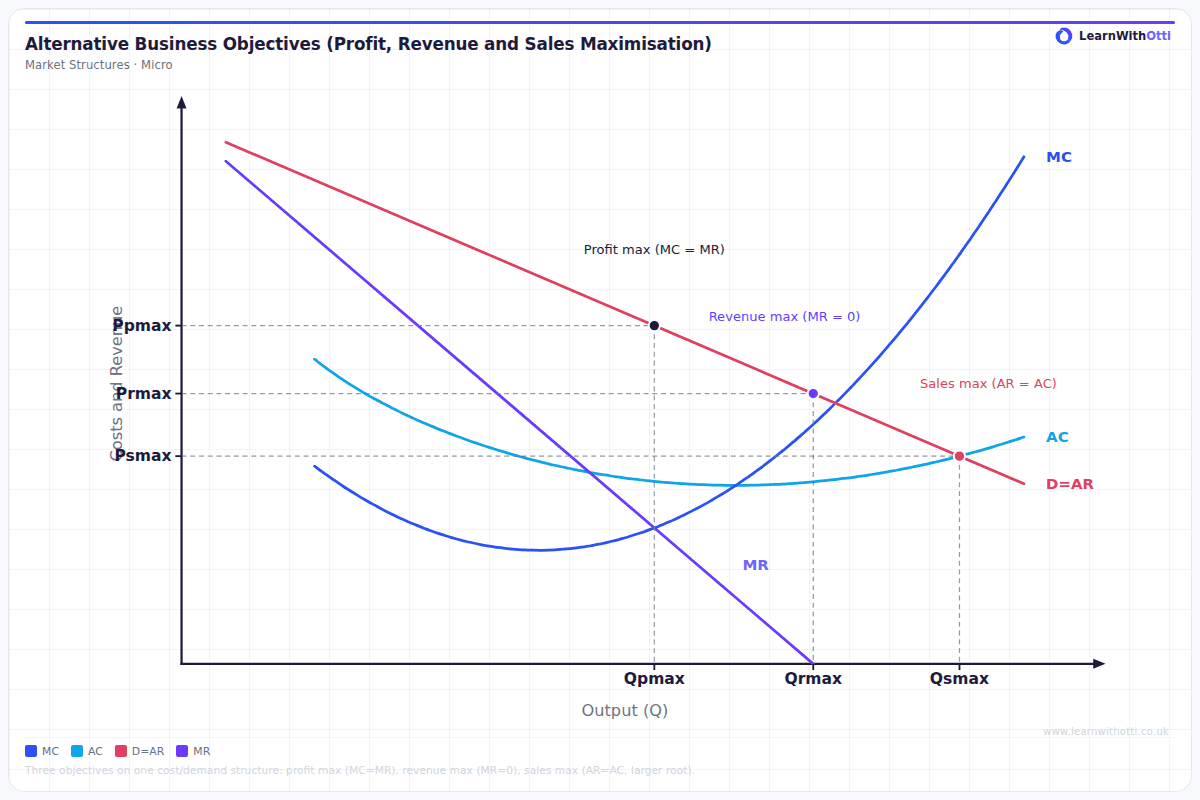
| Objective | Condition | Output | Price |
|---|---|---|---|
| Profit maximisation | MC = MR | Qpmax (lowest) | Ppmax (highest) |
| Revenue maximisation | MR = 0 | Qrmax | Prmax |
| Sales maximisation | AC = AR | Qsmax (highest) | Psmax (lowest) |
Key idea: Moving from profit maximisation to revenue maximisation to sales maximisation, output rises and price falls. Profit falls from its maximum to normal profit at Qsmax.
The order of revenue and profit maximisation depends on where MC meets MR.
Watch out: Profit-maximising output is always below revenue-maximising output, because MR must still be positive at Qpmax.
Key terms
| Term | Meaning |
|---|---|
| Profit maximisation | Producing where MC = MR, earning the largest possible profit |
| Revenue maximisation | Producing where MR = 0, earning the largest total revenue |
| Sales maximisation | Producing the largest output possible without a loss, where AC = AR |
| Satisficing | Aiming for a satisfactory profit while meeting other stakeholders' objectives |
| Principal–agent problem | Conflict when those who run a firm pursue different goals from its owners |
| Normal profit | The minimum profit needed to keep resources in their current use |
Common mistakes
- Mixing up revenue and sales maximisation. Revenue maximisation is MR = 0; sales maximisation is AC = AR.
- Placing profit maximisation where AR exceeds AC by the most per unit. The condition is MC = MR, not the largest gap per unit.
- Getting the order of outputs wrong. Profit-maximising output is lowest and sales-maximising output is highest.
- Treating satisficing as a fixed point. It is a range of outcomes below maximum profit.
- Giving the condition without the reason. Each objective needs a motive, such as managers' pay or deterring entry.
How this has been examined
In the Edexcel papers indexed on this site, this topic has appeared in five formats:
- 1-mark multiple choice — asked 3 times across 3 series (2018 to 2024)
- 4-mark calculation — asked twice across 2 series (2018 to 2025)
- 4-mark "Draw" diagram — asked once (2024)
- 10-mark "Assess" data response — asked once (2022)
- 25-mark "Evaluate" essay — asked once (2017)
It has appeared at every tariff from 1 to 25 marks.
Where this goes next
The revenue concepts behind each condition are in 3.3.1 Revenue, and the meaning of normal and supernormal profit in 3.3.4 Normal profits, supernormal profits and losses. The separation of ownership and control is introduced in 3.1.1 Sizes and types of firms, and these objectives are applied to a single-firm market in 3.4.5 Monopoly.
End of topic 3.2
Quiz yourself on 3.2 Business objectives
10 multiple-choice questions drawn from the 55 we have on the whole of topic 3.2, with instant feedback on every answer.
Start the 3.2 quiz →Otti is an AI tutor built for A-Level students. Ask it anything, practise exam questions, and get instant feedback written like an examiner would give it — not just right or wrong, but why.
Get one answer marked free