Edexcel A-Level Economics · Revision notes
4.3.2 Factors influencing growth and development
Why have some countries grown rich while others remain poor? There is no single answer. Development is held back by a combination of economic and non-economic factors, and they differ from one country to another. This topic covers the main factors and how they interact.
Economic factors
Primary product dependency
Many developing countries rely on exporting a narrow range of primary products, such as crops, minerals or oil. Zambia, for example, earns most of its export revenue from copper. This creates several problems:
- Demand for many primary products is income inelastic, so as world incomes rise, demand for them grows slowly. Consumers in rich countries spend extra income mainly on manufactured goods and services, not on more coffee or cocoa.
- Prices are set on world markets, so producers have little control over them. A small farmer is a price taker, and so is a small country that supplies only a fraction of world output.
- Over time, the prices of primary products have tended to fall relative to manufactured goods, worsening the terms of trade for countries that export them. This is known as the Prebisch-Singer hypothesis: a country has to export more and more to pay for the same quantity of imports.
- Reliance on one or two exports leaves the whole economy exposed if demand or prices fall. A collapse in the price of the main export cuts incomes, jobs, tax revenue and foreign currency earnings all at once.
Volatility of commodity prices
The prices of commodities such as copper, coffee and oil can swing sharply from year to year. Because supply and demand are both price inelastic in the short run, small changes in supply or demand cause large price movements. Supply of crops is inelastic because they take months or years to grow, and it can be hit by weather and disease, while demand is inelastic because there are few substitutes. For example, the price of oil fell from over $100 a barrel in mid-2014 to below $30 in early 2016. Export earnings, government revenue and farmers' incomes all become unpredictable, which makes it hard to plan investment. Governments may start spending programmes when prices are high, then have to cut them sharply when prices fall.
Savings gap: the Harrod-Domar model
The Harrod-Domar model links growth to saving and investment. Savings provide the funds for investment, investment increases the capital stock, and more capital increases output.
Growth rate = savings ratio ÷ capital-output ratio
The capital-output ratio is the amount of capital needed to produce one extra unit of output. For example, if a country saves 20% of its income and needs £4 of capital to produce £1 of extra output, its growth rate is 20% ÷ 4 = 5%. Growth can therefore be raised either by saving more or by using capital more productively, which lowers the capital-output ratio.
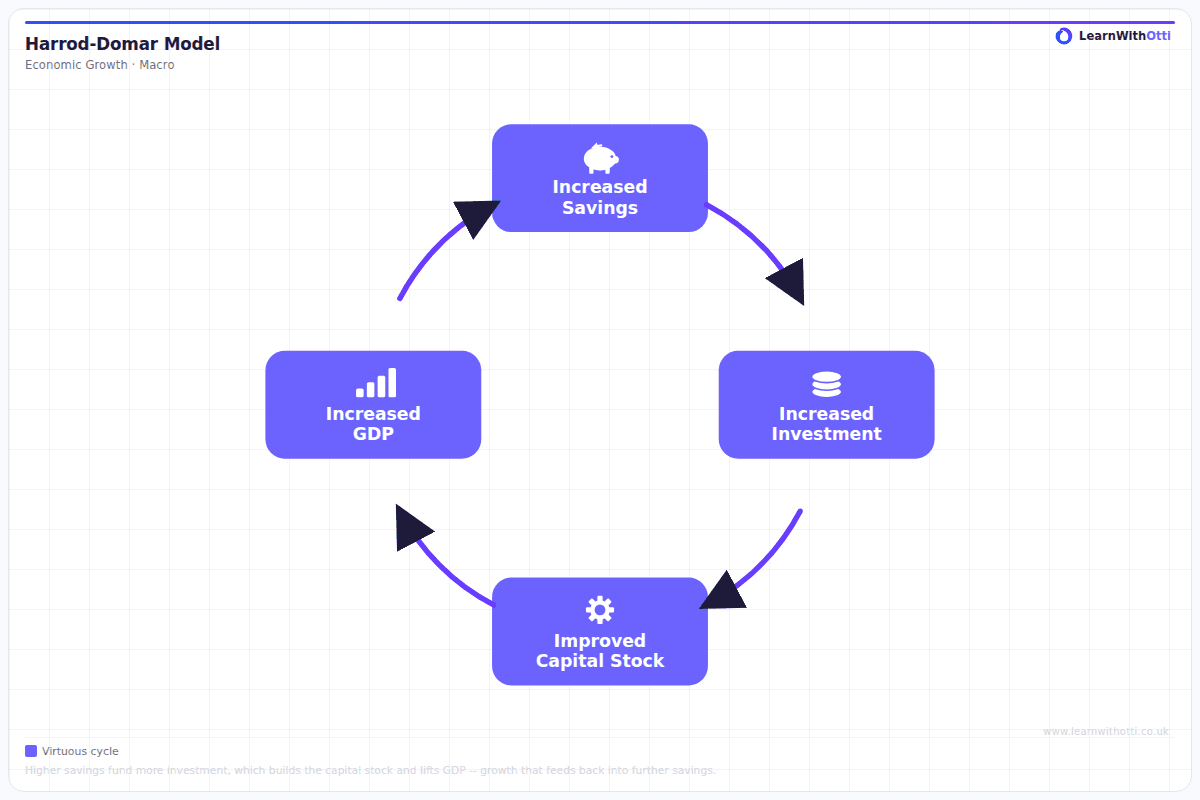
Key idea: In poor countries, incomes are low, so most income is spent on necessities and little is saved. Low saving means low investment, which means low growth, which keeps incomes low.
This is a savings gap, and it can trap a country in poverty. The model suggests the gap can be filled from outside, through foreign aid, foreign direct investment or borrowing from abroad.
Limitations: the model assumes saving is automatically turned into productive investment, ignores the role of technology and human capital, and assumes capital is used efficiently. In practice, savings may be held abroad, lost to corruption or spent on projects that add little to output, so extra saving does not guarantee faster growth.
Foreign currency gap
Developing countries often need to import machinery, technology and fuel to grow, and these must be paid for in foreign currency. If export earnings are too low to pay for the imports needed, the country faces a foreign currency gap, which limits investment and growth. The gap is often caused by primary product dependency and falling export prices, and it is made worse by the need to repay foreign debts. It can be narrowed by attracting foreign direct investment and tourism, or by diversifying into exports with higher value.
Capital flight
Capital flight is the large-scale movement of money out of a country, usually by wealthy residents or investors. It happens when there is political instability, fear of currency collapse, high inflation or a risk of confiscation. It drains the funds available for domestic investment. It also reduces the government's tax base and puts downward pressure on the currency, which can trigger further outflows. UNCTAD has estimated that illicit financial flows out of Africa are worth more each year than the continent receives in aid.
Demographic factors
Rapid population growth means a large share of the population is young and dependent. Resources must go on schooling and health care for children, and growth in GDP is shared among more people, so GDP per head rises slowly. A high dependency ratio also means that each worker supports more non-workers, which keeps household saving low. If the young population later becomes a large working-age population, it can boost growth, but only if there are jobs for it. This is called a demographic dividend, and it helped the rapid growth of East Asian economies such as South Korea. Without enough jobs, a large young population can instead bring high youth unemployment and social unrest.
Debt
Many developing countries borrowed heavily from abroad. Repaying the interest and the loans takes money that could otherwise be spent on health, education and infrastructure. If the currency falls, debts in foreign currency become even harder to repay. Some countries have spent more on debt repayments than on health care. Debt relief programmes, such as the Heavily Indebted Poor Countries (HIPC) initiative, cancelled some debts, but borrowing has since risen again, and Zambia defaulted on its debts in 2020.
Access to credit and banking
Without access to banks and credit, people cannot save safely or borrow to start a business or invest in a farm. Large parts of the population in many developing countries are excluded from formal banking, which holds back enterprise. Banks are reluctant to lend small sums to people with no credit history or collateral, so borrowers may be left with informal moneylenders who charge very high interest rates. Microfinance, pioneered by the Grameen Bank in Bangladesh, and mobile money services such as M-Pesa in Kenya have helped to widen access.
Infrastructure
Poor roads, ports, electricity supply, water and communications raise the costs of doing business and make it hard to trade. Firms cannot grow if they cannot get their goods to market or rely on a power supply. In Nigeria, for example, many firms run their own diesel generators because the national grid is unreliable, which raises their costs. Infrastructure is expensive and has some features of a public good, so it usually needs government funding, which poor countries struggle to provide.
Education and skills
A poorly educated workforce has low productivity and cannot easily adopt new technology. Low levels of human capital limit both growth and development. Many children in low-income countries leave school early, often to work or because families cannot afford the costs, and girls are most likely to miss out. Skilled workers may also emigrate to richer countries for higher pay, known as the brain drain, as with doctors and nurses who leave to work abroad.
Absence of property rights
If people do not have legal title to their land or homes, they cannot use them as collateral to borrow, and they have less incentive to invest in them. Weak property rights also deter investment by firms, who fear their assets could be taken. The economist Hernando de Soto called the land and buildings that poor people occupy without legal title dead capital, because their value cannot be used to raise finance. Secure property rights depend on a working legal system and courts that enforce contracts fairly.
Non-economic factors
- Corruption and poor governance. Bribery and the misuse of public money divert resources, deter investment and weaken trust in institutions.
- Political instability and conflict. War and civil unrest destroy infrastructure, displace people and drive away investment.
- Disease and poor health. Diseases such as malaria and HIV/AIDS reduce life expectancy and the productivity of the workforce.
- Geography and climate. Being landlocked raises the cost of trade; extreme weather and natural disasters damage crops and infrastructure. Climate change is increasing these risks.
- Social and cultural factors. Discrimination, such as limited education for girls, wastes potential and reduces the productive capacity of the economy.
How the factors interact
These factors reinforce each other. Low income leads to low saving, low saving to low investment, low investment to poor infrastructure and weak growth, and weak growth keeps incomes low. This is sometimes called a vicious circle of poverty. Breaking the circle usually requires action on several factors at once.
Key terms
| Term | Meaning |
|---|---|
| Primary product dependency | Heavy reliance on exporting raw materials and agricultural goods |
| Harrod-Domar model | A model linking growth to the savings ratio and the capital-output ratio |
| Capital-output ratio | The amount of capital needed to produce one extra unit of output |
| Savings gap | Too little saving to finance the investment needed for growth |
| Foreign currency gap | Too little foreign currency to pay for the imports needed for growth |
| Capital flight | The large-scale movement of money out of a country |
| Property rights | Legal ownership of assets, which allows them to be used and traded |
Common mistakes
- Listing factors without explaining the mechanism. Each factor needs a link to lower investment, productivity or growth.
- Getting the Harrod-Domar formula upside down. Growth equals the savings ratio divided by the capital-output ratio.
- Treating all developing countries as the same. The most important factors differ from country to country.
- Ignoring non-economic factors. Governance, conflict and health can matter as much as economic factors.
How this has been examined
In the Edexcel papers indexed on this site, this topic has appeared in five formats:
- 25-mark "Evaluate" essay — asked once (2025)
- 25-mark "Evaluate" synoptic essay — asked 3 times across 3 series (2018 to 2025)
- 12-mark "Discuss" data response — asked twice across 2 series (2017 to 2020)
- 8-mark "Examine" data response — asked 5 times across 5 series (2018 to 2024)
- 5-mark "Explain" data response — asked once (2019)
Where this goes next
The ways development is measured are covered in 4.3.1 Measures of development, and the strategies used to overcome these barriers in 4.3.3 Strategies influencing growth and development. Terms of trade are covered in 4.1.4 Terms of trade, and poverty and inequality in 4.2.1 Absolute and relative poverty and 4.2.2 Inequality.
Otti is an AI tutor built for A-Level students. Ask it anything, practise exam questions, and get instant feedback written like an examiner would give it — not just right or wrong, but why.
Get one answer marked free