Edexcel A-Level Economics · Revision notes
3.4.2 Perfect competition
Perfect competition is a theoretical market structure in which no single firm has any power over price. Very few real markets meet every condition, but the model matters because it shows what competition at its most intense would achieve. Every other market structure is judged against it.
Characteristics of perfect competition
- Many buyers and many sellers. Each firm supplies such a tiny share of the market that changing its own output has no noticeable effect on total supply, so it cannot influence the market price. The same is true of each buyer.
- Homogeneous (identical) products. Consumers have no reason to prefer one firm's output to another's, so there is no brand loyalty and no point in non-price competition such as advertising.
- Perfect information. Buyers and sellers know all prices and the quality of every product. A firm that charged more than the market price would lose all its customers at once, because they would know they could buy the same product more cheaply elsewhere.
- Freedom of entry and exit. There are no barriers to new firms joining the market or existing firms leaving it. This is what drives the market to normal profit in the long run: supernormal profit attracts new firms, and losses make firms leave.
- Firms aim to maximise profit. Each firm produces where marginal cost equals marginal revenue (MC = MR).
Together these mean each firm is a price taker. The price is set by market demand and supply, and the firm can sell as much as it likes at that price. If it charged even slightly more, consumers would buy from someone else, because the products are identical and everyone knows the prices.
Key idea: A perfectly competitive firm is a price taker. It can sell as much as it likes at the market price but nothing at all at a higher price, so it has no reason to charge less and no ability to charge more.
Markets for some agricultural products and foreign currency come close to these conditions, but even they fall short in some respects. For example, a single wheat farmer cannot change the world price of wheat by growing more or less.
The firm's revenue curves
Because the firm is a price taker, its demand curve is horizontal at the market price. Every unit sells for the same price, so each extra unit adds exactly the price to total revenue:
Price = average revenue (AR) = marginal revenue (MR)
Key distinction: The firm's demand curve is perfectly elastic, but the market demand curve slopes downwards in the normal way. The market price is set where market demand meets market supply, and each firm then takes that price as given.
Short-run equilibrium
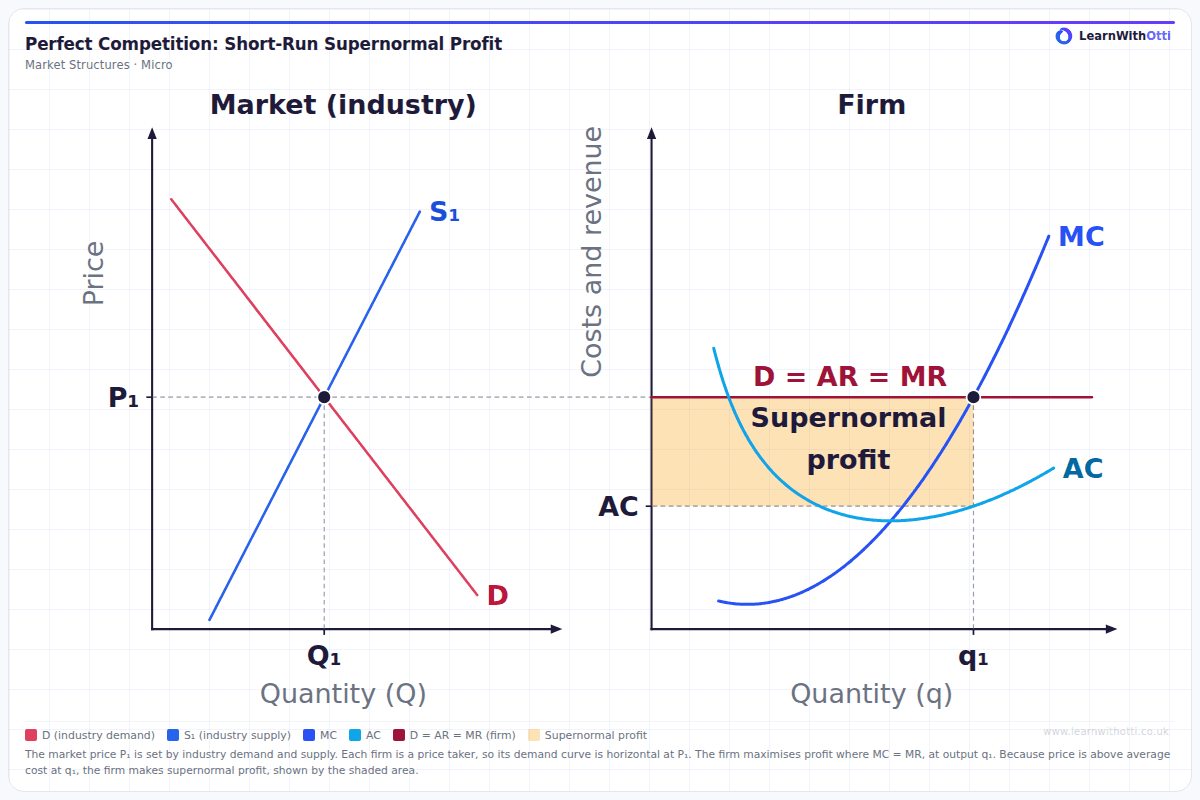
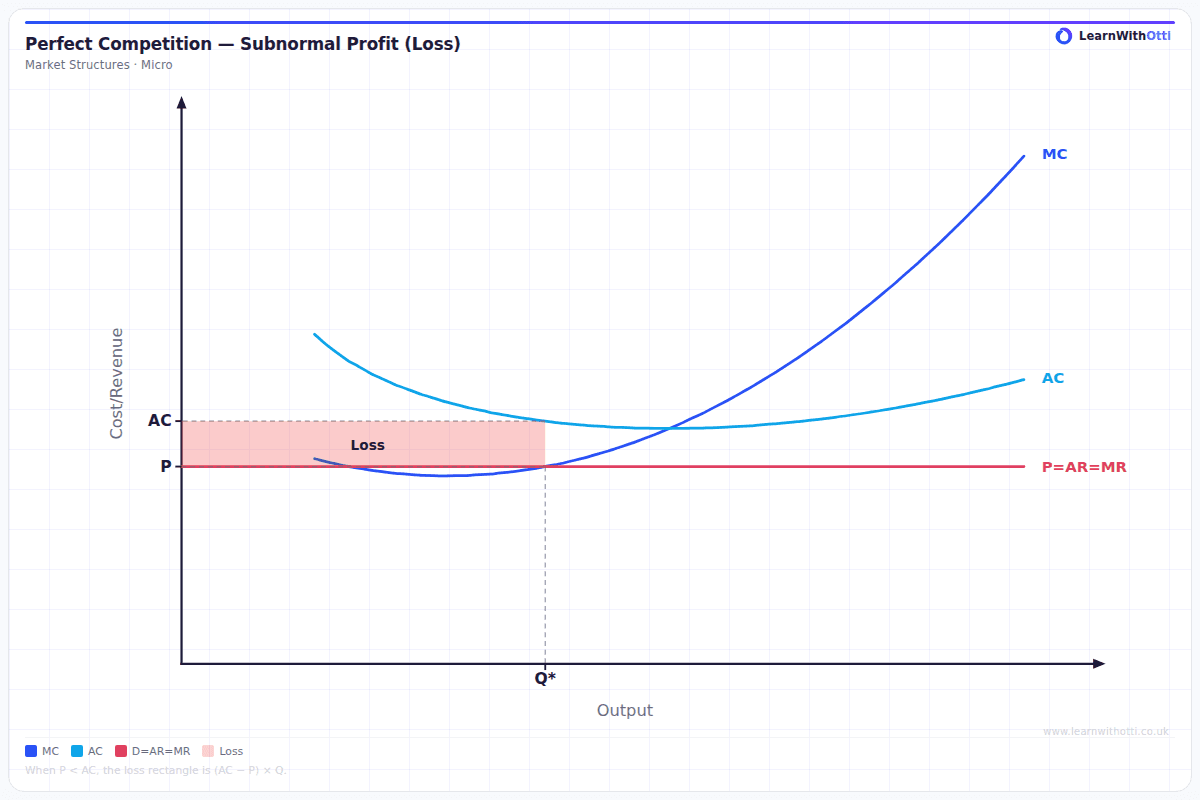
The firm maximises profit where MC = MR. Since MR equals price, this is where MC = price. If MC is below the price, producing one more unit adds more to revenue than to cost, so profit rises by expanding output. If MC is above the price, the last unit costs more than it earns, so profit rises by cutting output.
In the short run, the number of firms is fixed, because new firms cannot enter and existing firms cannot leave quickly. A firm can make:
- supernormal profit, if price is above average cost (AC) at the profit-maximising output. The profit on each unit is the gap between price and AC, so total supernormal profit is (P − AC) × Q.
- normal profit, if price equals AC. The firm covers all its costs, including the opportunity cost of the owner's capital and effort, so it has no reason to leave the industry.
- a loss, if price is below AC.
Whether a loss-making firm keeps producing in the short run, and the shut-down point, are covered in 3.3.4 Normal profits, supernormal profits and losses.
Long-run equilibrium
In the long run, freedom of entry and exit means supernormal profits and losses cannot last.
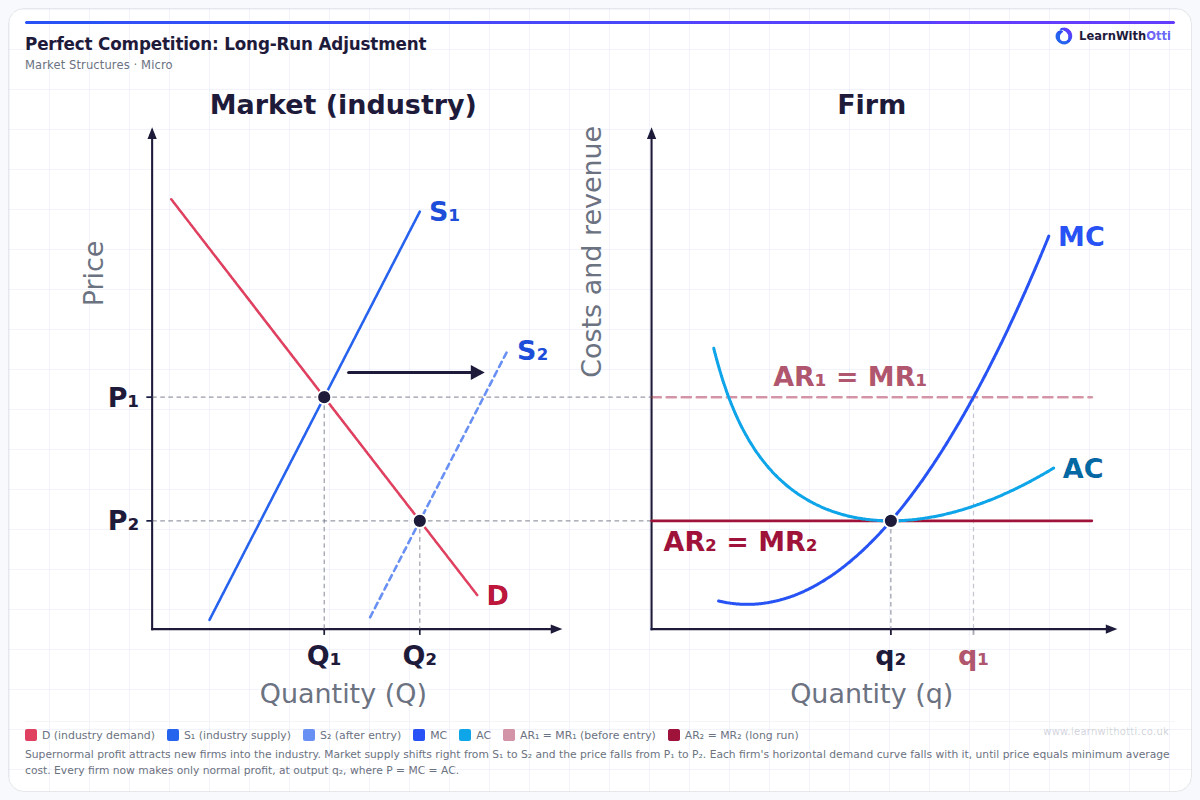
If firms are making supernormal profit:
- New firms are attracted into the market by the supernormal profit, and with no barriers to entry nothing stops them.
- Market supply increases, shifting the market supply curve to the right.
- The market price falls, lowering each firm's horizontal demand curve.
- Entry continues until price falls to the minimum point of AC, where every firm makes only normal profit.
If firms are making losses, the process runs in reverse. Firms that cannot cover their costs leave the market, so the market supply curve shifts to the left. The market price rises until the remaining firms make normal profit.
In long-run equilibrium, price equals the minimum point of AC, every firm makes normal profit, and there is no incentive for any firm to enter or leave.
Key idea: In the long run, free entry and exit compete away supernormal profit and remove losses, so every firm ends up making normal profit at the minimum point of its AC curve.
Diagrammatic analysis
The standard diagram has two panels side by side:
- The market (industry) panel on the left shows the downward-sloping market demand curve and the upward-sloping market supply curve. Their intersection sets the market price.
- The firm panel on the right shows the firm's MC and AC curves and its horizontal demand curve (AR = MR) at the market price.
The price is carried across from the market panel to the firm panel. The firm's output is read off where MC cuts MR, and profit is the area between price and AC at that output. In long-run equilibrium, the AR = MR line just touches the bottom of the AC curve.
The two panels use very different quantity scales. The market produces millions of units, and each firm produces only a tiny fraction of that.
Efficiency in perfect competition
In long-run equilibrium:
- Allocative efficiency is achieved, because price equals marginal cost. The price shows the value consumers place on the last unit, and MC is the cost of producing it, so resources are allocated to match what consumers want.
- Productive efficiency is achieved, because firms produce at the minimum of AC. Output is produced at the lowest possible cost per unit, so no resources are wasted.
- X-inefficiency is unlikely, because a firm with higher costs than its rivals would make a loss at the market price and be forced out.
The weakness is dynamic efficiency. With only normal profit in the long run, firms have little to invest in research and development. And because information is perfect, any innovation would be copied immediately, so the incentive to innovate is weak. Small firms may also be unable to gain the economies of scale that larger firms could achieve.
Evaluating the model
- The assumptions are unrealistic. Few markets have identical products, perfect information and no barriers to entry, so perfect competition is rarely seen in practice.
- It is still a useful benchmark. It shows the efficient outcome that competition would produce, so economists can judge other market structures, and the case for government intervention, by how far they fall short of it.
- Some real markets come close. Some agricultural and commodity markets, and online markets where prices are easy to compare, show many of its features.
Evaluation: Perfect competition is statically efficient but may be dynamically inefficient. Whether it is the best market structure depends on how much weight is given to low prices now compared with innovation in the future.
Key terms
| Term | Meaning |
|---|---|
| Perfect competition | A market structure with many firms selling identical products, perfect information and free entry and exit |
| Price taker | A firm that must accept the market price |
| Homogeneous product | A product that is identical whichever firm makes it |
| Normal profit | The minimum profit needed to keep a firm in the industry, where AR = AC |
| Supernormal profit | Profit above normal profit, where AR is greater than AC |
Common mistakes
- Drawing a downward-sloping demand curve for the firm. The firm's demand curve is horizontal; only the market demand curve slopes down.
- Leaving supernormal profit in the long run. Free entry competes it away.
- Forgetting the market panel. The firm's price comes from market demand and supply.
- Claiming perfect competition is efficient in every sense. It is statically efficient but weak on dynamic efficiency.
How this has been examined
In the Edexcel papers indexed on this site, this topic has appeared in one format:
- 4-mark "Draw" diagram — asked once (2021)
Where this goes next
The revenue curves of a price taker are introduced in 3.3.1 Revenue, and normal profit, supernormal profit and the shut-down point in 3.3.4 Normal profits, supernormal profits and losses. The efficiency outcomes are compared across structures in 3.4.1 Efficiency. The structure that relaxes the assumption of identical products is 3.4.3 Monopolistic competition, and the opposite extreme is 3.4.5 Monopoly.
Otti is an AI tutor built for A-Level students. Ask it anything, practise exam questions, and get instant feedback written like an examiner would give it — not just right or wrong, but why.
Get one answer marked free