Edexcel A-Level Economics · Revision notes
1.2.7 Price Mechanism
What the specification covers
In our own words — not the official specification wording
The three jobs price does in allocating scarce resources, and how that works in markets of different sizes.
- The three jobs price performs in deciding where resources go:
- Price rises when something is scarce, so that it goes to those willing to pay most for it.
- A higher price rewards producers for supplying more, and consumers for buying less.
- A change in price carries information about what buyers now want, prompting resources to move.
- How the price mechanism works in markets of different reach — local, national and worldwide.
Nobody decides how many loaves Britain bakes. No committee allocates land between housing and farming. Yet resources do get allocated, and the thing doing it is price. This topic sets out the three jobs price performs.
The three functions of the price mechanism
1. Rationing
Resources are scarce, so something must decide who gets them. Price does it: as a good becomes scarcer, its price rises, and it is rationed to those willing and able to pay most.
This is why concert tickets for a popular act cost more than for an empty venue, and why water is cheap in Britain and expensive in a desert. Rationing is not a moral judgement about who deserves the good — it allocates by willingness and ability to pay, which is exactly the objection critics raise.
2. Incentive
Price rewards behaviour. A higher price is an incentive for producers to supply more, because the profit from each unit rises. It is simultaneously an incentive for consumers to buy less, and to look for substitutes.
This is the mechanism that makes supply respond. Without the profit incentive there would be no reason for a producer to expand into a market where goods are scarce.
3. Signalling
Price carries information. A rising price tells producers that demand has increased or supply has fallen, and that resources should move into this market. A falling price says the opposite.
Key idea: Crucially, the signal travels without anyone having to collect or transmit the information deliberately. A baker in Leeds does not need to know why wheat prices rose; the price itself carries everything needed to act on.
How the three work together
Take a sudden surge in demand for electric cars.
- Signalling: the price rises, telling producers demand has increased.
- Incentive: higher prices make production more profitable, so firms expand output and new firms enter.
- Rationing: in the meantime, the higher price allocates the limited stock to those valuing them most.
Over time, supply rises, price falls back, and resources have moved into electric car production without any central decision. This is what Adam Smith's "invisible hand" describes.
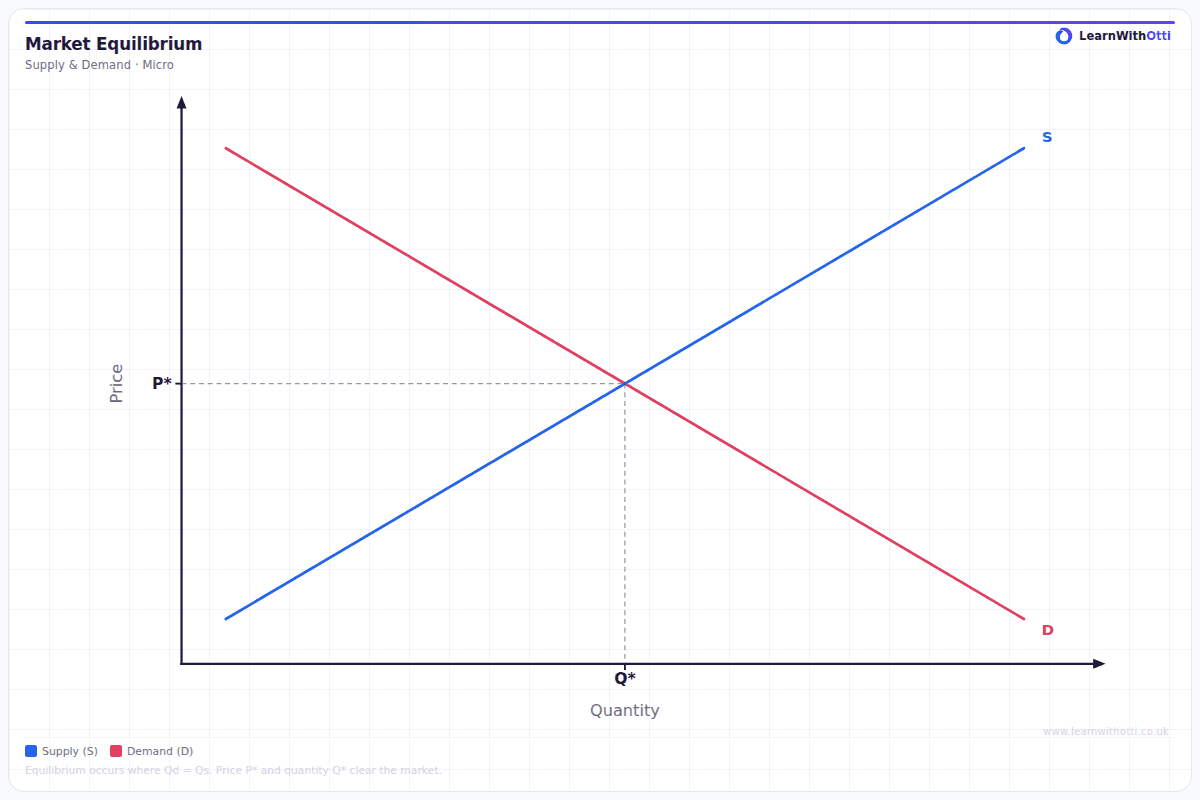
The price mechanism in different markets
Local markets. Hairdressing, plumbing, a sandwich shop. Prices vary considerably between areas because the goods cannot be traded across distances. Local conditions — rents, wages, competition — dominate.
National markets. Housing, rail travel, most retailing. Prices are influenced by national conditions, though significant regional variation persists where goods are immobile. Housing is the clearest example: the mechanism works nationally, but a house in Doncaster cannot be moved to London, so price differences endure.
Global markets. Oil, wheat, copper, financial assets. Price is set by world supply and demand, and a single world price tends to prevail once transport costs are allowed for. An individual country is usually a price taker.
The same three functions operate at every level. What changes is the scale of the forces setting the price, and how far a national government can influence it.
Where the mechanism does not work well
The price mechanism allocates efficiently only under conditions that often fail. Where there are externalities, public goods, imperfect information or significant market power, the signals are distorted and resources are misallocated. That is market failure, and it is the subject of the next topic.
Evaluation: It is also worth noting the equity objection: rationing by ability to pay allocates goods to those with money, not to those with the greatest need. The mechanism is efficient on its own terms while being silent about fairness. For example, if a shortage pushes up the price of a medicine, it goes to those who can afford it rather than to the patients who need it most.
Key terms
| Term | Meaning |
|---|---|
| Price mechanism | The process by which prices allocate scarce resources |
| Rationing | Price rising to allocate scarce goods to those willing to pay most |
| Incentive | Price rewarding producers for supplying and consumers for economising |
| Signalling | Price conveying information about scarcity and demand |
| Invisible hand | Adam Smith's term for self-interested action producing a coordinated outcome |
| Price taker | An agent that must accept the prevailing market price |
Common mistakes
- Confusing signalling and incentive. Signalling is about information — price telling you something. Incentive is about reward — price making it worth acting. They are close but distinct, and questions often ask for both.
- Listing the three functions without applying them. Each one only means something when you show how it operates in a specific market.
- Treating the mechanism as always efficient. It allocates efficiently only where market failure is absent.
- Ignoring the equity point. Rationing by ability to pay is efficient, not fair, and saying so is a strong evaluation.
- Assuming global markets mean identical prices everywhere. Transport costs, taxes and trade barriers keep prices apart.
How this has been examined
In the Edexcel papers indexed on this site, this topic has appeared in two formats:
- 2-mark "Explain" — asked once (2019)
- 1-mark multiple choice — asked once (2018)
A small footprint at low tariffs. The content itself appears far more often inside questions on market failure and government intervention, where the mechanism is the baseline that failure departs from.
Where this goes next
The price this mechanism uses is determined in 1.2.6 Price determination, and the welfare it creates is measured in 1.2.8 Consumer and producer surplus. Where the mechanism fails is the whole of 1.3.1 Types of market failure, and the government's response is 1.4.1 Government intervention in markets. The different economic systems that rely on it to different degrees come from 1.1.6 Free market economies, mixed economy and command economy.
Otti is an AI tutor built for A-Level students. Ask it anything, practise exam questions, and get instant feedback written like an examiner would give it — not just right or wrong, but why.
Get one answer marked free