Edexcel A-Level Economics · Revision notes
2.4.2 Injections and withdrawals
The simple circular flow assumes households spend all their income. In reality, some money leaves the flow and some new money enters it. This topic covers those withdrawals and injections, and what happens to national income when they are not equal.
Withdrawals
A withdrawal (or leakage) is money that leaves the circular flow and is not passed on as spending on domestic output. There are three:
- Saving (S). Income that households do not spend, such as money put into a savings account.
- Taxation (T). Income taken by the government, such as income tax and VAT.
- Imports (M). Spending on goods and services produced abroad, so the money flows out of the domestic economy.
Total withdrawals = saving + taxation + imports (S + T + M)
Injections
An injection is spending on domestic output that does not come from households' consumption of their current income. There are three:
- Investment (I). Spending by firms on capital goods, such as machinery and buildings.
- Government spending (G). Spending by the government on goods and services, such as health care and roads.
- Exports (X). Spending by foreign consumers and firms on goods and services produced in the UK.
Total injections = investment + government spending + exports (I + G + X)
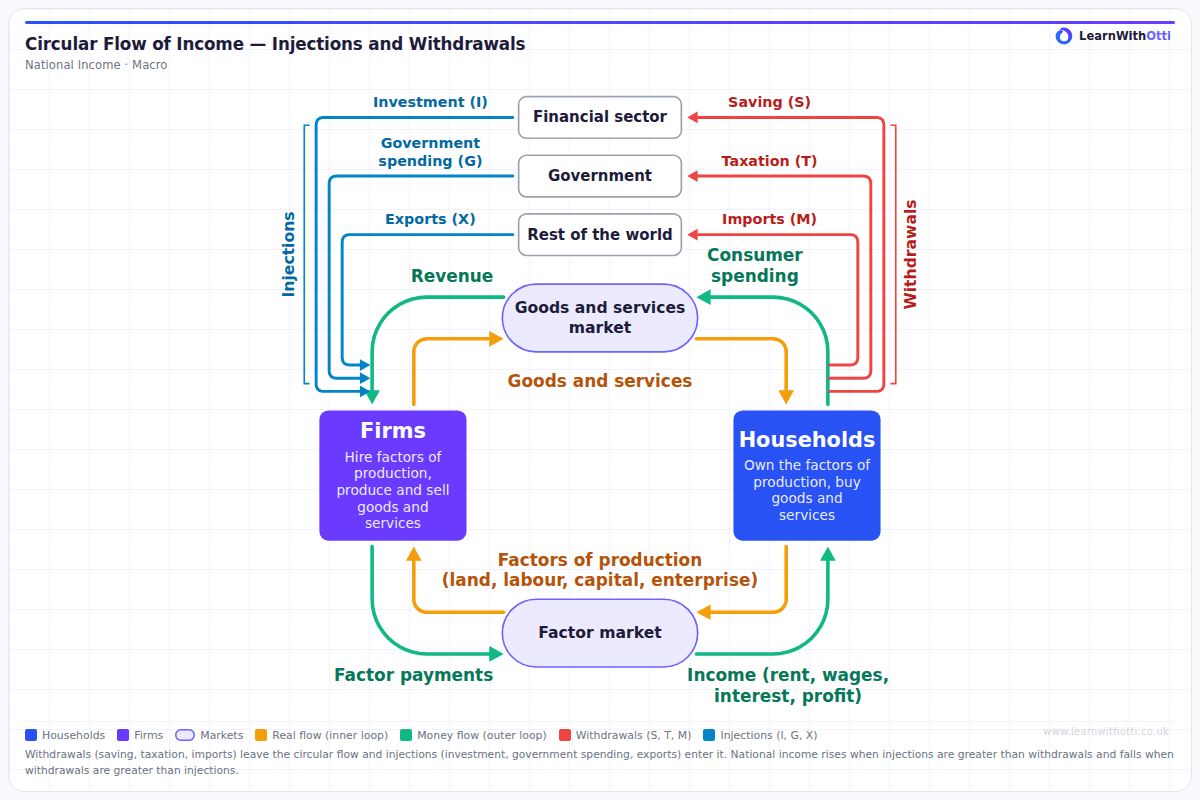
On the diagram, each withdrawal is paired with an injection through the same sector. Saving goes to the financial sector, which lends for investment. Taxation goes to the government, which spends it. Spending on imports goes to the rest of the world, which buys exports. The pairs do not have to match individually. What matters is the total of all three injections compared with the total of all three withdrawals.
The impact of injections and withdrawals
What happens to national income depends on how total injections compare with total withdrawals.
If injections are greater than withdrawals
More money is entering the flow than leaving it. Spending on domestic output rises, firms produce more, and incomes rise. National income increases.
For example, a rise in government spending on infrastructure, or a rise in exports, increases the flow of income around the economy.
If withdrawals are greater than injections
More money is leaving the flow than entering it. Spending on domestic output falls, firms cut production, and incomes fall. National income decreases.
For example, if households become worried about the future and save more, spending falls and national income shrinks.
If injections equal withdrawals
The money entering the flow exactly matches the money leaving it, so national income stays the same. The economy is in equilibrium:
Equilibrium: injections = withdrawals (I + G + X = S + T + M)
How the economy returns to equilibrium
Changes in national income themselves change withdrawals. When national income rises, households save more, pay more tax and buy more imports. So rising income increases withdrawals until they again equal injections, and a new, higher equilibrium is reached.
The same works in reverse. When national income falls, saving, tax and imports all fall, until withdrawals once more equal injections at a lower level of income.
A note on saving
Saving is a withdrawal from the circular flow in the short run, which is why an increase in saving can reduce national income. But saving is not lost from the economy entirely. Banks lend saved money to firms and households, which can finance investment, an injection.
Evaluation: Whether higher saving reduces national income depends on whether it is matched by higher investment.
The idea that higher saving by everyone can reduce national income, and may even leave total saving no higher, is known as the paradox of thrift.
Key terms
| Term | Meaning |
|---|---|
| Withdrawal (leakage) | Money that leaves the circular flow: saving, taxation or imports |
| Injection | Spending on domestic output that does not come from current household consumption: investment, government spending or exports |
| Equilibrium national income | The level at which total injections equal total withdrawals |
| Paradox of thrift | The idea that an increase in saving by everyone can reduce national income |
Common mistakes
- Mixing up injections and withdrawals. Saving, taxes and imports leave the flow; investment, government spending and exports enter it.
- Listing them without the effect. The key point is whether injections are greater or less than withdrawals, and what that does to national income.
- Treating saving as always harmful. Saving can finance investment; the effect depends on whether it is matched by investment.
- Comparing individual items. Equilibrium needs total injections to equal total withdrawals, not each pair, such as saving and investment, to match.
How this has been examined
This topic has not appeared as a standalone question in the Edexcel papers indexed on this site.
Its ideas sit underneath the multiplier and the equilibrium level of national output, which build directly on it.
Where this goes next
The simple circular flow is set out in 2.4.1 National income. Equilibrium national output is analysed using AD and AS in 2.4.3 Equilibrium levels of real national output, and the way a change in injections changes national income by more than the initial amount in 2.4.4 The multiplier. Each injection is covered in 2.2.3 Investment (I), 2.2.4 Government expenditure (G) and 2.2.5 Net trade (X-M).
Otti is an AI tutor built for A-Level students. Ask it anything, practise exam questions, and get instant feedback written like an examiner would give it — not just right or wrong, but why.
Get one answer marked free