Edexcel A-Level Economics · Revision notes
4.4.3 Role of central banks
A central bank sits at the centre of a country's financial system. In the UK, it is the Bank of England. It sets interest rates, holds the government's accounts, stands behind the banking system in a crisis and supervises the banks. This topic covers those four functions.
Implementation of monetary policy
Monetary policy is the use of interest rates and the money supply to influence the economy, mainly to control inflation.
In the UK, the government sets an inflation target of 2%, measured by the Consumer Prices Index. The Bank of England has been operationally independent since 1997, which means it, not the government, decides how to meet that target.
- The Bank's Monetary Policy Committee (MPC), with nine members, meets regularly to set Bank Rate, the interest rate the Bank pays on reserves held by commercial banks.
- Changes in Bank Rate feed through to the interest rates banks charge on loans and mortgages and pay on savings.
- A rise in Bank Rate tends to reduce borrowing and spending, lowering aggregate demand and inflation. A cut has the opposite effect.
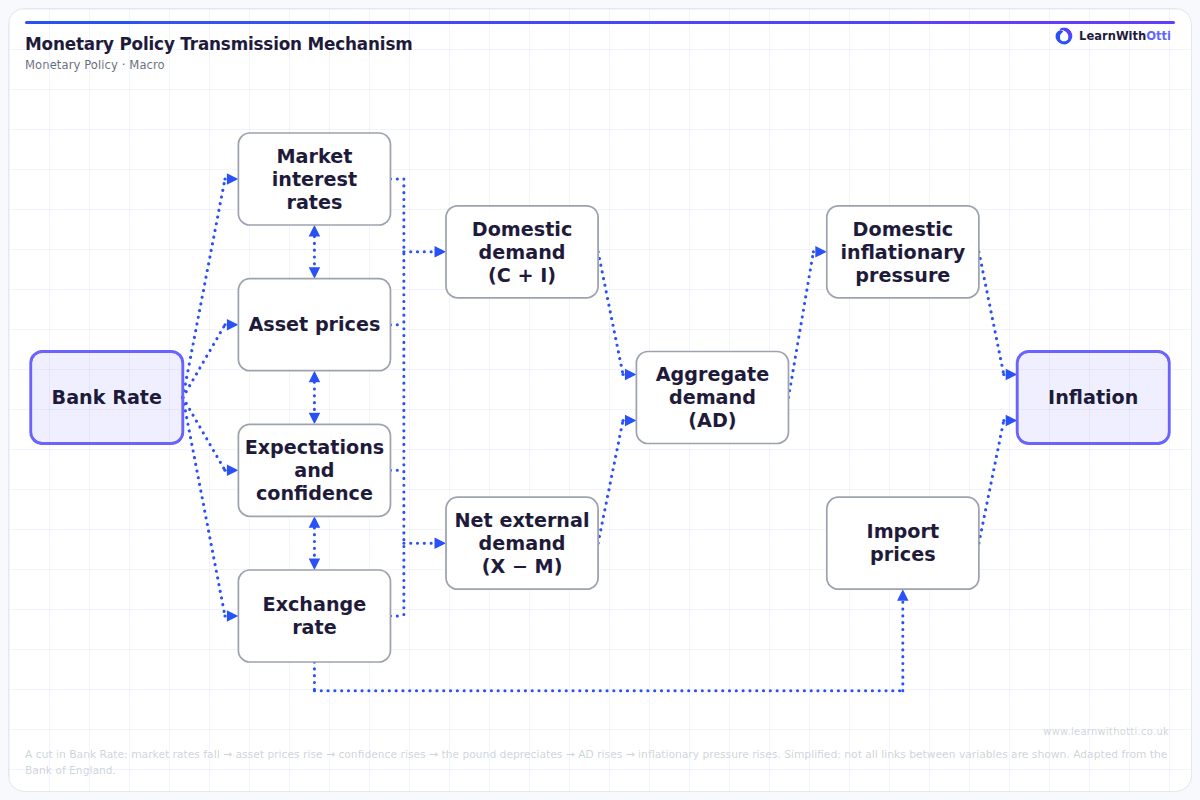
When interest rates are already very low, the Bank can also use quantitative easing (QE): creating new money to buy government bonds and other assets, which lowers long-term interest rates and encourages spending.
Why independence matters.
Key idea: An independent central bank is less tempted to cut interest rates before an election, so its commitment to the inflation target is more credible. This helps keep people's expectations of inflation low.
Banker to the government
The Bank of England holds the government's main bank accounts. Tax revenue is paid into them and government spending is paid out of them. The Bank also helps the government manage its borrowing and the flow of money between the government and the rest of the economy.
Banker to the banks: lender of last resort
Commercial banks hold accounts at the Bank of England and use them to settle payments with each other. The Bank also acts as lender of last resort: if a bank that is fundamentally sound runs short of cash, the Bank will lend to it, so that a temporary shortage does not turn into a collapse.
This matters because banks lend out most of the money deposited with them. If many depositors try to withdraw their money at once, a bank run, even a healthy bank cannot pay them all. In 2007, Northern Rock suffered the first run on a UK bank in well over a century, and the Bank of England provided emergency support.
Evaluation: The lender of last resort role prevents panic spreading through the banking system. But it can also create moral hazard, if banks take more risk believing they will be rescued.
Role in the regulation of the banking industry
After the financial crisis, the Bank of England was given greater responsibility for keeping the financial system stable.
- The Prudential Regulation Authority (PRA), part of the Bank, supervises individual banks, building societies and insurers. It requires them to hold enough capital and liquid assets to absorb losses and meet withdrawals.
- The Financial Policy Committee (FPC) looks at risks to the financial system as a whole, such as rapid growth in mortgage lending, and can require banks to hold more capital when risks are building up.
- Stress tests check whether the largest banks could survive a severe recession or market crash.
A separate body, the Financial Conduct Authority, regulates how financial firms treat their customers.
Benefits and limits of regulation
- Stronger regulation makes banks safer and reduces the chance that taxpayers have to rescue them.
- But holding more capital can make banks lend less, which may slow growth, and regulation may not keep pace with new risks.
Key terms
| Term | Meaning |
|---|---|
| Central bank | The institution at the centre of a country's financial system, such as the Bank of England |
| Monetary policy | The use of interest rates and the money supply to influence the economy |
| Monetary Policy Committee | The Bank of England committee that sets Bank Rate |
| Bank Rate | The interest rate set by the Bank of England |
| Quantitative easing | Creating money to buy bonds and other assets, lowering long-term interest rates |
| Lender of last resort | A central bank's role in lending to banks that run short of cash |
| Prudential regulation | Rules that require banks to hold enough capital and liquidity to stay safe |
Common mistakes
- Saying the Bank of England sets the inflation target. The government sets the target; the Bank decides how to meet it.
- Confusing Bank Rate with the rates customers pay. Bank Rate influences, but does not directly set, the rates on loans and savings.
- Describing lender of last resort as rescuing failed banks. It is lending to banks that are short of cash but fundamentally sound.
- Ignoring moral hazard. Being ready to support banks can encourage them to take more risk.
How this has been examined
In the Edexcel papers indexed on this site, this topic has appeared as:
- 15-mark "Discuss" data response — asked once (2019)
Where this goes next
The roles of financial markets are covered in 4.4.1 Role of financial markets, and the failures that make regulation necessary in 4.4.2 Market failure in the financial sector. Interest rates and quantitative easing as demand-side tools are examined in 2.6.2 Demand-side policies, and the inflation target in 2.1.2 Inflation.
End of topic 4.4
Quiz yourself on 4.4 The financial sector
10 multiple-choice questions drawn from the 29 we have on the whole of topic 4.4, with instant feedback on every answer.
Start the 4.4 quiz →Otti is an AI tutor built for A-Level students. Ask it anything, practise exam questions, and get instant feedback written like an examiner would give it — not just right or wrong, but why.
Get one answer marked free