Edexcel A-Level Economics · Revision notes
3.6.2 The impact of government intervention
The previous topic set out the tools governments use to control firms: price and profit regulation, competition policy, quality standards and performance targets, privatisation, nationalisation and deregulation. This topic asks whether those tools work. It looks at the impact of intervention on prices, profit, efficiency, quality and choice, and then at the two main reasons why intervention may fall short of its aims: regulatory capture and asymmetric information.
Why the impact matters
Intervention in markets for firms is usually aimed at markets where competition is weak, such as monopolies, natural monopolies and oligopolies. Without intervention, a firm with market power can restrict output and charge a price above marginal cost, earn supernormal profit in the long run and face little pressure to keep costs down.
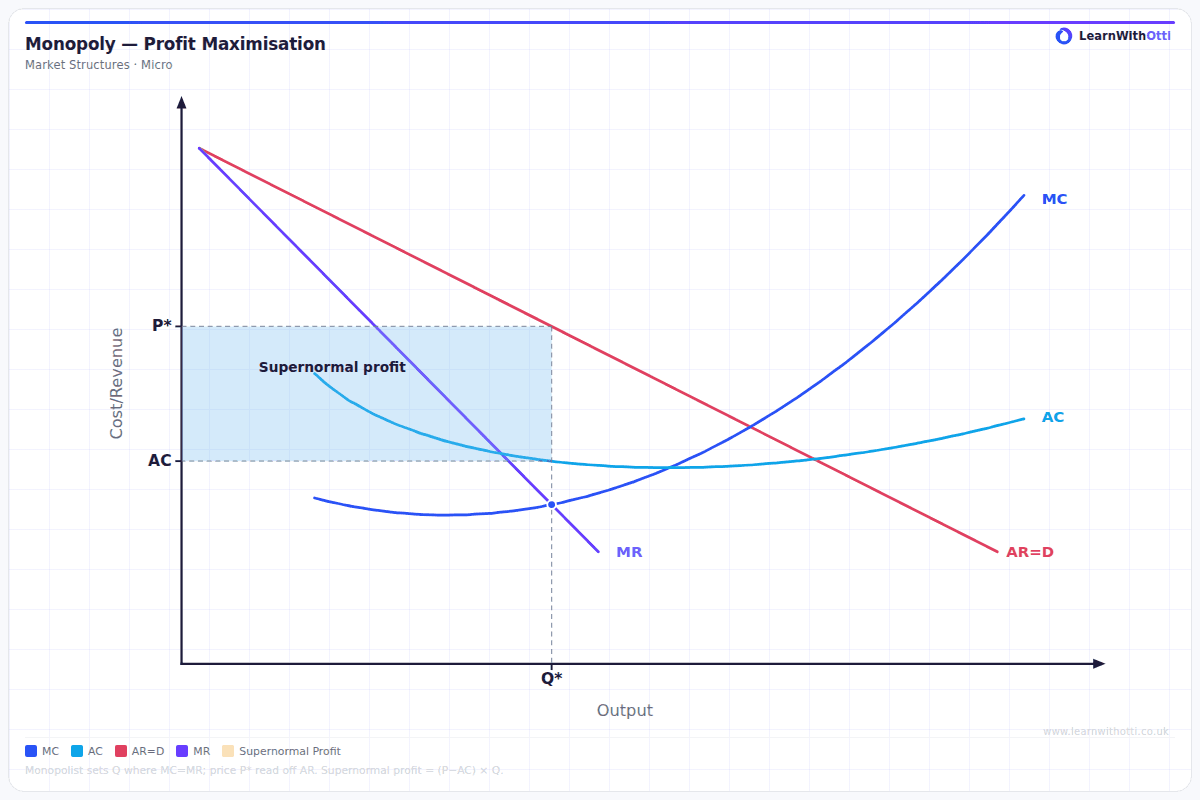
The diagram shows the problem. A profit-maximising monopolist produces where marginal cost equals marginal revenue and sets the price from the demand curve. Price is above marginal cost, so the firm is allocatively inefficient, and output is lower than it would be in a competitive market.
Evaluation: Intervention aims to push the outcome closer to the competitive one, but every tool has side effects. The judgement is always whether the gains outweigh the costs.
Impact on prices
Price regulation
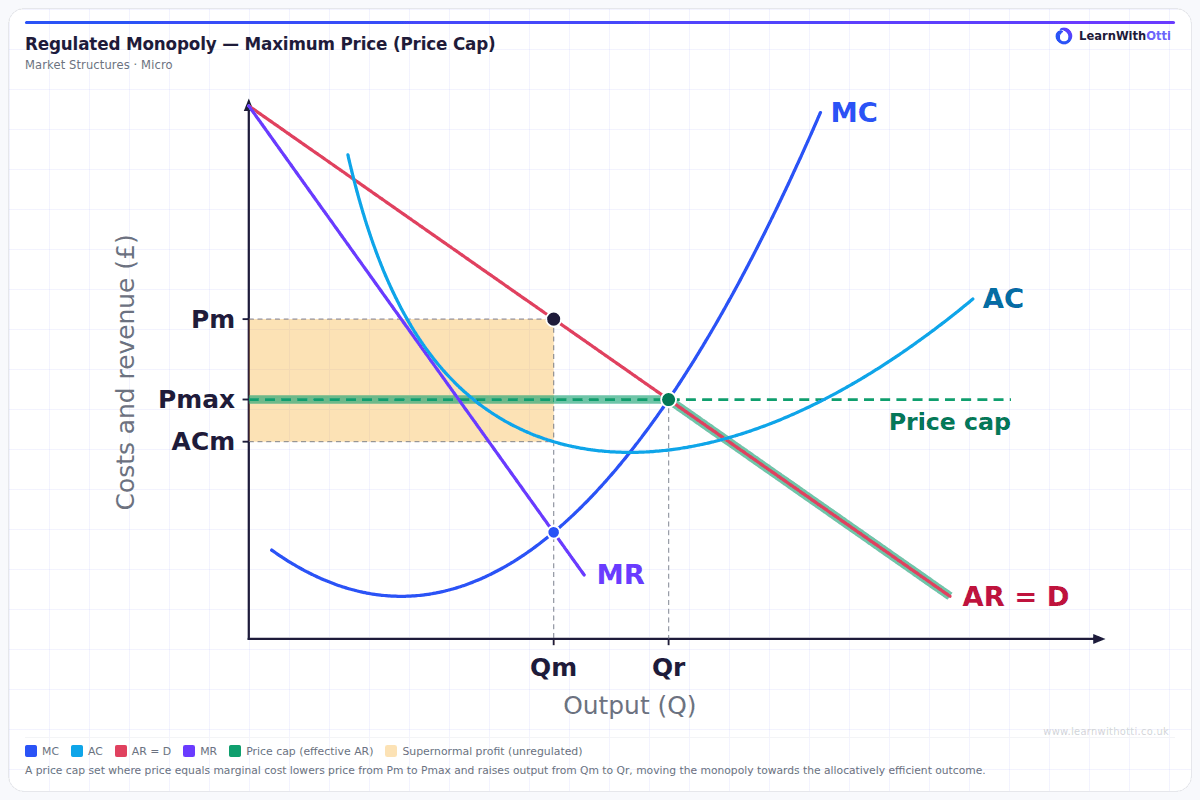
- A price cap such as RPI minus X limits how much a regulated firm can raise its prices each year. If X is positive, prices must rise by less than inflation, so real prices fall.
- Ofgem caps the unit price of gas and electricity on standard tariffs, and Ofwat sets limits on the bills water companies can charge.
- Consumers gain directly from lower prices than an unregulated monopolist would charge.
Competition policy and promoting competition
- Blocking mergers and punishing cartels stops firms gaining or abusing market power, so prices stay closer to the competitive level.
- Deregulation and privatisation can bring new firms into a market. Fares on many European air routes fell sharply after the airline market was opened to low-cost carriers.
Limits
- If the price cap is set too low, the firm may not cover its costs, and may cut investment or leave the market.
- Prices for a natural monopoly cannot simply be forced down to marginal cost. Because average cost is still falling where demand meets marginal cost, a price equal to marginal cost would mean the firm makes a loss.
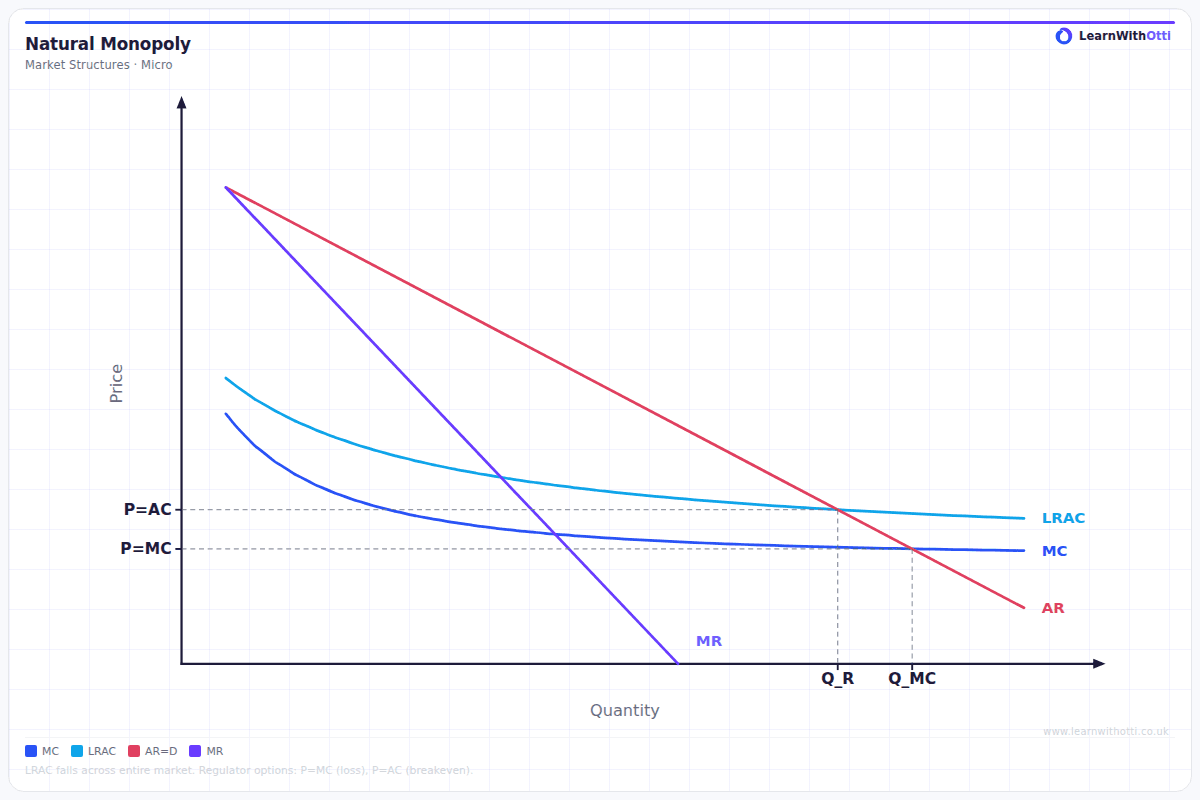
This is why regulators of natural monopolies such as water and the electricity grid usually aim for a price close to average cost, which allows a normal profit, rather than the allocatively efficient price.
Impact on profit
Profit regulation
- Rate of return regulation limits the profit a firm can earn as a percentage of the capital it has invested.
- It protects consumers from excessive profits, but it removes the reward for cutting costs. It can also encourage firms to over-invest in capital, because a larger capital base allows a larger total profit.
Price caps and profit
- Under RPI minus X, a firm that cuts costs faster than X keeps the extra profit until the next review. This gives a strong incentive to become more efficient.
- However, if a firm earns large profits under a cap, it suggests that X was set too low, and consumers lose out until the next review.
Windfall taxes
- The government can tax unusually large profits directly. The Energy Profits Levy, introduced in 2022, taxed the profits of oil and gas producers after energy prices rose sharply. This takes back some of the gain without changing prices, but it may discourage future investment.
Nationalisation and privatisation
- A nationalised industry may not aim for profit at all, and losses are covered by taxpayers.
- Privatisation gives firms a profit motive, which can drive efficiency, but it also means profits are paid to shareholders rather than reinvested or used to lower prices.
Impact on efficiency
Productive efficiency and X-inefficiency
- Firms that face no competition often let costs rise above the lowest possible level. This is X-inefficiency.
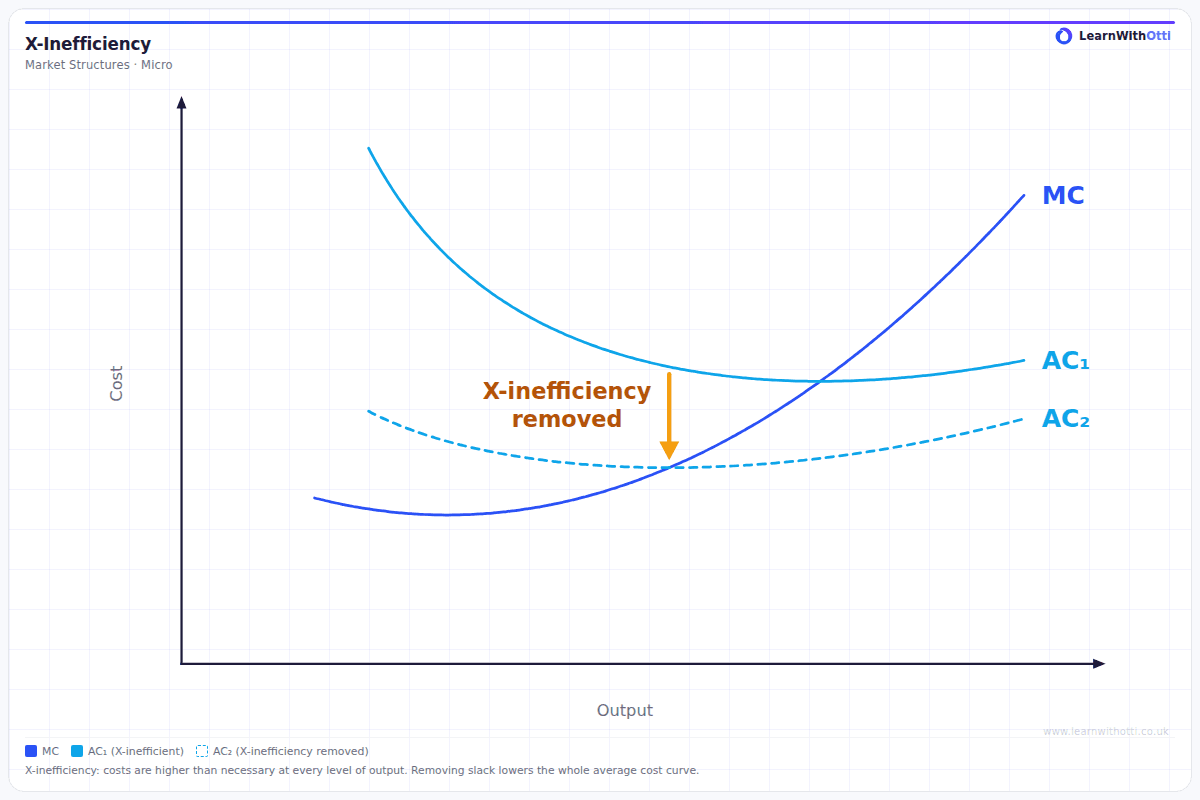
- Price caps, performance targets and the threat of competition all put pressure on firms to cut waste and move back down to the lowest average cost curve.
- Competitive tendering, where private firms bid for the right to supply a public service, means the contract goes to the firm that can provide it most cheaply.
Allocative efficiency
- Lower prices bring the outcome closer to the point where price equals marginal cost, so more of the good is produced and the deadweight welfare loss shrinks.
Dynamic efficiency
- Intervention can reduce dynamic efficiency if it cuts the profit that pays for investment and innovation. A firm that expects its profit to be capped may see little point in investing in new technology.
- On the other hand, competition forces firms to innovate to survive, and regulators can set targets for investment, as Ofwat does for water infrastructure.
Impact on quality
- A firm under a tight price cap can protect its profit by cutting quality rather than costs. Fewer staff, less maintenance and slower repairs all reduce costs but harm consumers.
- Quality standards and performance targets are used to prevent this. Rail operators are judged on punctuality, and water companies face penalties for leaks and sewage discharges.
- Targets can backfire. Firms may hit the target in ways that do not improve the service, or neglect parts of the service that are not measured.
- Competition improves quality as well as price, because consumers can switch to a rival if the service is poor.
Impact on choice
- Competition policy and deregulation increase the number of firms in a market, giving consumers more choice. The energy and telecoms markets in the UK opened up to many new suppliers after privatisation and deregulation.
- More choice is only valuable if consumers can compare offers. Complicated tariffs can make switching hard, so regulators may also require clear information.
- Some intervention reduces choice. A nationalised industry is usually the only supplier, and some regulation, such as the energy price cap, leaves suppliers little room to offer different prices on standard tariffs.
- In 2021 and 2022, many small energy suppliers went out of business when wholesale prices rose faster than the price cap allowed them to charge, which reduced choice for consumers.
Limits to government intervention
Regulatory capture
- Regulatory capture happens when a regulator comes to act in the interests of the firms it regulates rather than consumers.
- It can happen because regulators rely on firms for information and expertise, because staff move between the regulator and the industry, and because firms lobby hard while consumers are spread out and poorly organised.
- A captured regulator may set a generous price cap, allow high profits or fail to punish poor performance. Critics have argued that water companies in England were allowed to build up large debts and pay high dividends while investment in infrastructure fell short and sewage discharges continued.
- Solutions include fixed terms for regulators, rules on staff moving to and from the industry, and publishing decisions so they can be challenged.
Asymmetric information
- The firm knows far more about its own costs, demand and ability to cut costs than the regulator does.
- This makes it hard to set the right value of X in a price cap or the right rate of return. Firms have an incentive to overstate their costs so that the regulator sets a more generous cap.
- It also makes quality hard to monitor. A firm can hide cuts to maintenance that only show up years later.
- Regulators try to reduce the gap by comparing the performance of similar firms against each other, and by requiring firms to publish detailed information.
Other limits
- Regulation has administrative and compliance costs, which may be passed on to consumers.
- Intervention can have unintended consequences, as when a tight cap leads to lower investment or firms leaving the market.
- These limits are examples of 1.4.2 Government failure.
Evaluating the impact
- What type of market is it? In a natural monopoly, competition is not possible, so regulation of price and quality is the main option. In other markets, promoting competition may achieve more than regulation.
- Short run against long run. A tight cap lowers prices now but may reduce investment and quality in future.
- How good is the regulator's information? The impact depends on setting caps and targets at the right level.
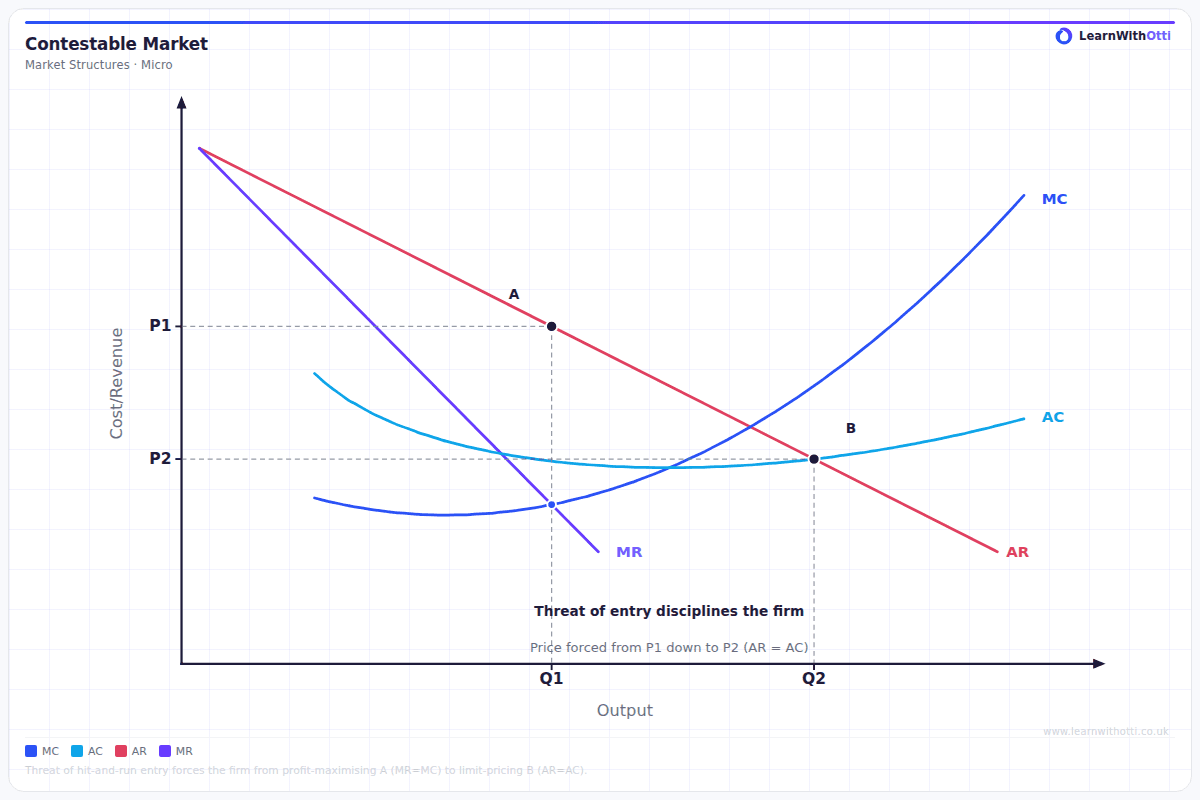
- Is the market contestable? If barriers to entry are low, the threat of entry may control prices without much regulation, as covered in 3.4.7 Contestability.
- Who gains? Lower prices help consumers but reduce returns to shareholders and may reduce tax revenue from profits.
Key terms
| Term | Meaning |
|---|---|
| Price regulation | A limit on the prices a firm can charge, such as an RPI minus X cap |
| RPI minus X | A price cap that limits price rises to the rate of inflation minus an efficiency factor X |
| Rate of return regulation | A limit on profit as a percentage of the capital a firm has invested |
| X-inefficiency | Costs above the lowest possible level, caused by a lack of competitive pressure |
| Performance target | A standard of service a regulated firm must meet, with penalties if it does not |
| Regulatory capture | When a regulator acts in the interests of the firms it regulates rather than consumers |
| Asymmetric information | When one side of a relationship knows more than the other, such as a firm knowing more about its costs than the regulator |
Common mistakes
- Assuming a price cap always helps consumers. If it is set too low, quality and investment may fall, and firms may leave the market.
- Forcing a natural monopoly to price at marginal cost. Average cost is above marginal cost where it meets demand, so the firm would make a loss.
- Ignoring quality. A firm under pressure on price can cut quality instead of costs.
- Treating all intervention as the same. Competition policy, regulation and changes in ownership work in different ways and have different impacts.
- Describing regulatory capture without explaining why it happens. Link it to the regulator's reliance on the firm for information and to lobbying.
- Forgetting dynamic efficiency. Lower profits can mean less money for investment and innovation.
How this has been examined
In the Edexcel papers indexed on this site, this topic has appeared in one format:
- 25-mark "Evaluate" synoptic essay — asked once (2021)
Where this goes next
The tools whose impact is assessed here are set out in 3.6.1 Government intervention. The market structures that intervention targets are covered in 3.4.5 Monopoly and 3.4.4 Oligopoly, and the types of efficiency in 3.4.1 Efficiency. The threat of entry as an alternative to regulation is covered in 3.4.7 Contestability, and the wider case for intervention failing is developed in 1.4.2 Government failure.
End of topic 3.6
Quiz yourself on 3.6 Government intervention
10 multiple-choice questions drawn from the 41 we have on the whole of topic 3.6, with instant feedback on every answer.
Start the 3.6 quiz →Otti is an AI tutor built for A-Level students. Ask it anything, practise exam questions, and get instant feedback written like an examiner would give it — not just right or wrong, but why.
Get one answer marked free