Edexcel A-Level Economics · Revision notes
3.5.3 Wage determination in competitive and non-competitive markets
Wages are the price of labour, so they are set by the demand for and supply of labour, just like any other price. But labour markets are rarely perfectly competitive, and governments intervene in them heavily. This topic brings demand and supply together, covers how wages are set when employers or workers have power, and examines government intervention.
Labour market equilibrium in a competitive market
In a competitive labour market, there are many employers and many workers, none of whom can influence the wage on their own.
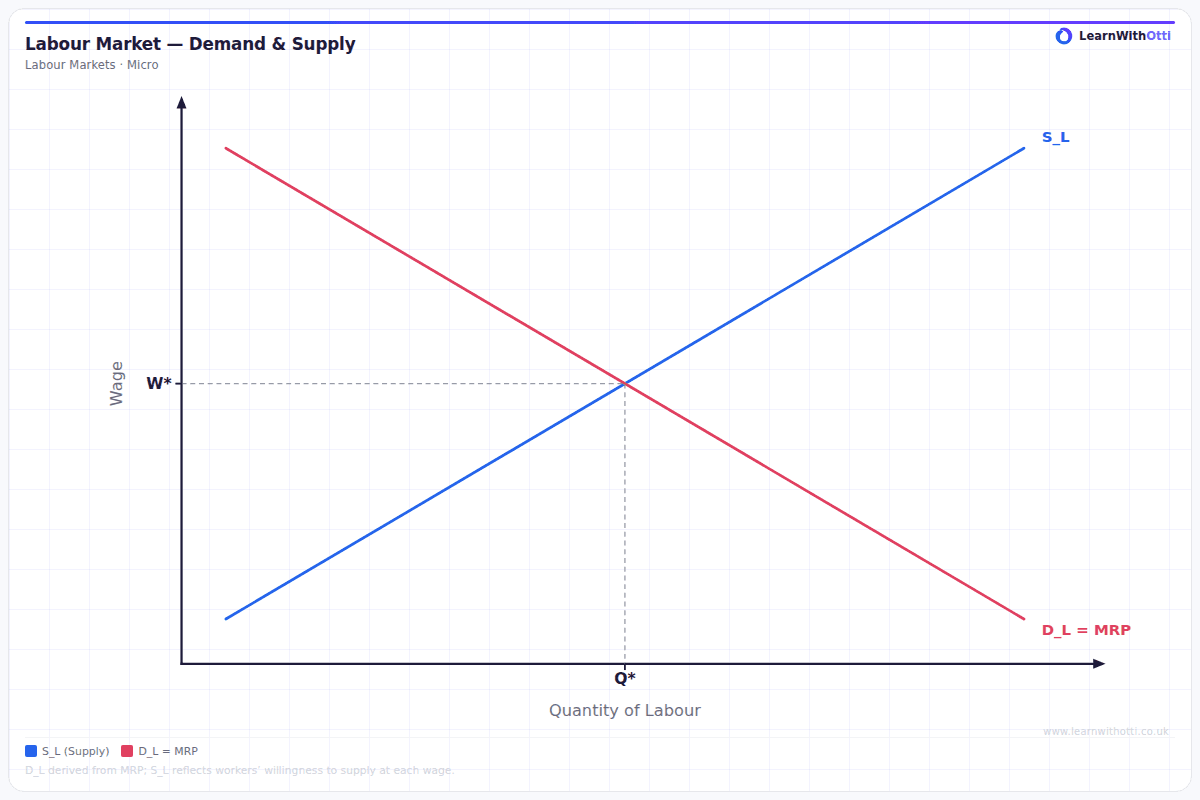
- The demand for labour slopes downwards: at a lower wage, firms employ more workers.
- The supply of labour slopes upwards: at a higher wage, more workers are willing to work.
The equilibrium wage is where demand equals supply. At this wage, everyone who wants a job at the going rate can find one, and every employer who wants to hire at that rate can do so.
Changes in equilibrium
- A rise in the demand for labour, for example because demand for the product rises, increases both the wage and employment.
- A rise in the supply of labour, for example from migration, increases employment but lowers the wage.
Why wages differ between occupations
Wages differ because demand and supply conditions differ. Occupations that need scarce skills and long training have a low supply of labour and often a high demand, so they pay high wages. Jobs that many people can do have a large supply and pay lower wages.
| Hospital consultant | Fast-food worker | |
|---|---|---|
| Supply of labour | Small. It takes over ten years of training after school, and only qualified doctors can apply | Large. Little training is needed, so many people can do the job |
| Elasticity of supply | Very inelastic. More consultants cannot be trained quickly, even if pay rises | Elastic. Extra workers can be found quickly, often from similar jobs |
| Demand for labour | High and rising, as an ageing population needs more health care. Each consultant's work is highly valued | Lower. Each extra worker adds relatively little revenue, and ordering screens can replace some staff |
| Result | High wages, over £100,000 a year | Wages close to the National Living Wage |
So the gap in pay is not about how hard people work. It reflects the combination of scarce, inelastic supply and high demand at one end, and plentiful, elastic supply with lower demand at the other.
Non-competitive labour markets
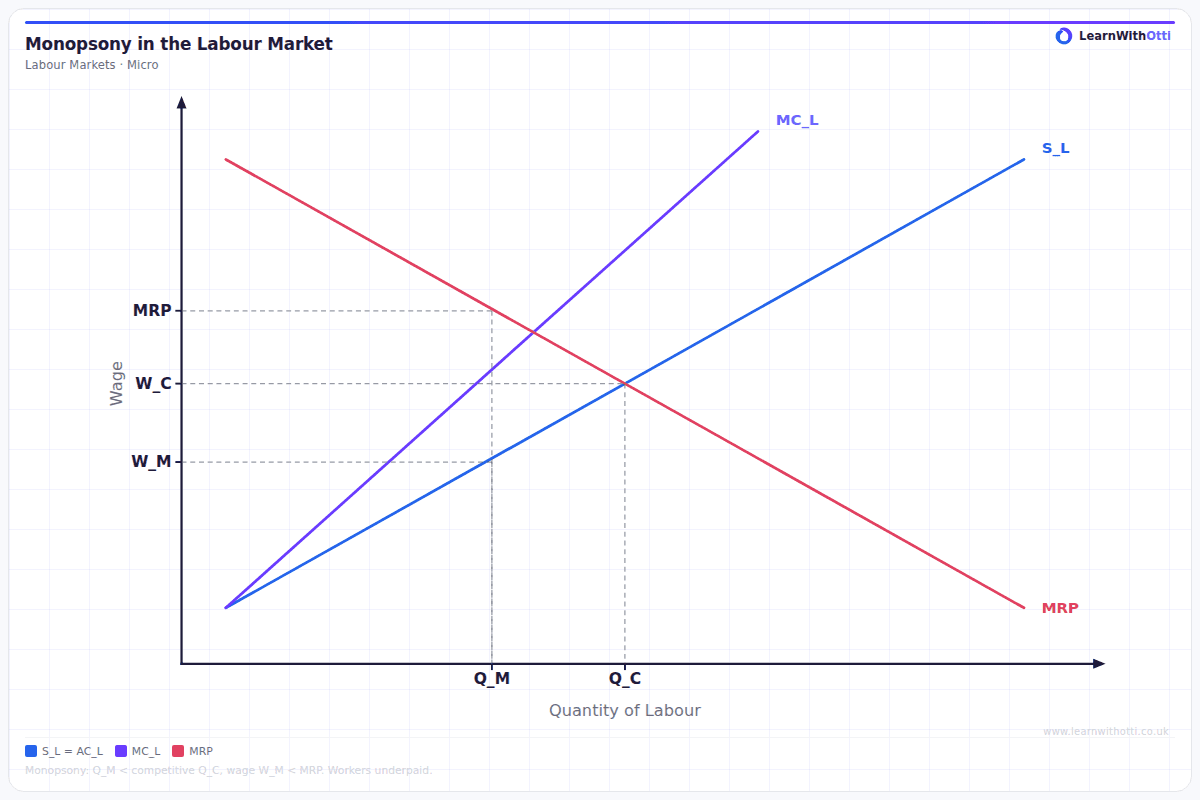
Monopsony employers. A single dominant employer can pay a wage below the competitive level and employ fewer workers.
Trade unions. Unions bargain collectively on behalf of workers.
Key distinction: In a competitive market, a union that pushes the wage above equilibrium may raise pay for its members but reduce employment. Facing a monopsony employer, a union can raise both wages and employment by offsetting the employer's power.
The significance of elasticity
Elasticity of demand for labour
The wage elasticity of demand for labour measures how much employment changes when the wage changes. It is more elastic when labour is easily replaced by machines, when wages are a large share of total costs, and when demand for the product is price elastic. It is also more elastic in the long run, because firms have time to change their methods of production.
Evaluation: If demand for labour is elastic, a rise in wages, such as from a minimum wage, causes a larger fall in employment.
Elasticity of supply of labour
The elasticity of supply of labour measures how much the number of workers willing to work in an occupation changes when the wage changes. Supply of labour is more inelastic when:
- Skills are scarce and training is long. It takes many years to qualify as a doctor or an airline pilot, so a higher wage cannot quickly create more workers.
- Qualifications or licences are required, which limit who is allowed to do the job.
- Workers are immobile. If workers cannot easily move between areas or occupations, a higher wage in one place or job attracts few extra workers.
- The time period is short. Over time, higher wages encourage more people to train, so supply becomes more elastic in the long run.
Supply is more elastic when the job needs few skills, when there is plenty of unemployment or spare labour, and when workers can move easily from similar jobs.
Why elasticity matters
- The effect of a rise in demand for labour. If supply is inelastic, a rise in demand mainly raises wages, as with doctors or top footballers. If supply is elastic, it mainly raises employment, as with bar staff or delivery drivers.
- Minimum wages. A minimum wage causes fewer job losses where demand for labour is inelastic, such as in care work, where staff cannot easily be replaced by machines. Where demand is elastic, for example where self-service technology is a close alternative, job losses are larger.
- Trade union bargaining. Unions can win higher wages with little loss of jobs when demand for labour is inelastic. Where demand is elastic, a higher wage costs more jobs, which weakens a union's bargaining power.
- Wage differentials. High pay in occupations such as medicine and law is explained by high demand combined with inelastic supply.
- Government policy. Training, apprenticeships and immigration policy can make the supply of labour more elastic, easing skills shortages and limiting rises in wage costs in those occupations.
Current labour market issues
- Zero-hours contracts and the gig economy. Flexible work suits some workers but leaves others with uncertain hours and income.
- Skills shortages in areas such as health care, construction and technology.
- The gender pay gap, the difference between average earnings of men and women.
- Migration, which affects the supply of labour in many sectors.
- Automation and artificial intelligence, which may replace some jobs and create others.
- Public sector pay disputes, as pay in some public sector jobs has fallen behind the private sector.
Government intervention in the labour market
Minimum wages
A minimum wage is a legal floor on hourly pay. In the UK, the National Living Wage applies to workers aged 21 and over, with lower rates for younger workers and apprentices.
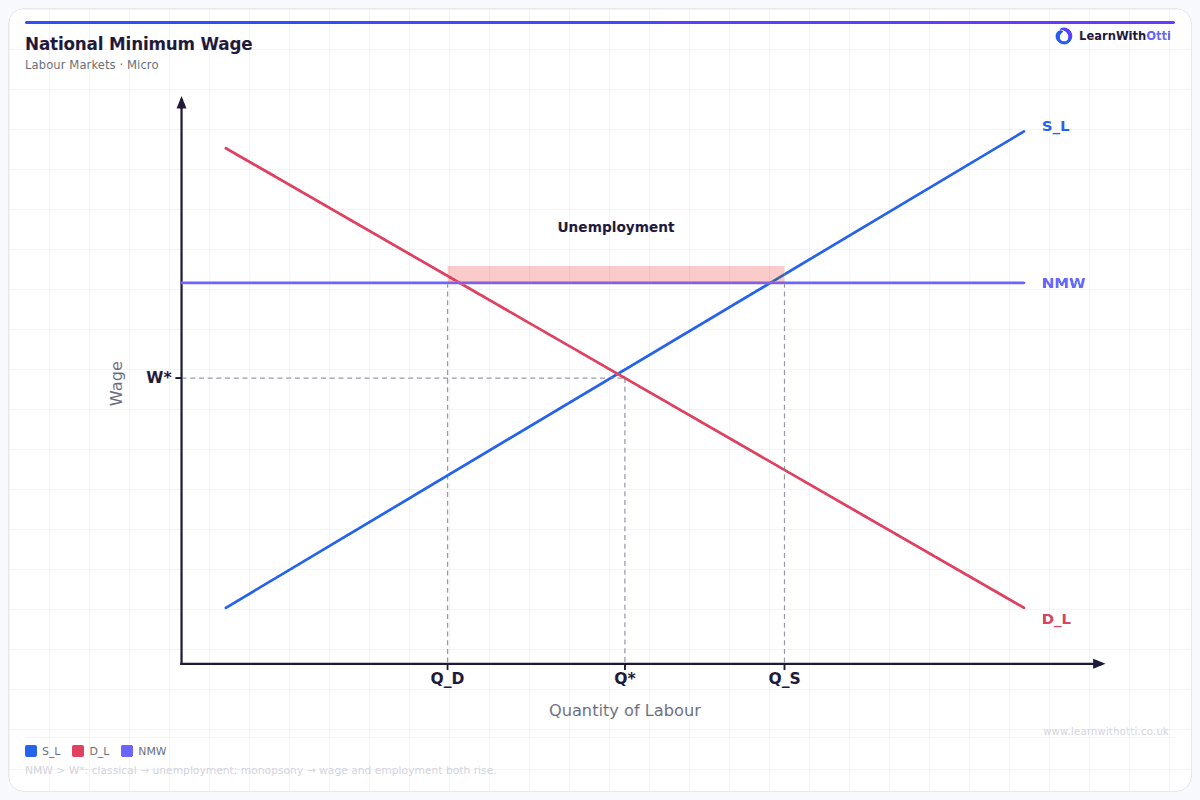
- In a competitive market, a minimum wage set above the equilibrium wage raises pay for those in work, but the quantity of labour demanded falls and the quantity supplied rises, creating unemployment.
- In a monopsony market, a minimum wage can raise both wages and employment, because it removes the employer's incentive to restrict hiring.
- Benefits: it reduces in-work poverty, can raise productivity by motivating workers, and reduces reliance on in-work benefits.
- Costs: possible job losses, especially among young and low-skilled workers, and higher costs for small firms.
Maximum wages
A maximum wage is a legal ceiling on pay. It is rare, but caps on pay for senior public sector staff and limits on bankers' bonuses have been used. Maximum wages may reduce inequality, but they can cause skilled workers to move abroad or to sectors without the cap.
Public sector wage setting
The government is the largest employer in the UK, so it sets the pay of millions of workers, including nurses, teachers and members of the armed forces. Independent pay review bodies make recommendations, but the government decides.
Evaluation: Holding public sector pay down can save money, but it can also cause staff shortages and industrial action if pay falls behind the private sector.
Policies to tackle labour market immobility
- Training and apprenticeships to reduce occupational immobility.
- Relocation support and help with moving costs to reduce geographical immobility.
- Housing policy, such as building more affordable homes in areas with many jobs.
- Better information about job vacancies through job centres and online services.
Key terms
| Term | Meaning |
|---|---|
| Equilibrium wage | The wage at which the demand for labour equals the supply of labour |
| Trade union | An organisation that bargains collectively on behalf of workers |
| National Living Wage | The UK's legal minimum hourly wage for workers aged 21 and over |
| Maximum wage | A legal ceiling on the pay of a group of workers |
| Wage elasticity of demand for labour | The responsiveness of the demand for labour to a change in the wage |
| Elasticity of supply of labour | The responsiveness of the supply of labour to a change in the wage |
Common mistakes
- Assuming a minimum wage always causes unemployment. In a monopsony market it can raise employment.
- Forgetting elasticity. The effect of a wage change on employment depends on the elasticity of demand for labour.
- Drawing a minimum wage below equilibrium. It only has an effect if it is set above the market wage.
- Treating all labour markets as competitive. Monopsony employers and trade unions change the outcome.
How this has been examined
In the Edexcel papers indexed on this site, this topic has appeared in eight formats:
- 25-mark "Evaluate" essay — asked twice across 2 series (2019 to 2021)
- 25-mark "Evaluate" synoptic essay — asked twice across 2 series (2022 to 2024)
- 15-mark "Discuss" data response — asked once (2018)
- 12-mark "Discuss" data response — asked once (2017)
- 8-mark "Examine" data response — asked once (2025)
- 4-mark "Draw" diagram — asked once (2025)
- 4-mark "Explain" data response — asked once (2023)
- 1-mark multiple choice — asked once (2023)
It has appeared at every tariff from 1 to 25 marks.
Where this goes next
The two sides of the labour market are covered in 3.5.1 Demand for labour and 3.5.2 Supply of labour, and a single dominant employer in 3.4.6 Monopsony. Minimum prices in product markets are covered in 1.4.1 Government intervention in markets, and the link between wages, poverty and inequality in 4.2.1 Absolute and relative poverty and 4.2.2 Inequality.
End of topic 3.5
Quiz yourself on 3.5 Labour market
10 multiple-choice questions drawn from the 61 we have on the whole of topic 3.5, with instant feedback on every answer.
Start the 3.5 quiz →Otti is an AI tutor built for A-Level students. Ask it anything, practise exam questions, and get instant feedback written like an examiner would give it — not just right or wrong, but why.
Get one answer marked free