Edexcel A-Level Economics · Revision notes
2.6.4 Conflicts and trade-offs between objectives and policies
Governments rarely achieve all their macroeconomic objectives at once. Progress on one objective can make another harder to reach, and a policy aimed at one problem can create new ones elsewhere. This topic covers the main conflicts between objectives, the short-run Phillips curve as the best-known example, and the trade-offs between policies.
Conflicts between objectives
Some objectives support each other. Faster growth usually reduces unemployment and raises tax revenue, which helps the budget balance. But several important objectives pull in opposite directions, especially in the short run.
Economic growth and low inflation
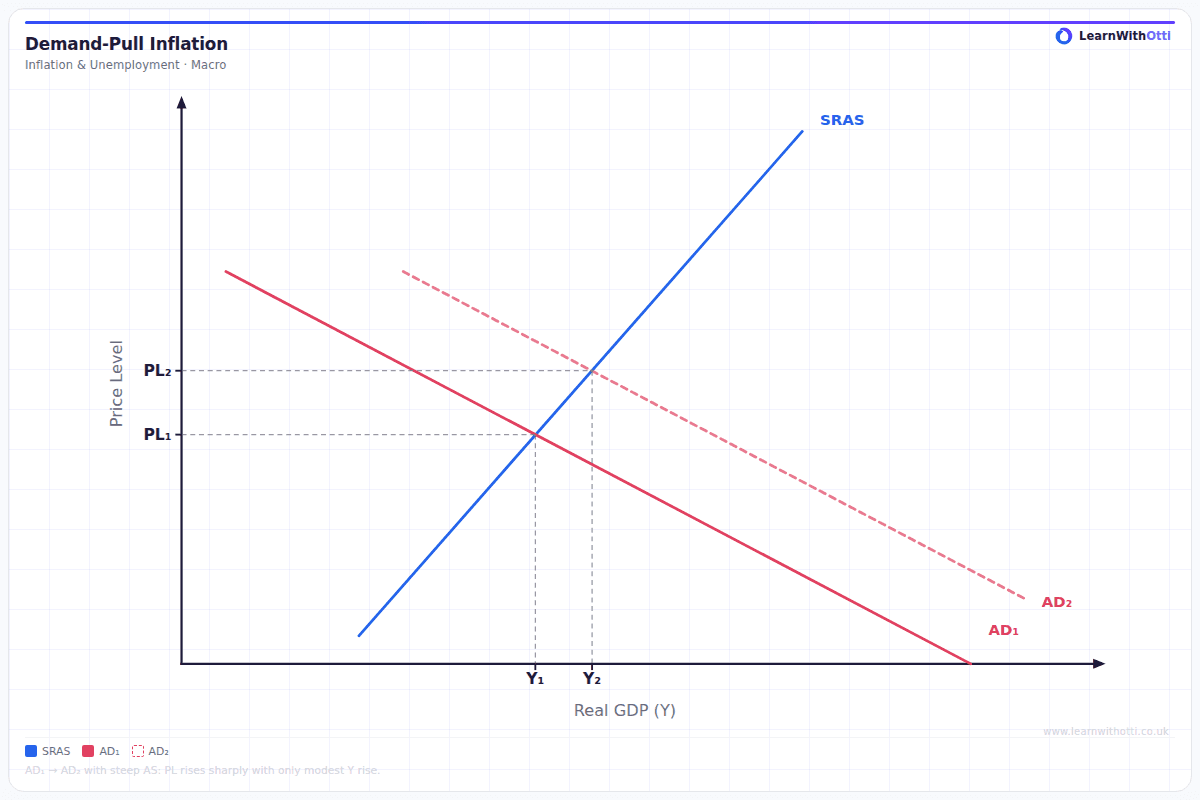
Key idea: If AD grows faster than the economy's productive capacity, spare capacity is used up. Firms compete for scarce workers and materials, costs rise and firms raise prices. Rapid growth close to full capacity leads to demand-pull inflation.
Controlling inflation may then require slower growth.
Economic growth and the current account
As incomes rise, households buy more goods and services, including imports. The UK has a high propensity to import, so fast growth tends to worsen the current account. If UK inflation also rises above that of other countries, UK exports become less price competitive.
Economic growth and protection of the environment
More output usually means more energy use, more resource depletion, more waste and more emissions. Growth can therefore conflict with environmental objectives such as net zero. Cleaner technology can reduce this conflict, but it does not remove it.
Economic growth and greater income equality
Growth does not always benefit everyone equally. In periods of rapid growth, the incomes of the highly skilled and of those who own assets can rise faster than the incomes of low earners, widening inequality. In the other direction, highly progressive taxes designed to reduce inequality may reduce incentives to work and invest, slowing growth.
Low unemployment and low inflation
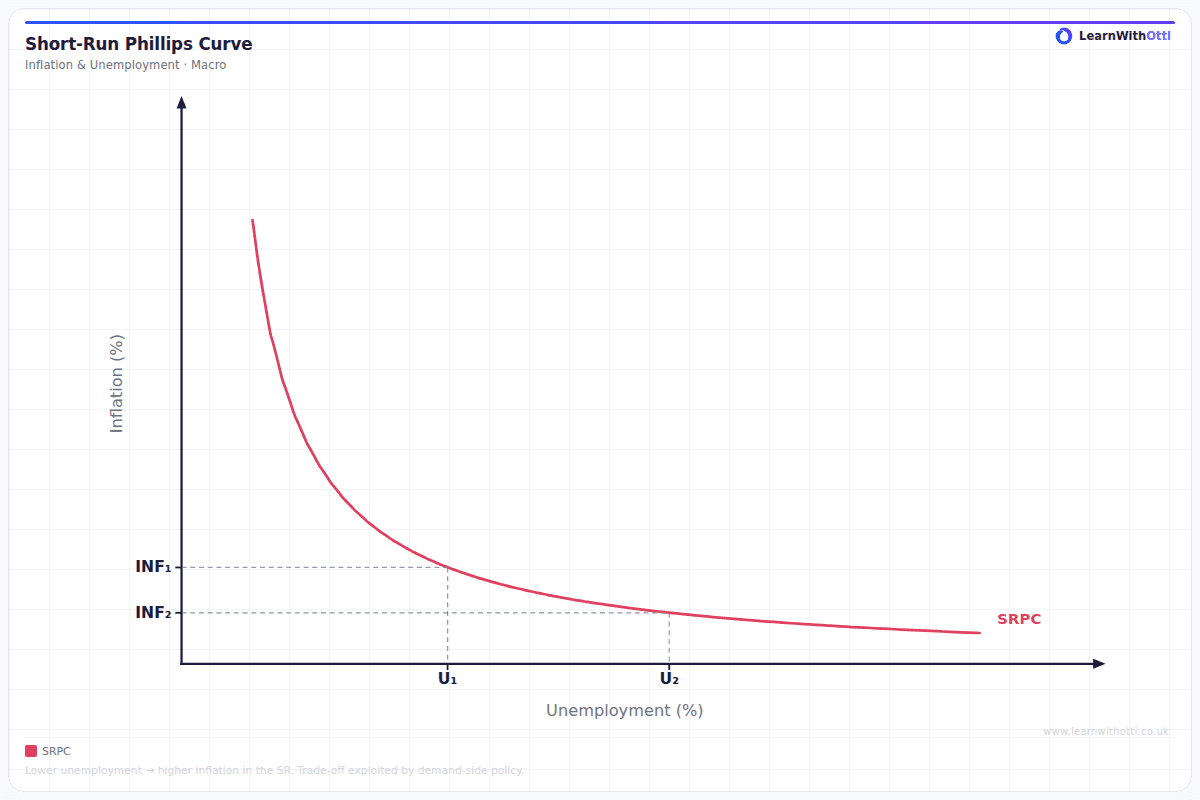
When unemployment is low, workers have more bargaining power and firms must offer higher wages to recruit. Rising wage costs are passed on as higher prices. This trade-off is shown by the short-run Phillips curve, below.
A balanced budget and growth or unemployment
Key idea: Cutting a budget deficit means cutting government spending or raising taxes. Both reduce AD in the short run, which slows growth and can raise unemployment. In a recession, automatic stabilisers push the budget into deficit, so trying to balance it at the same time would make the recession deeper.
Low inflation and the current account
Raising interest rates to reduce inflation tends to cause the pound to appreciate, as higher UK rates attract savings from abroad. A stronger pound makes UK exports dearer for foreign consumers and imports cheaper, which can worsen the current account.
The short-run Phillips curve
In 1958, the economist A. W. Phillips published evidence from UK data showing that, over almost a century, years of low unemployment tended to be years of rapid wage inflation, and years of high unemployment tended to be years of low wage inflation. The relationship was later expressed in terms of price inflation and unemployment.
What the curve shows
- The short-run Phillips curve (SRPC) slopes downwards, showing an inverse relationship between the rate of inflation and the rate of unemployment.
- A movement up the curve means lower unemployment but higher inflation. A movement down the curve means lower inflation but higher unemployment.
Why the relationship exists
- When AD rises, firms produce more and take on more workers, so unemployment falls.
- As the labour market tightens, workers can bargain for higher wages and firms compete for staff.
- Higher wage costs, along with stronger demand, push up prices.
The policy implication. In the 1950s and 1960s, the curve was taken to mean that governments faced a menu of choices. They could use demand-side policy to choose a lower unemployment rate, as long as they were willing to accept higher inflation, or the reverse.
When the relationship broke down
In the 1970s, the UK experienced high inflation and high unemployment at the same time, known as stagflation. This did not fit the original curve. A major cause was supply shocks: sharp rises in oil prices raised costs for firms across the economy, pushing up inflation and reducing output and employment at the same time.
Policy conflicts and trade-offs
Each policy has side effects. A policy that helps one objective can harm another, and policies run by different bodies can pull in different directions.
Monetary policy
- Raising interest rates to reduce inflation also reduces consumption and investment, slowing growth and raising unemployment. It hits households with mortgages hardest, and the stronger pound can worsen the current account.
- Cutting interest rates or using QE to support growth risks higher inflation later, can fuel rises in house prices, and may widen wealth inequality by raising the price of assets owned mainly by wealthier households.
Fiscal policy
- Expansionary fiscal policy supports growth and employment, but increases the budget deficit and national debt. It may cause crowding out and, close to full capacity, inflation.
- Contractionary fiscal policy to reduce the deficit, such as UK austerity after 2010, improves the public finances over time but slows growth and can lead to cuts in public services that affect low-income households most.
- Raising indirect taxes brings in revenue but adds to inflation in the short run and is regressive.
Supply-side policy
- Cutting income tax and corporation tax may improve incentives, but reduces tax revenue in the short run, worsening the budget balance, and the gains may go mainly to high earners.
- Interventionist spending on infrastructure and training raises capacity in the long run, but adds to government borrowing now.
- Labour market reforms such as weaker employment protection may lower unemployment, but can make work less secure and widen inequality.
Environmental policy
- Environmental taxes and regulation protect the environment, but raise costs for firms, may push up prices, and can reduce international competitiveness and growth in the short run.
Monetary and fiscal policy in conflict. Because the Bank of England and the government make decisions separately, their policies can pull against each other. If the government cuts taxes while the Bank is raising interest rates to bring inflation down, the Bank may need to raise rates further to offset the extra demand.
Judging how serious a conflict is
- Spare capacity. With a large negative output gap, demand-side policy can raise growth and cut unemployment with little inflation. The conflict is sharpest close to full capacity.
- Time horizon. Many conflicts are short-run. Contractionary policy may cause a recession now but lower inflation and a stronger budget position later.
- The cause of the problem. Cost-push inflation creates a harder trade-off than demand-pull inflation, because raising interest rates reduces output that is already falling.
- Supply-side policies. Raising productive capacity allows growth without inflation, easing several conflicts at once, but only in the long run.
- Policy mix. Combining policies, such as using fiscal policy to support growth while monetary policy controls inflation, can reduce trade-offs.
- Priorities. Which objective matters most is a value judgement. Different governments, and different groups in society, weigh the objectives differently.
Key terms
| Term | Meaning |
|---|---|
| Trade-off | Giving up progress on one objective to make progress on another |
| Policy conflict | When a policy aimed at one objective makes another objective harder to achieve |
| Short-run Phillips curve | A curve showing an inverse relationship between inflation and unemployment |
| Stagflation | High inflation and high unemployment at the same time, with low or negative growth |
| Propensity to import | The share of extra income that is spent on imports |
| Policy mix | The combination of monetary, fiscal and supply-side policies used together |
Common mistakes
- Treating every objective as conflicting. Some objectives support each other, such as growth and lower unemployment. Identify which conflict, and why.
- Stating a conflict without the mechanism. Saying that growth causes inflation is incomplete until it is linked to spare capacity being used up and costs rising.
- Drawing the Phillips curve with the axes the wrong way round. Inflation goes on the vertical axis and unemployment on the horizontal axis.
- Treating the Phillips curve trade-off as fixed. The 1970s showed that supply shocks can shift the curve.
- Ignoring time. A conflict that is severe in the short run may disappear in the long run, especially if supply-side policies raise capacity.
- Forgetting that priorities are a value judgement. Which objective should come first depends on who is affected and how society weighs the costs.
How this has been examined
In the Edexcel papers indexed on this site, this topic has appeared in two formats:
- 25-mark "Evaluate" essay — asked twice across 2 series (2021 to 2025)
- 12-mark "Discuss" data response — asked once (2019)
Where this goes next
The objectives themselves are set out in 2.6.1 Possible macroeconomic objectives, and the policies used to pursue them in 2.6.2 Demand-side policies and 2.6.3 Supply-side policies. The causes of inflation behind the Phillips curve are covered in 2.1.2 Inflation, the measures of unemployment in 2.1.3 Employment and unemployment, and the role of spare capacity in 2.5.2 Output gaps. These conflicts are revisited in a global setting in 4.5.4 Macroeconomic policies in a global context.
End of topic 2.6
Quiz yourself on 2.6 Macroeconomic objectives and policies
10 multiple-choice questions drawn from the 68 we have on the whole of topic 2.6, with instant feedback on every answer.
Start the 2.6 quiz →Otti is an AI tutor built for A-Level students. Ask it anything, practise exam questions, and get instant feedback written like an examiner would give it — not just right or wrong, but why.
Get one answer marked free