Edexcel A-Level Economics · Revision notes
2.5.4 The impact of economic growth
Economic growth is usually treated as a good thing, and it is one of the main macroeconomic objectives of government. But growth has costs as well as benefits, and they fall differently on different groups. This topic covers the benefits and costs of economic growth for consumers, firms and the government, and its impact on current and future living standards.
Consumers
Benefits
- Higher real incomes. When real GDP grows faster than the population, real GDP per capita rises. Firms produce more, so they pay out more in wages, rent, interest and profit, and on average people can afford to buy more goods and services. Because the figure is real, this is a genuine rise in purchasing power, not just higher prices.
- More jobs and greater job security. Labour is a derived demand: firms need more workers to produce the extra output. Unemployment falls, people who were out of work gain an income, and workers already in jobs face less risk of being laid off, which makes them more confident about spending and borrowing.
- More choice and better quality. Growing markets give firms the revenue and the incentive to develop new products and improve existing ones, because higher demand means a better return on research and development. Consumers gain from products such as new medicines and digital services that did not exist before.
- Better public services. As incomes and spending rise, the government collects more tax without raising tax rates. This can pay for more spending on health, education and transport, which consumers use whether or not their own income has risen.
Costs
- Inflation. If growth comes mainly from aggregate demand rising faster than productive capacity, firms run short of workers and materials and raise prices. Real incomes are eroded, and people on fixed incomes, such as some pensioners and benefit claimants, lose most because their income does not rise with prices.
- Uneven gains. Growth is usually concentrated in particular industries and regions. Workers with skills in demand see their wages rise fastest, while those in declining industries or poorer regions may gain little, so inequality can widen even while average incomes rise.
- Negative externalities. More production uses more energy and raw materials, and higher incomes mean more cars, flights and consumption. This creates pollution, congestion and noise, which harm third parties and are not reflected in market prices.
- Longer hours and stress. Some of the extra output may come from people working longer hours or more intensively rather than more productively. Measured income rises, but leisure time falls, so wellbeing may not improve as much as GDP suggests.
Firms
Benefits
- Higher sales and profits. Rising real incomes increase demand for normal goods, especially luxuries, whose demand is income elastic. Higher sales spread fixed costs over more units, so profits usually rise faster than sales.
- More investment. Higher profits provide internal finance for investment, and confidence that demand will keep rising makes new capacity look worthwhile. This is the accelerator effect: firms invest when they expect output to grow. The extra capital also adds to the productive capacity of the economy.
- Economies of scale. As firms grow, they can buy in bulk, use specialised machinery and spread fixed costs over a larger output. Their long-run average costs fall, which can be passed on as lower prices or kept as higher profit.
- Lower risk. When demand is growing, firms are less likely to be left with unsold stock or unable to cover their costs, so fewer businesses fail and it is easier to raise finance from banks and investors.
Costs
- Rising costs. Fast growth means many firms want more workers and materials at the same time. Shortages of skilled labour push up wages, and higher demand for raw materials and components pushes up their prices, which squeezes profit margins.
- Capacity constraints. In the short run, firms cannot expand capacity quickly. If they cannot meet orders, customers may turn to competitors, including foreign firms, so sales are lost to imports.
- Weaker international competitiveness. If growth pushes UK inflation above that of other countries, UK goods become relatively more expensive abroad and imports become relatively cheaper at home, so exporters and firms competing with imports lose sales.
- Uneven effects. Not every firm gains. Demand for inferior goods, such as some value or budget products, falls as incomes rise, because consumers switch to better alternatives.
The government
Benefits
- Higher tax revenue without higher tax rates. Income tax receipts rise as incomes rise, VAT receipts rise as spending rises, and corporation tax receipts rise as profits rise. With a progressive income tax, revenue can rise faster than incomes, as more income is taxed at higher rates.
- Lower spending on welfare benefits. As unemployment falls, fewer people claim unemployment-related benefits, and rising wages reduce the number who qualify for in-work support.
- Improving public finances. Higher revenue and lower welfare spending reduce the budget deficit. Government debt also falls as a percentage of GDP, both because less is borrowed and because GDP itself is larger.
- More room for spending or tax cuts. The extra revenue can pay for public services and infrastructure, or allow tax cuts, without extra borrowing. This makes it easier for the government to meet its fiscal rules.
Costs
- Inflationary pressure. If growth is above the trend rate and the economy runs out of spare capacity, inflation rises. The Bank of England may raise interest rates, and the government may need to tighten fiscal policy, which can slow growth sharply.
- A worsening current account. Rising incomes increase spending on imports, especially when domestic firms are already at full capacity. If exports do not rise as fast, the current account deficit widens.
- Pressure on infrastructure and public services. A larger economy and a growing population put more strain on housing, transport, schools and health care. The government must spend more just to keep services at the same standard.
- Environmental costs. Growth can increase pollution and carbon emissions, which the market does not correct on its own. The government may need taxes, regulation or spending to deal with these negative externalities, and to meet commitments such as net zero by 2050.
Current and future living standards
Current living standards
Growth in real GDP per capita raises the average person's material standard of living. But how much it improves wellbeing depends on:
- distribution: who receives the extra income
- what is produced: more spending on clean-up after pollution adds to GDP without making anyone better off
- the costs that GDP misses: pollution, congestion and lost leisure time
Future living standards
Growth affects the future as well as the present.
- Investment raises future capacity. Growth that comes from investment in capital, infrastructure, education and technology increases productive capacity, so future generations can enjoy higher living standards.
- There is an opportunity cost. Resources used to produce capital goods today cannot be used to produce consumer goods. On a production possibility frontier, choosing more capital goods now means less consumption now, but a larger outward shift of the frontier later.
- Resource depletion and environmental damage. Growth that uses up non-renewable resources, or damages the environment through pollution and climate change, can reduce the living standards of future generations.
Key idea: Growth that meets the needs of the present without reducing the ability of future generations to meet their own needs is called sustainable growth.
It depends on the type of growth
Evaluation: The balance of benefits and costs depends on where the growth comes from. Growth driven by rising aggregate demand alone uses up spare capacity and, once the economy is close to full capacity, mainly pushes up prices. Growth driven by an increase in productive capacity raises output without the same inflationary pressure, so its benefits are more likely to last and to outweigh its costs.
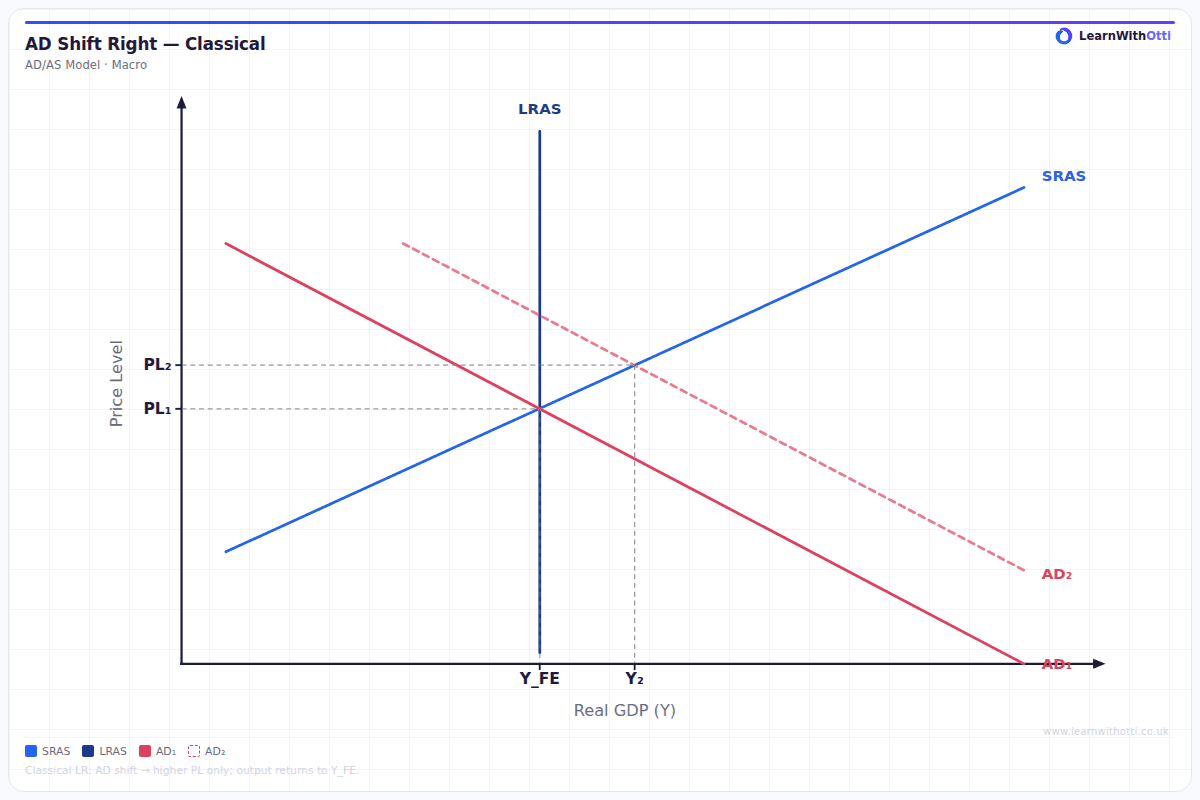
Demand-led growth close to full capacity. If AD rises when the economy is already at full capacity, the result is mainly a higher price level. Growth like this is unlikely to last and tends to bring inflation and a worsening current account.
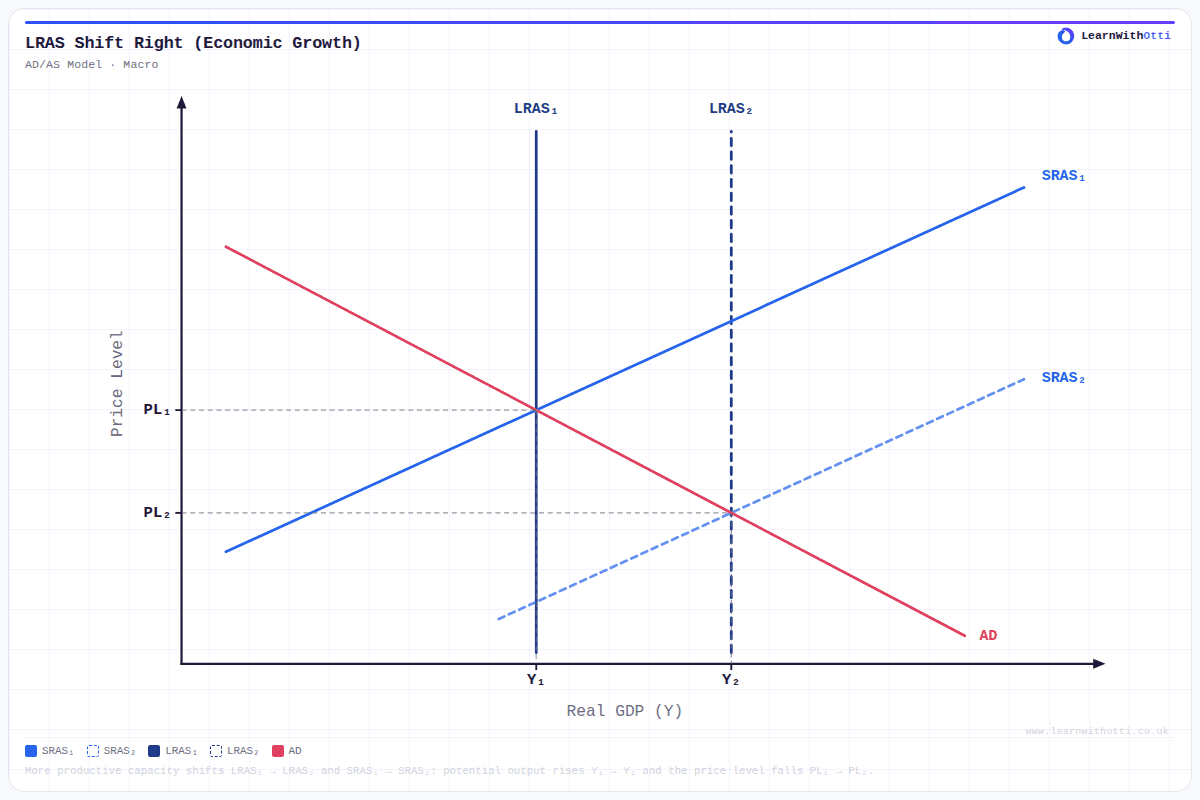
Supply-led growth. If growth comes from an increase in LRAS, through better technology, more investment or a more skilled workforce, real output can rise without rising inflation. This kind of growth is more likely to be sustained, and its benefits are more likely to outweigh its costs.
Other factors also shape the impact: how evenly the gains are shared, how much environmental damage the growth causes, and whether the growth rate is steady or swings between boom and recession.
Key terms
| Term | Meaning |
|---|---|
| Living standards | The economic wellbeing of people, measured partly by real GDP per capita |
| Sustainable growth | Growth that meets present needs without reducing the ability of future generations to meet theirs |
| Negative externality | A cost of production or consumption borne by a third party |
| Opportunity cost | The next best alternative given up when a choice is made |
| Productive capacity | The maximum output an economy can produce with its resources fully and efficiently employed |
Common mistakes
- Listing benefits and costs without saying who is affected. Make clear whether you are discussing consumers, firms or the government.
- Assuming growth benefits everyone equally. Average incomes can rise while some groups are left behind.
- Ignoring the type of growth. Demand-led growth at full capacity and supply-led growth have very different effects on inflation and sustainability.
- Forgetting the future. Growth today can raise or reduce future living standards, depending on whether it comes from investment or from using up resources.
- Treating higher GDP as the same as higher wellbeing. GDP leaves out distribution, environmental costs and leisure.
How this has been examined
This topic has not appeared as a standalone question in the Edexcel papers indexed on this site.
Where this goes next
How growth is measured, and why GDP is an imperfect guide to living standards, is covered in 2.1.1 Economic growth. Growth as a policy aim, and the trade-offs it involves, are covered in 2.6.1 Possible macroeconomic objectives and 2.6.4 Conflicts and trade-offs between objectives and policies. The environmental costs build on 1.3.2 Externalities, the distribution of gains on 4.2.2 Inequality, and broader measures of wellbeing on 4.3.1 Measures of development.
End of topic 2.5
Quiz yourself on 2.5 Economic growth
10 multiple-choice questions drawn from the 48 we have on the whole of topic 2.5, with instant feedback on every answer.
Start the 2.5 quiz →Otti is an AI tutor built for A-Level students. Ask it anything, practise exam questions, and get instant feedback written like an examiner would give it — not just right or wrong, but why.
Get one answer marked free