Edexcel A-Level Economics · Revision notes
3.3.4 Normal Profits, Supernormal Profits and Losses
Profit is the difference between total revenue and total cost. In economics, though, cost includes a return to the entrepreneur, which changes what "profit" means. This topic covers the condition for maximising profit, the three levels of profit, and when a firm should stop producing.
The condition for profit maximisation
Profit = total revenue − total cost
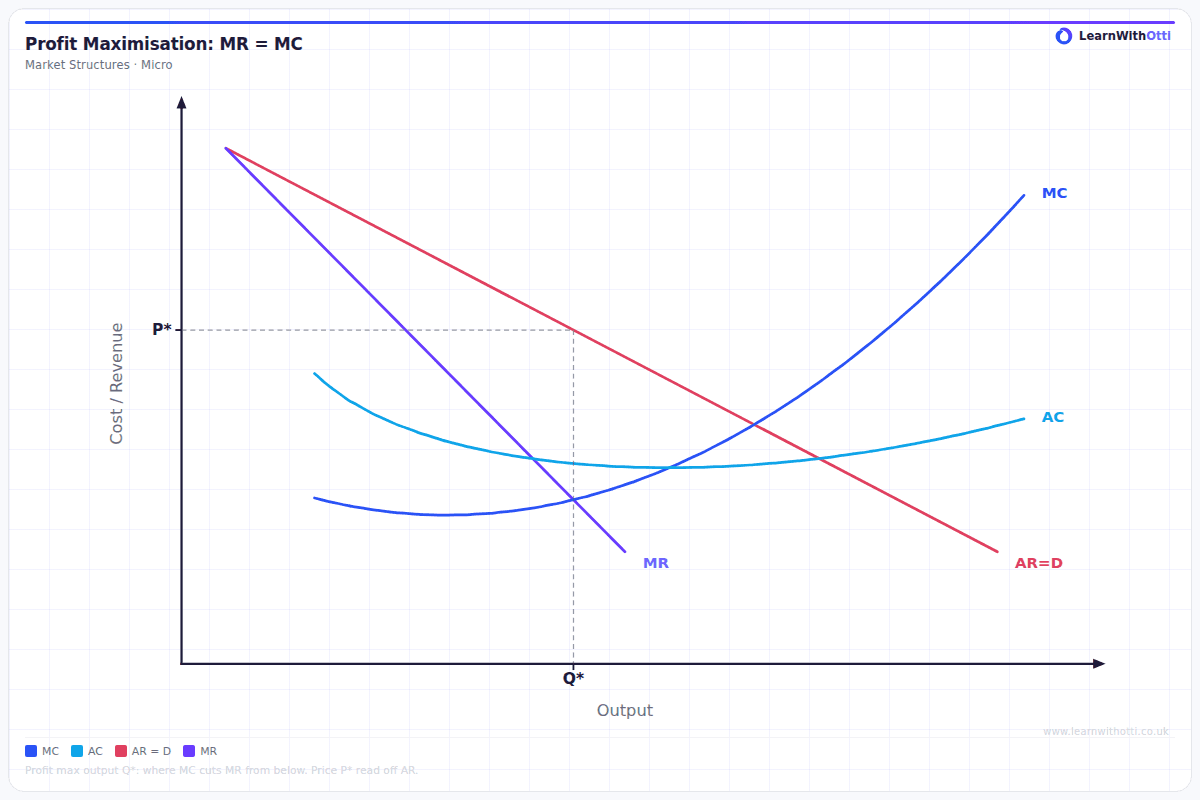
Profit is maximised where marginal cost equals marginal revenue (MC = MR), with MC cutting MR from below.
- Below this output, the next unit adds more to revenue than to cost (MR greater than MC), so expanding raises profit.
- Above it, the next unit adds more to cost than to revenue (MC greater than MR), so cutting output raises profit.
The condition that MC must cut MR from below rules out the point where MC is still falling. At that point, producing more would still add to profit.
MC = MR applies in every market structure. What differs between structures is the shape of the revenue curves.
Normal profit, supernormal profit and losses
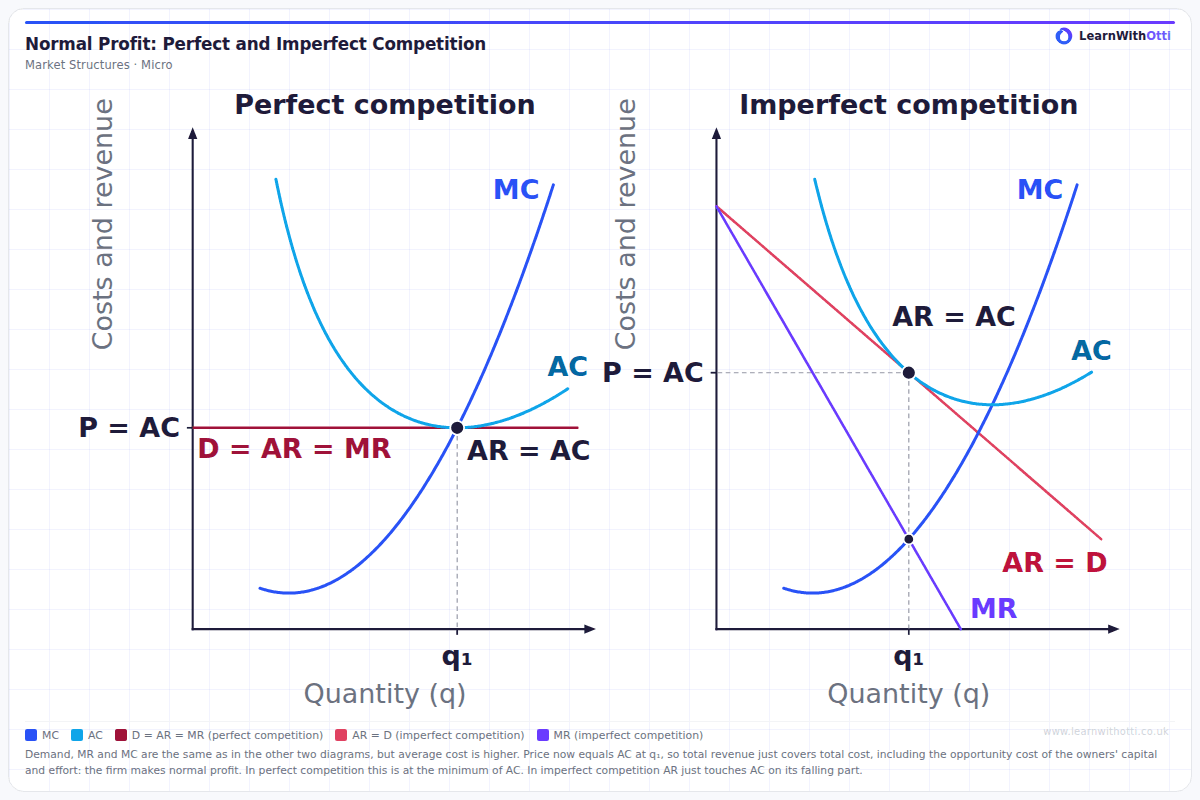
Normal profit is the minimum profit needed to keep the firm's resources in their current use. It is the return the entrepreneur could have earned in the next best alternative, so it is an opportunity cost.
Economists include normal profit in the firm's costs. This means that when average revenue equals average cost (AR = AC), the firm is making normal profit, even though its accountants would report a positive profit.
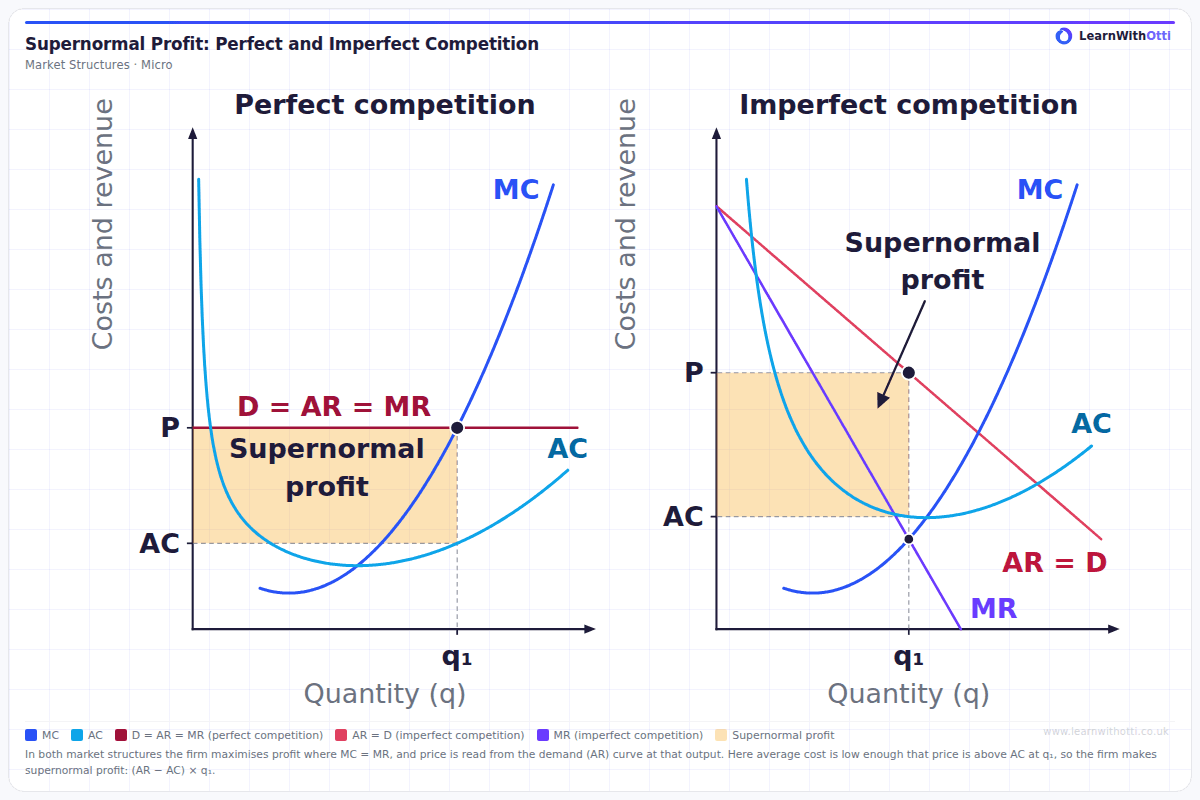
Supernormal (abnormal) profit is profit above normal profit.
- It occurs when AR is greater than AC at the profit-maximising output.
- On a diagram, it is the rectangle between price and AC, multiplied by output: (AR − AC) × Q.
- Supernormal profit signals that resources earn more here than elsewhere, which attracts new firms into the market if there are no barriers to entry.
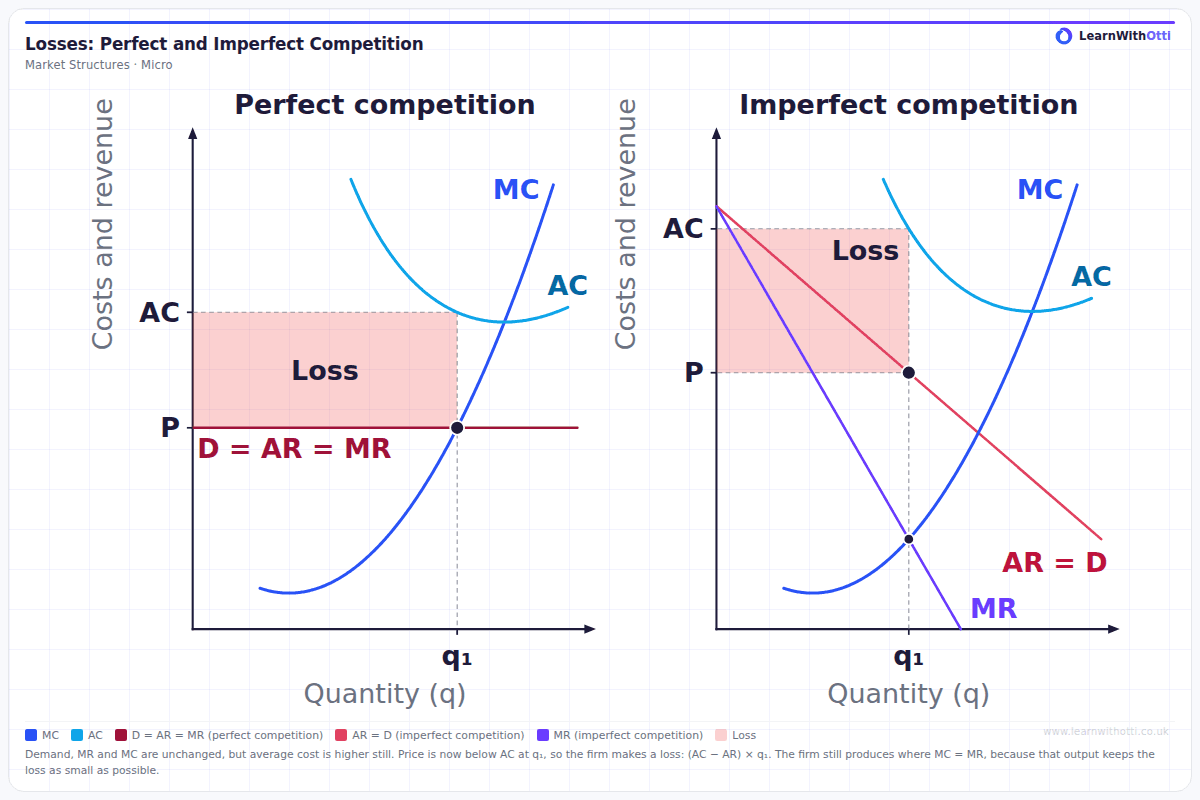
A loss (subnormal profit) occurs when AR is less than AC. The firm is not covering all its costs, including the opportunity cost of the entrepreneur's resources.
| Situation | Condition | Meaning |
|---|---|---|
| Supernormal profit | AR > AC | Earning more than the next best use of resources |
| Normal profit | AR = AC | Earning exactly enough to stay in this use |
| Loss | AR < AC | Earning less than the next best use of resources |
Short-run and long-run shut-down points
A firm making a loss does not necessarily stop producing straight away. The decision depends on whether it can cover its costs, and the answer differs between the short run and the long run.
In the short run Fixed costs must be paid whether the firm produces or not. So the relevant question is whether production covers variable costs.
- If price (AR) is at least equal to average variable cost (AVC), the firm should keep producing. Its revenue covers variable costs and makes some contribution to fixed costs, so the loss is smaller than if it shut down.
- If price falls below AVC, the firm should shut down. Producing only adds to its losses, because it cannot even cover the costs it would avoid by closing.
The short-run shut-down point is where AR = AVC, at the minimum point of the AVC curve.
In the long run All costs are variable, so the firm must cover all of them, including normal profit.
- If price is below AC in the long run, the firm should leave the industry, because its resources would earn more elsewhere.
The long-run shut-down point is where AR = AC, at the minimum point of the AC curve.
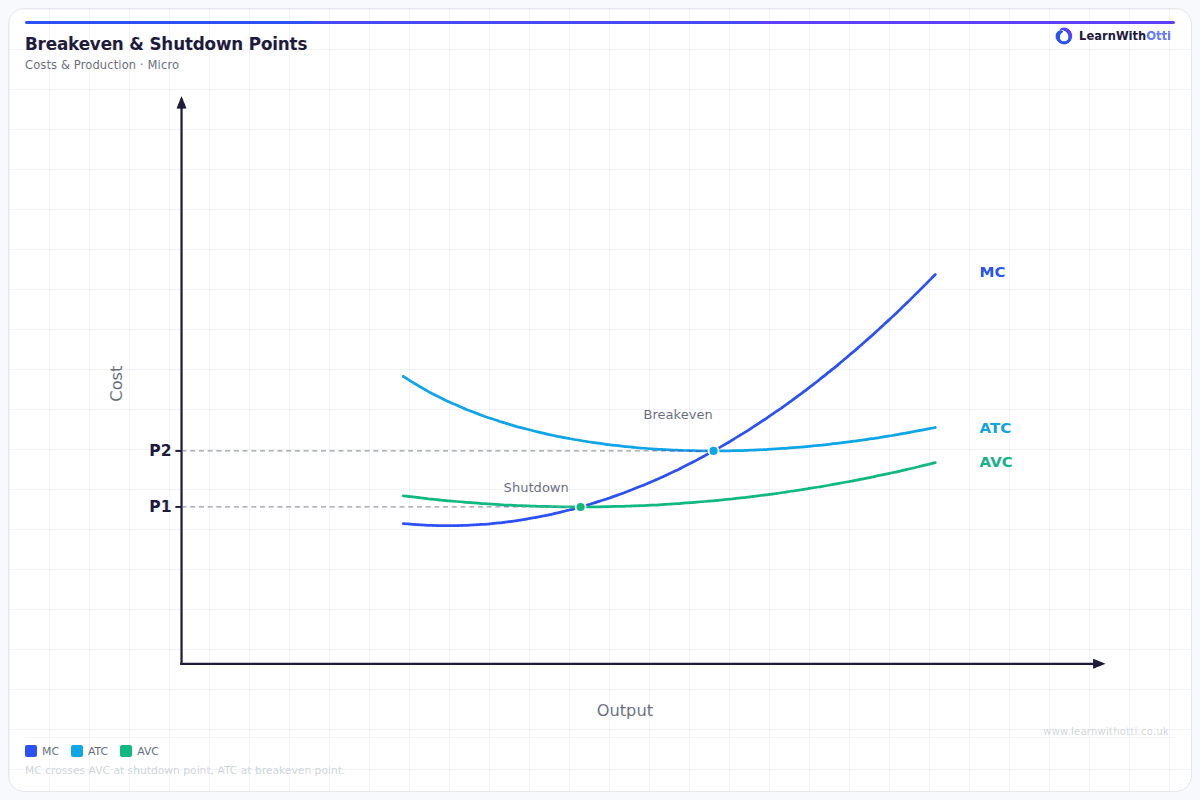
A worked example A firm sells 100 units at £8 each, so total revenue is £800. Its total variable cost is £600 and its fixed cost is £400.
- Total cost is £1,000, so it makes a loss of £200.
- If it shut down, it would still pay fixed costs of £400, a bigger loss.
- Revenue covers variable costs with £200 to spare, so it should continue in the short run.
- In the long run, if nothing changes, it should leave the industry.
Key terms
| Term | Meaning |
|---|---|
| Profit maximisation | Producing where MC = MR, with MC cutting MR from below |
| Normal profit | The minimum return needed to keep resources in their current use, counted as a cost |
| Supernormal profit | Profit above normal profit, where AR > AC |
| Loss | Where AR < AC, so not all costs including normal profit are covered |
| Short-run shut-down point | Where price falls below average variable cost |
| Long-run shut-down point | Where price falls below average cost |
Common mistakes
- Treating normal profit as zero accounting profit. It is a positive return, counted as a cost.
- Showing profit at the output where AR and AC are furthest apart. The firm produces where MC = MR, and profit is measured at that output.
- Shutting down as soon as a loss is made. In the short run, a firm covering AVC should keep producing.
- Using AC for the short-run shut-down point. The short-run comparison is with AVC.
- Forgetting "from below". MC must be rising as it cuts MR.
How this has been examined
In the Edexcel papers indexed on this site, this topic has appeared in five formats:
- 12-mark "Discuss" data response — asked 6 times across 5 series (2019 to 2023)
- 8-mark "Examine" data response — asked once (2018)
- 4-mark calculation — asked once (2019)
- 4-mark "Draw" diagram — asked once (2017)
- 2-mark calculation — asked once (2017)
The 12-mark data response is the most frequent format for this topic, appearing in five different series.
Where this goes next
The revenue and cost measures used here are in 3.3.1 Revenue and 3.3.2 Costs, and the alternatives to profit maximisation in 3.2.1 Business objectives. The way supernormal profit attracts entry and is competed away is central to 3.4.2 Perfect competition, while barriers that protect it are covered in 3.4.5 Monopoly.
End of topic 3.3
Quiz yourself on 3.3 Revenues, costs and profits
10 multiple-choice questions drawn from the 48 we have on the whole of topic 3.3, with instant feedback on every answer.
Start the 3.3 quiz →Otti is an AI tutor built for A-Level students. Ask it anything, practise exam questions, and get instant feedback written like an examiner would give it — not just right or wrong, but why.
Get one answer marked free