Edexcel A-Level Economics · Revision notes
4.1.8 Exchange rates
An exchange rate is the price of one currency in terms of another, such as £1 = $1.25. It matters because it changes the price of every export and import without any change in prices at home, so it affects trade, growth, jobs, inflation and investment. This topic covers how exchange rates are set, what moves them, how governments influence them, and what happens when they change.
Exchange rate systems
Floating exchange rates
The exchange rate is determined by the demand for and supply of the currency on the foreign exchange market, with no government target. The pound, the US dollar and the euro all float.
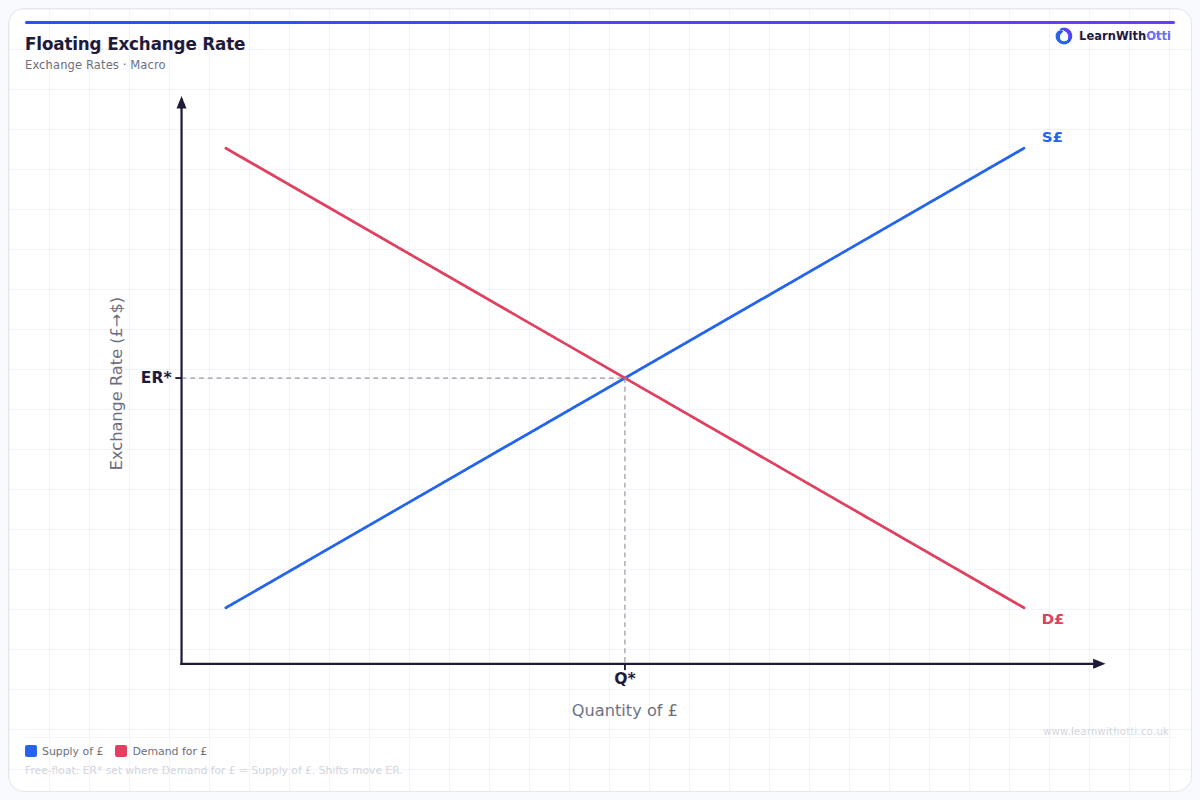
- Demand for pounds comes from foreigners buying UK exports, investing in the UK or saving in UK banks.
- Supply of pounds comes from UK residents buying imports, investing abroad or saving abroad, because they must sell pounds to buy foreign currency.
Fixed exchange rates
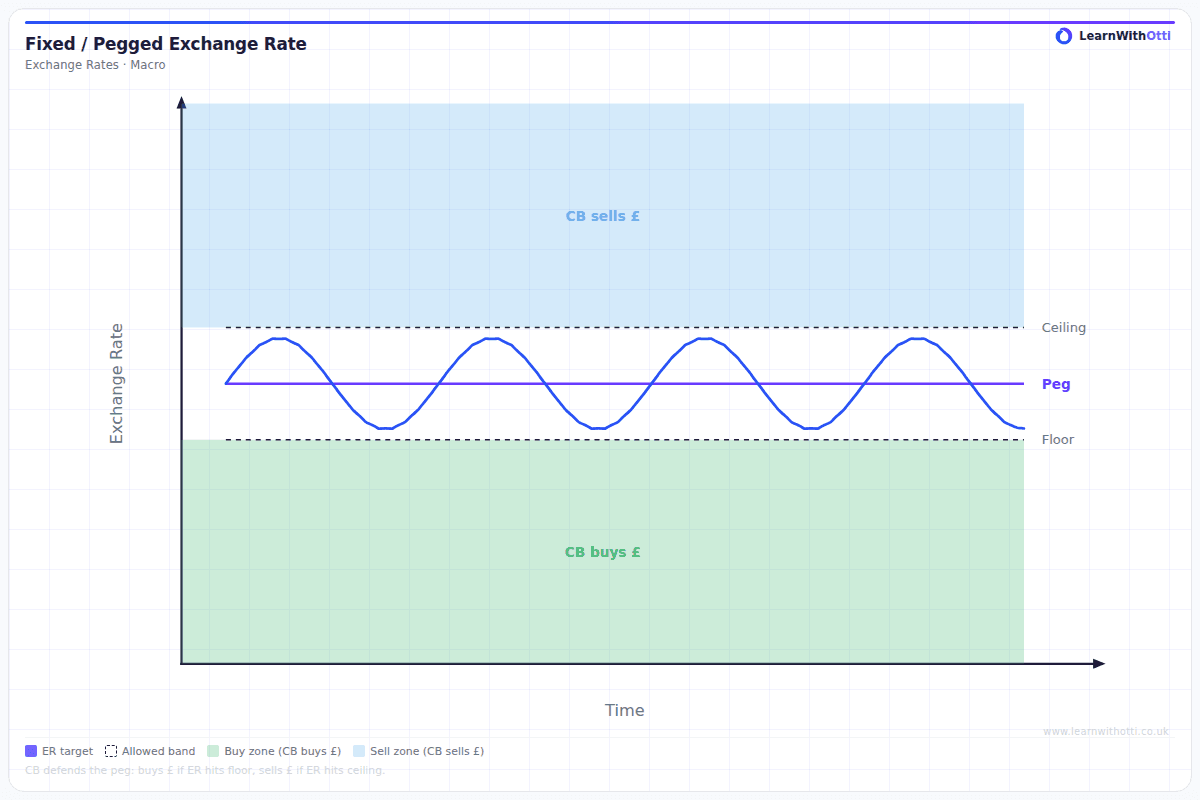
The government or central bank sets a target value against another currency, or a group of currencies, and intervenes to keep it there. Some Gulf states, for example, peg their currencies to the US dollar. Fixed systems usually allow the rate to move within a narrow band around the target.
Managed exchange rates
The currency floats, but the central bank intervenes from time to time to influence its value, either to keep it within an unofficial range or to smooth out sharp movements. This is sometimes called a managed float or a dirty float.
Appreciation, revaluation, depreciation and devaluation
The terms differ according to the exchange rate system:
| Rise in value | Fall in value | |
|---|---|---|
| Floating rate (market forces) | Appreciation | Depreciation |
| Fixed rate (government decision) | Revaluation | Devaluation |
Key distinction: So the pound depreciates when market forces push its value down. A country with a fixed rate devalues when its government deliberately sets a lower target.
A worked example
The exchange rate falls from £1 = $1.25 to £1 = $1.10.
- A UK car priced at £20,000 cost an American buyer $25,000 (20,000 × 1.25). It now costs $22,000 (20,000 × 1.10). UK exports become cheaper abroad.
- An American product priced at $50 cost a UK buyer £40 (50 ÷ 1.25). It now costs about £45.45 (50 ÷ 1.10). Imports become dearer in the UK.
Factors influencing floating exchange rates
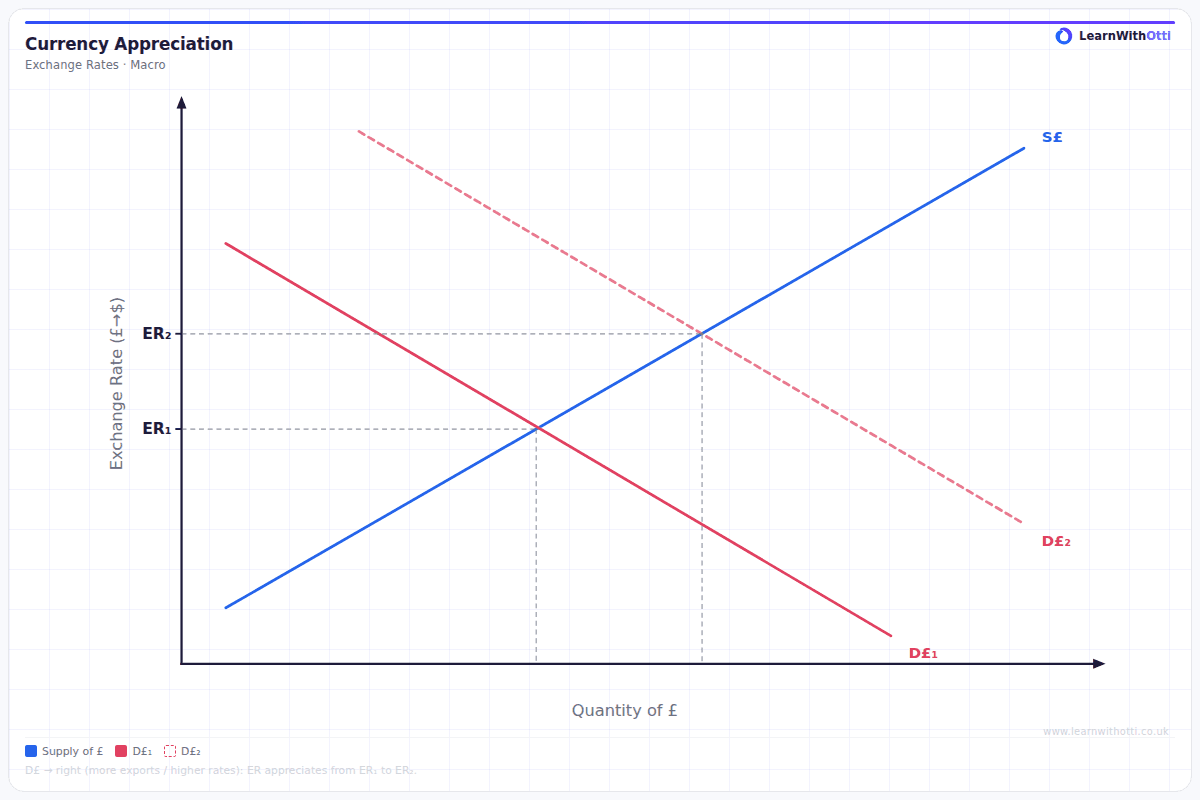
- Interest rates. Higher UK interest rates attract savings from abroad (hot money), raising demand for pounds and causing an appreciation.
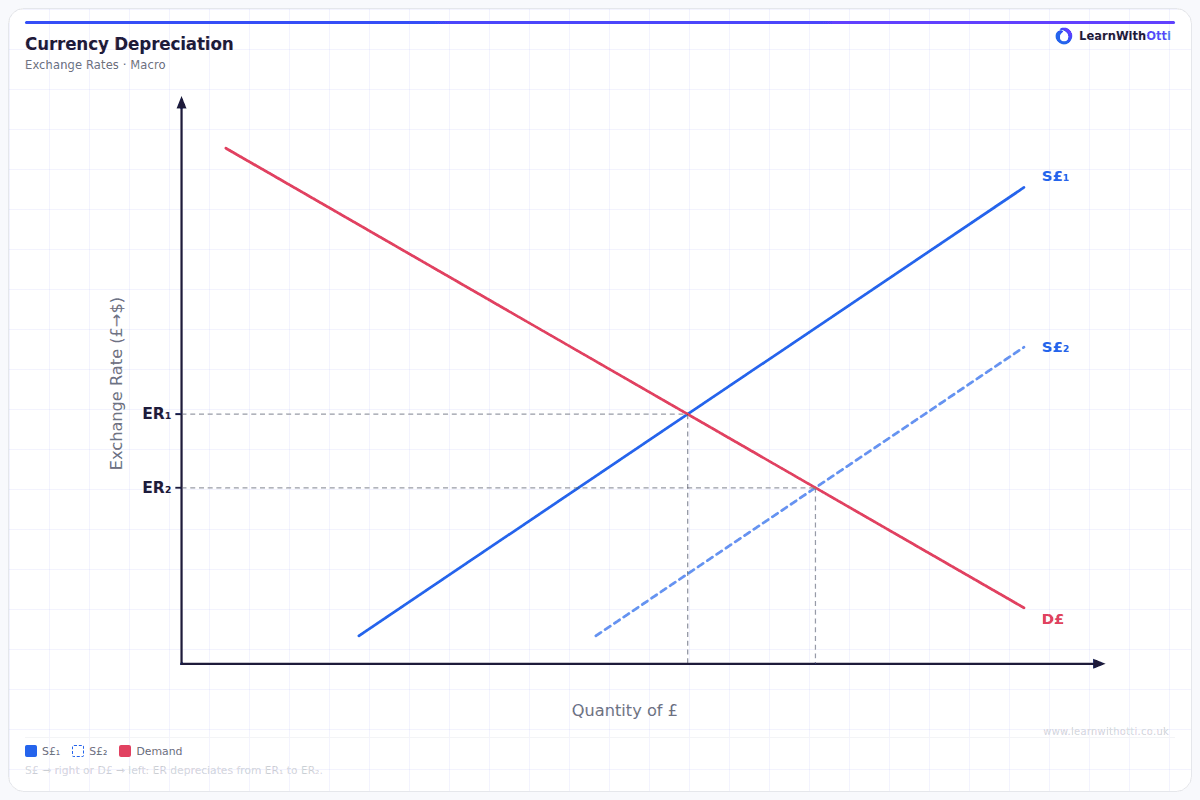
- Trade flows. Rising demand for UK exports increases demand for pounds; rising imports increase the supply of pounds.
- Relative inflation. If UK inflation is higher than in other countries, UK goods become less competitive, demand for exports falls and the pound tends to depreciate.
- Foreign direct investment. Foreign firms building factories in the UK must buy pounds, raising demand for the currency.
- Speculation. Traders buy currencies they expect to rise and sell those they expect to fall, and their expectations can become self-fulfilling.
- Confidence and political stability. Uncertainty about economic policy can cause investors to sell a currency. The pound fell sharply after the 2016 EU referendum result.
Government intervention in currency markets
Governments and central banks can influence the exchange rate in two ways:
- Buying and selling currency. To raise the value of the pound, the Bank of England can use its reserves of foreign currency to buy pounds, increasing demand. To lower it, it can sell pounds, increasing supply.
- Changing interest rates. Raising interest rates attracts hot money and pushes the currency up; cutting them pushes it down.
Both have limits. Reserves can run out, and interest rates also affect inflation and growth at home, so using them to target the exchange rate can conflict with other objectives.
Competitive devaluation and depreciation
A competitive devaluation (or depreciation) is when a country deliberately lowers its exchange rate to make its exports cheaper and gain a trade advantage over other countries.
The consequences:
- Retaliation. Other countries may lower their own exchange rates in response, so no one gains a lasting advantage. This is sometimes called a currency war.
- Imported inflation. A lower exchange rate raises the price of imports, including raw materials and energy, pushing up inflation.
- A beggar-thy-neighbour effect. One country's gain in exports comes at the expense of its trading partners, which can damage world trade as a whole.
- Reduced pressure to improve competitiveness. A cheaper currency can hide underlying problems such as low productivity.
The impact of changes in exchange rates
The current account of the balance of payments
A depreciation makes exports cheaper and imports dearer, which should improve the current account. Two refinements matter.
- The Marshall-Lerner condition. A depreciation improves the current account only if the price elasticity of demand for exports plus the price elasticity of demand for imports, ignoring signs, is greater than 1. If demand is inelastic, the higher spending on dearer imports can outweigh the gain from extra exports.
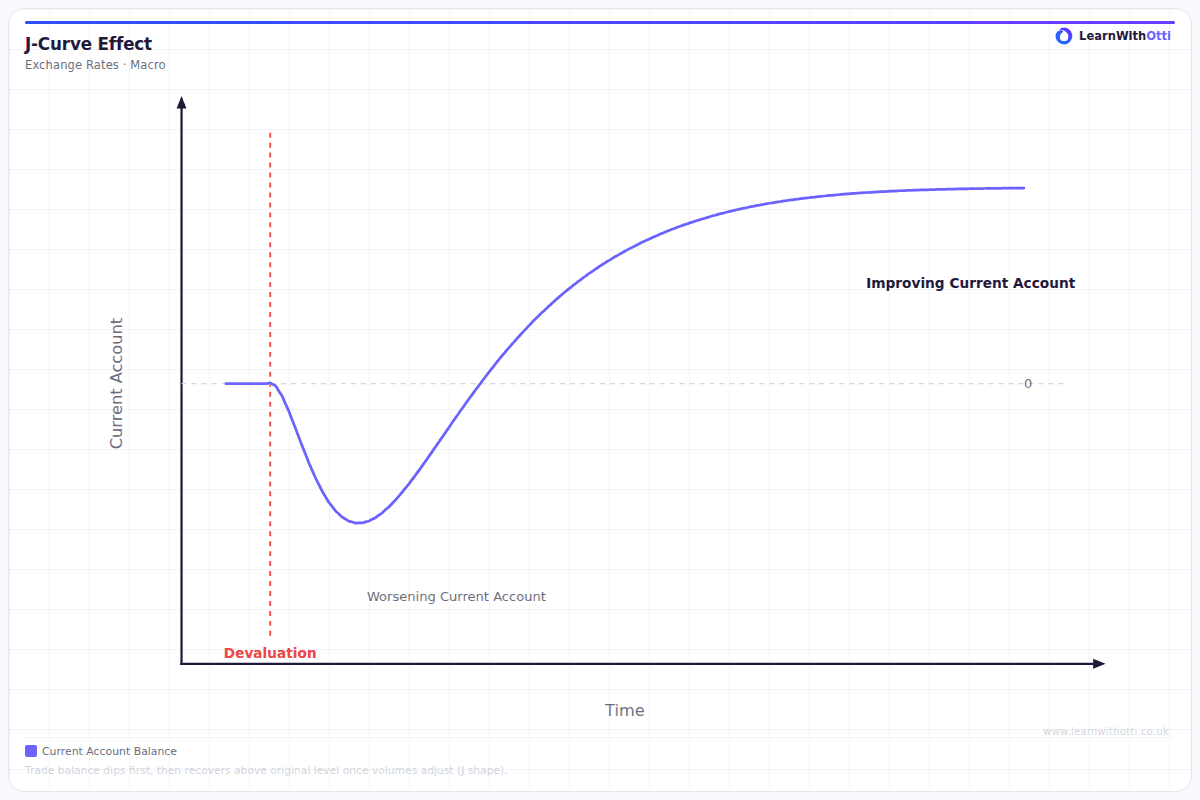
- The J-curve effect. In the short run, demand for exports and imports tends to be inelastic, because contracts are already signed and buyers take time to switch. So the current account may first get worse after a depreciation, then improve as demand becomes more elastic over time. Plotted over time, the path traces the shape of a J.
Economic growth and employment
A depreciation increases net exports, which raises aggregate demand. Output rises, and firms in export industries and those competing with imports take on more workers, so unemployment falls. An appreciation has the opposite effect.
The rate of inflation
A depreciation raises inflation in two ways: imported goods and raw materials become dearer (cost-push), and higher net exports increase AD (demand-pull). It also reduces the pressure on domestic firms to keep costs down. An appreciation lowers inflation.
Foreign direct investment flows
A lower exchange rate makes UK assets cheaper for foreign firms, which can encourage FDI. But a volatile or persistently falling currency can deter it, because it reduces the value of profits when they are converted back into the investor's own currency.
Key terms
| Term | Meaning |
|---|---|
| Exchange rate | The price of one currency in terms of another |
| Floating exchange rate | An exchange rate set by market demand and supply |
| Fixed exchange rate | An exchange rate held at a target value by government intervention |
| Managed exchange rate | A floating rate with occasional central bank intervention |
| Appreciation / depreciation | A rise / fall in a floating exchange rate |
| Revaluation / devaluation | A deliberate rise / fall in a fixed exchange rate |
| Hot money | Short-term financial flows that move between countries in search of higher interest rates |
| Marshall-Lerner condition | A depreciation improves the current account if the sum of the export and import price elasticities exceeds 1 |
| J-curve effect | The tendency for the current account to worsen before improving after a depreciation |
Common mistakes
- Mixing up depreciation and devaluation. Depreciation happens through the market; devaluation is a government decision.
- Getting the direction of price changes wrong. A fall in the pound makes exports cheaper abroad and imports dearer at home.
- Assuming a depreciation always improves the current account. It depends on the Marshall-Lerner condition, and the J-curve means it may worsen first.
- Stating the Marshall-Lerner condition with a sign error. The elasticities are added ignoring their minus signs.
- Forgetting the inflation cost of a depreciation. Dearer imports raise costs and prices.
How this has been examined
In the Edexcel papers indexed on this site, this topic has appeared in eight formats:
- 25-mark "Evaluate" essay — asked once (2018)
- 25-mark "Evaluate" synoptic essay — asked once (2022)
- 10-mark "Assess" data response — asked once (2017)
- 8-mark "Examine" data response — asked twice across 2 series (2019 to 2020)
- 5-mark calculation — asked once (2017)
- 5-mark "Explain" data response — asked 3 times across 3 series (2017 to 2024)
- 4-mark "Explain" data response — asked once (2021)
- 1-mark multiple choice — asked 3 times across 3 series (2020 to 2022)
It has appeared at every tariff from 1 to 25 marks.
Where this goes next
Exchange rates feed into the current account covered in 4.1.7 Balance of payments, and into price competitiveness in 4.1.9 International competitiveness. Their effect on aggregate demand through net trade is introduced in 2.2.5 Net trade (X-M). Interest rates as a policy tool are covered in 2.6.2 Demand-side policies, and the role of the central bank in 4.4.3 Role of central banks.
Otti is an AI tutor built for A-Level students. Ask it anything, practise exam questions, and get instant feedback written like an examiner would give it — not just right or wrong, but why.
Get one answer marked free