Edexcel A-Level Economics · Revision notes
4.1.3 Pattern of Trade
What the specification covers
In our own words — not the official specification wording
What determines which countries trade with which, and why those flows shift over time.
- The influences on who trades with whom, and on how those flows change:
- Which goods a country can produce at a lower opportunity cost than its trading partners.
- How fast-growing economies have changed the shape of world trade.
- The spread of regional and country-to-country trade agreements.
- How a currency's value against others alters the competitiveness of a country's goods.
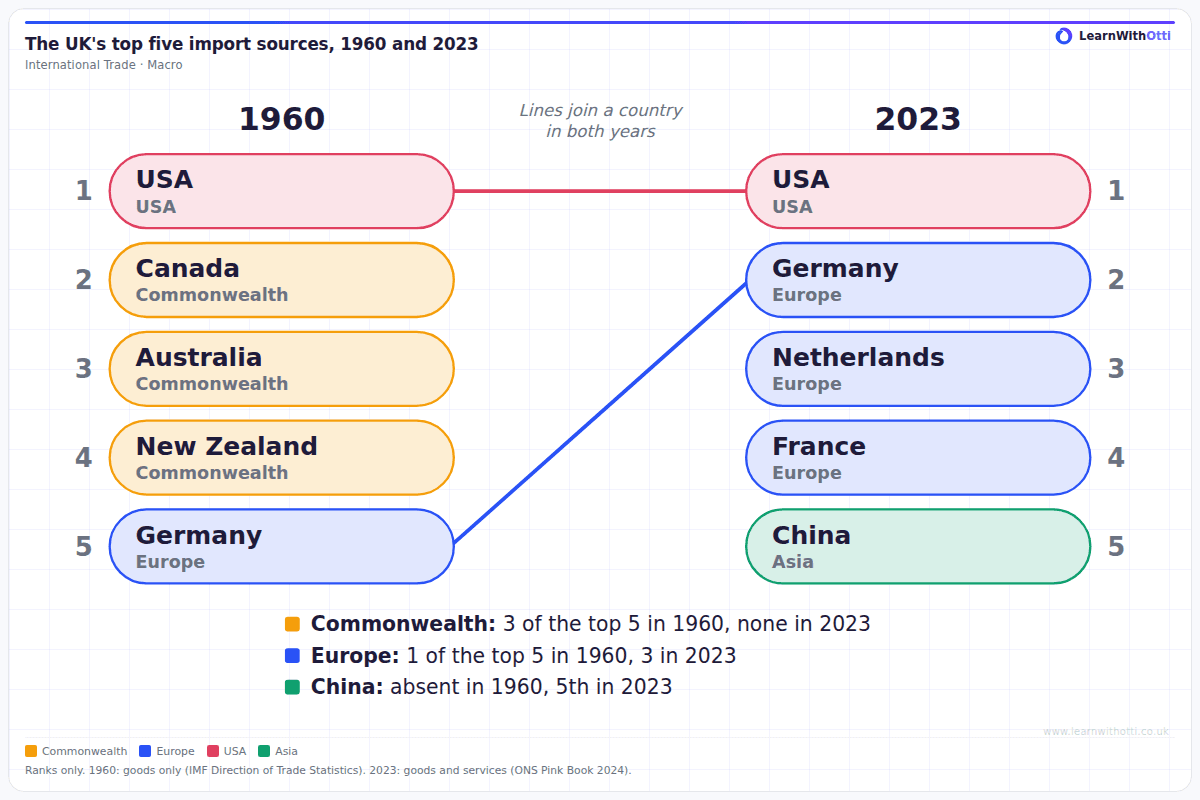
Comparative advantage explains why countries trade. It does not fully explain who trades with whom, or why those patterns shift. Britain's largest trading partners today are not the ones they were in 1960, as the first diagram shows. The reasons for that change are what this topic covers.
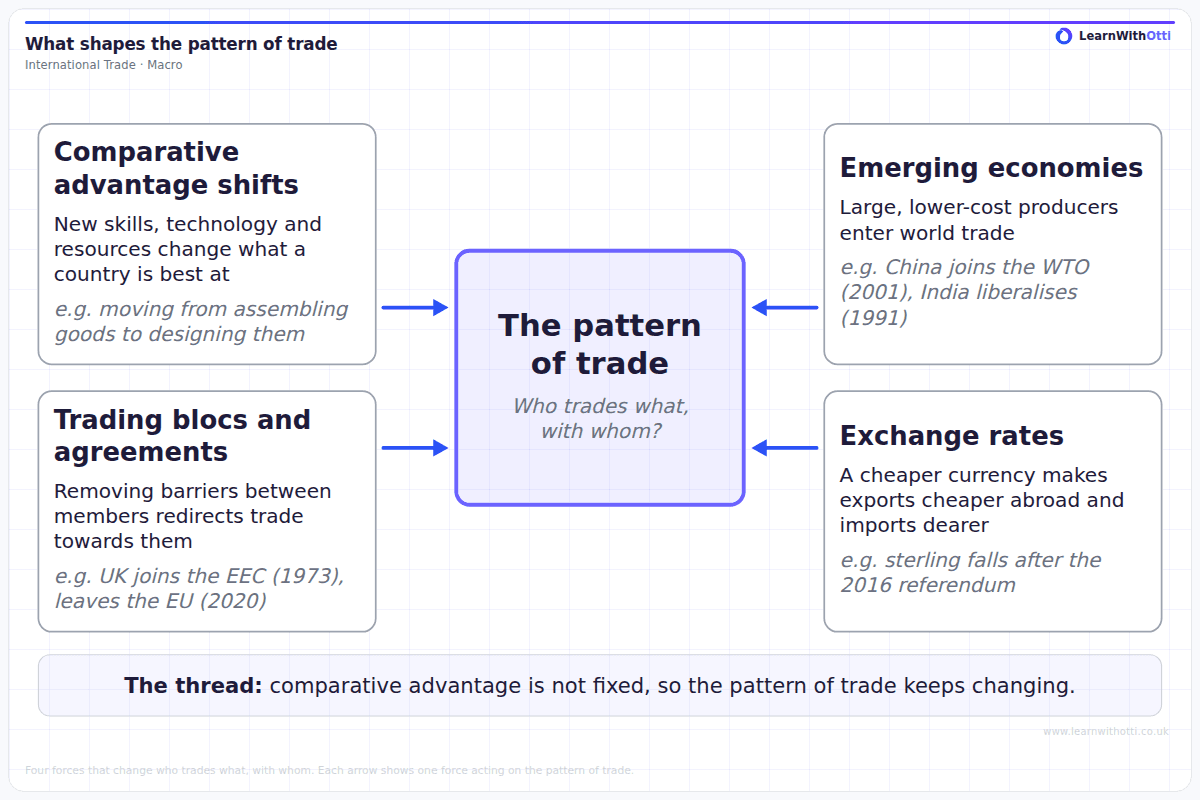
Four forces drive changes like these, and each has its own section below.
Comparative advantage
The underlying driver remains comparative advantage: countries tend to export goods they can produce at a lower opportunity cost than their partners.
But comparative advantage is not fixed. It shifts as the things underlying it shift:
- Factor endowments change. Resources are discovered or exhausted; populations age; capital accumulates.
- Technology changes. An innovation can hand a country an advantage it did not previously have.
- Skills and education change. A country that invests in human capital moves up the value chain, from assembly into design.
Key idea: So the pattern of trade is comparative advantage in motion, not a fixed allocation.
The impact of emerging economies
The single largest change in world trade over the past forty years has been the entry of large, lower-cost producers.
China's reforms from 1978 and its WTO accession in 2001 added hundreds of millions of workers to the traded economy. India's liberalisation from 1991 did similarly, with a stronger weighting towards services.
The effects on trade patterns:
- Manufacturing shifted towards lower-cost economies, so developed economies import more manufactured goods and export more services and high-value goods.
- Commodity demand rose sharply, benefiting resource exporters in Africa, Latin America and Australia, and tying their fortunes to Chinese growth.
- South-south trade grew. Emerging economies increasingly trade with each other rather than only with developed economies.
- Developed economies' manufacturing shrank as a share of output, with job losses concentrated in particular industries and regions.
Trading blocs and bilateral agreements
Membership of a trading bloc reshapes trade patterns in two distinct ways:
- Trade creation. Removing barriers between members means production shifts to the lower-cost producer within the bloc. This raises welfare.
- Trade diversion. A common external barrier means members buy from a higher-cost partner inside the bloc rather than a lower-cost producer outside it. This lowers welfare.
Evaluation: Whether a bloc improves things overall depends on which effect dominates.
The UK's EU membership increased trade with Europe and reduced it with Commonwealth countries — creation and diversion operating together.
Bilateral agreements between two countries have the same effects on a smaller scale, and have multiplied as progress through the WTO has slowed.
Changes in relative exchange rates
A currency's value alters the competitiveness of everything a country sells.
If sterling depreciates, UK exports become cheaper in foreign currency and imports dearer in sterling. Export volumes tend to rise and import volumes to fall, shifting the pattern of trade.
Two qualifications matter:
- The effect depends on elasticities. If demand for exports and imports is price-inelastic, a depreciation may worsen the trade balance before it improves it — the J-curve effect, with the Marshall-Lerner condition setting out when a depreciation improves the balance at all.
- Exchange rate moves can be temporary, while trade relationships take years to build. A short-lived depreciation may change little.
Other influences
- Transport and communication costs, which have fallen dramatically and made fragmented supply chains viable.
- Geography, which still matters: countries trade disproportionately with neighbours.
- Historical and cultural links, including language and former colonial relationships.
- Protectionism, which can redirect flows deliberately.
Key terms
| Term | Meaning |
|---|---|
| Pattern of trade | Which goods a country trades, and with which partners |
| Emerging economy | A rapidly industrialising economy with rising income levels |
| Trade creation | A shift to a lower-cost producer within a bloc after barriers fall |
| Trade diversion | A shift to a higher-cost producer inside a bloc, away from a cheaper outside one |
| Depreciation | A fall in a currency's value against others |
| Marshall-Lerner condition | The combined elasticity condition under which a depreciation improves the trade balance |
Common mistakes
- Treating comparative advantage as permanent. It moves with technology, skills and resources, which is precisely why trade patterns change.
- Mixing up trade creation and trade diversion. Creation shifts production to a cheaper producer and raises welfare; diversion shifts it to a dearer one and lowers it.
- Assuming a depreciation automatically improves the trade balance. It depends on elasticities, and in the short run the balance may worsen.
- Describing changes without explaining them. The economics is in why the pattern shifted, not in the observation that it did.
How this has been examined
In the Edexcel papers indexed on this site, this topic has appeared as:
- 25-mark "Evaluate" essay — asked once (2019)
It has been examined at full essay length rather than in short items, which fits content built around explaining change over time.
Where this goes next
The theory underpinning this is 4.1.2 Specialisation and trade, and the price ratio it produces is 4.1.4 Terms of trade. Blocs and the WTO are covered in 4.1.5 Trading blocs and the World Trade Organisation (WTO), and the barriers that redirect flows in 4.1.6 Restrictions on free trade. The exchange rate mechanics appear in 4.1.8 Exchange rates, and the record of these flows in 4.1.7 Balance of payments.
Otti is an AI tutor built for A-Level students. Ask it anything, practise exam questions, and get instant feedback written like an examiner would give it — not just right or wrong, but why.
Get one answer marked free