Edexcel A-Level Economics · Revision notes
4.1.6 Restrictions on Free Trade
What the specification covers
In our own words — not the official specification wording
Why governments restrict trade despite the case for free trade, the instruments they use, and who gains and loses as a result.
- The arguments governments make for limiting imports.
- The instruments used to restrict trade:
- A tax on imported goods.
- A physical limit on the quantity that may be imported.
- Payments to home producers that lower their costs relative to foreign rivals.
- Rules and standards that raise the cost of importing without taxing it directly.
- Who gains and who loses from protection: shoppers, firms, the government, living standards and the distribution of income.
If free trade raises world output, why does almost every country restrict it? Because the gains and losses from trade fall on different people, and the losers are usually concentrated, visible and politically organised while the gainers are dispersed and quiet.
Reasons for restricting trade
Infant industry argument. A new domestic industry cannot yet compete with established foreign firms that already enjoy economies of scale. Temporary protection gives it time to grow, so that its average costs fall as output rises and it can eventually compete without help. The weakness is practical: protection intended as temporary rarely ends, because the industry lobbies to keep it, and firms sheltered from competition have little incentive to become efficient.
Protecting employment. Imports displace domestic production and jobs, often concentrated in particular towns, where the loss of one large employer can hit the whole local economy. Restricting imports can slow this decline and give workers time to retrain. The counter-argument is that protection preserves jobs in inefficient industries at the cost of jobs elsewhere, and raises prices for everyone. Higher import prices also raise costs for firms that use imported inputs, which can cost jobs in those industries.
Preventing dumping. Dumping is selling exports below cost, or below the home market price, to drive out competitors. Once domestic firms have left the market, the foreign firm may raise its prices, so consumers gain only in the short run. Anti-dumping duties are permitted under WTO rules. The difficulty is proving it: a genuinely lower-cost producer looks much the same from outside.
Correcting a trade deficit. Restricting imports improves the balance directly, because spending switches from foreign to domestic goods. But it invites retaliation, which reduces exports and can cancel out the gain. It also does nothing about the underlying lack of competitiveness, so the deficit is likely to return once the restrictions are removed.
National security. A country may not wish to depend on imports for food, energy or defence. The argument is economically weak in normal times, because buying from the cheapest supplier is usually more efficient, but it carries much more weight when supply chains break. The Covid-19 pandemic and the rise in gas prices in 2022 showed how quickly an economy can be hit when essential imports are disrupted.
Protecting standards. Imports produced to lower environmental or labour standards may be restricted. Without restrictions, domestic firms that meet higher standards face higher costs and can be undercut by imports. This can be genuine, or protectionism wearing a respectable coat, because strict standards can also be used to keep out imports that are perfectly safe.
Raising revenue. Tariffs are relatively easy to collect, because goods pass through a small number of ports and border points. This matters more for developing economies with limited administrative capacity, where collecting income tax from a large informal economy is difficult.
Retaliation. A country may impose restrictions in response to another country's tariffs or quotas, to put pressure on it to remove them. This is why trade disputes escalate: each new restriction invites a response, and both sides end up trading less.
Types of restriction
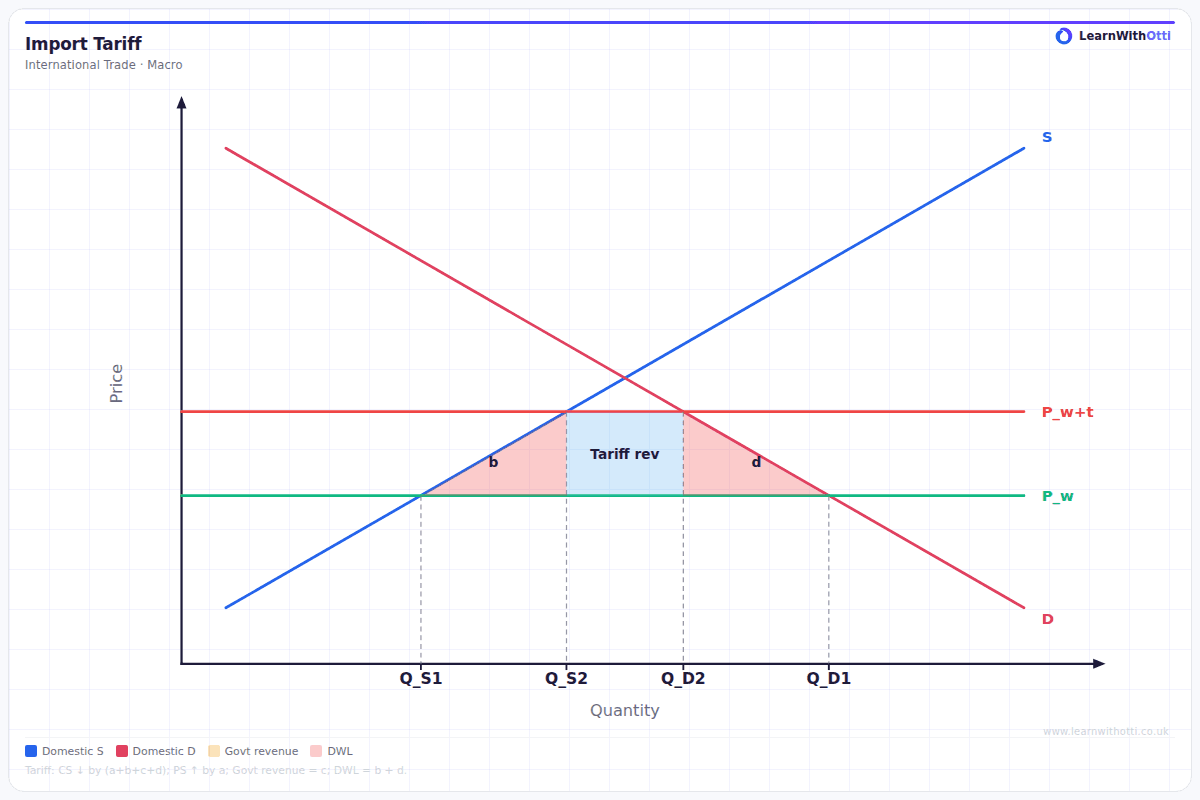
Tariffs — a tax on imports. The domestic price rises by the tariff, so domestic production rises, imports fall, and the government collects revenue. Consumers pay more and consume less, and the loss to consumers exceeds the gains to producers and government combined — the net welfare loss. This loss arises because some goods are now made by less efficient domestic firms, and some consumers who valued the good above the world price no longer buy it.
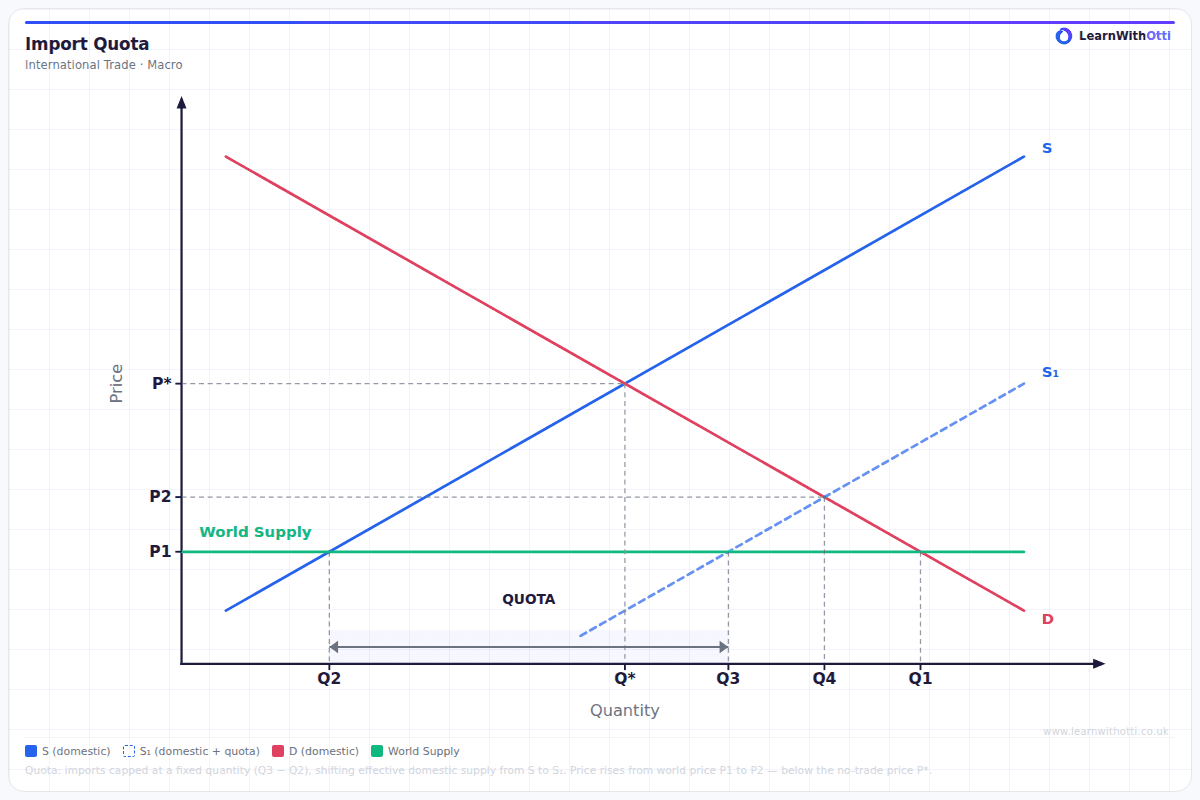
Quotas — a physical limit on the quantity imported.
Key distinction: The effect on price and quantity resembles a tariff, with one key difference: the government collects no revenue. The gain from the higher price goes to whoever holds the import licences, often foreign producers.
Because the quantity of imports is fixed, a rise in domestic demand cannot be met by more imports, so it pushes the price up further than it would under a tariff.
Subsidies to domestic producers — payments that lower domestic costs, letting home firms undercut imports. Domestic output rises and imports fall, but the cost falls on taxpayers rather than consumers, and consumer prices do not rise. Subsidies have an opportunity cost, because the money could have been spent on health, education or other priorities, and they can be hard to remove once firms depend on them.
Non-tariff barriers — everything else:
- Product standards and safety regulations. Foreign firms must adapt their products to meet domestic rules, which raises their costs, even when the rules have a genuine safety purpose.
- Complex customs procedures and documentation. Delays at the border and extra paperwork raise the cost of importing, especially for small firms and for goods that perish quickly.
- Licensing requirements. Importers must obtain a licence before goods can enter, which lets the government limit imports without declaring an open quota.
- Government procurement favouring domestic suppliers. Public bodies buy from home firms even when foreign firms are cheaper, which raises costs for taxpayers.
- Voluntary export restraints. The exporting country agrees to limit its own exports, usually to avoid tougher restrictions. The effect is similar to a quota.
Non-tariff barriers have grown in importance as tariffs have fallen, because they are harder to measure and harder to challenge.
The impact of protection
Key idea: Consumers lose. Prices rise, choice narrows, and the burden falls hardest on low-income households, who spend a larger share of income on traded goods. Protection is therefore usually regressive.
With less competition from imports, domestic firms also face less pressure to improve quality or keep prices down.
Domestic producers of the protected good gain: higher prices, higher output, more employment. Producers who use the protected good as an input lose, since their costs rise — a steel tariff helps steelmakers and harms carmakers. In the long run, protected firms may become less efficient, because they no longer have to compete with the best producers in the world.
Government gains revenue from tariffs, nothing from quotas, and pays out under subsidies. Tariff revenue may also shrink over time, because the tariff reduces the quantity of imports on which it is collected.
Living standards generally fall. Resources are retained in industries where the country lacks comparative advantage, so output is lower than it could be. Consumers pay more for goods that could be bought more cheaply abroad, so their real incomes fall.
Equality is usually worsened, for the reason above: higher prices for necessities hit poorer households hardest. Meanwhile, the gains go mainly to the owners and workers of the protected industries.
Foreign producers lose access, and developing economies dependent on agricultural exports are particularly exposed to developed-country agricultural protection. Lower export earnings reduce their ability to pay for imports of capital goods, which can slow their growth and development.
The wider world loses, because retaliation can escalate into a trade war in which every participant ends up worse off. As trade falls, countries lose the benefits of specialisation and comparative advantage, so world output falls.
Evaluating protectionism
Three questions usually decide the answer:
- How long? Is the protection temporary or permanent?
- Who bears the cost? The costs are dispersed across consumers and the benefits concentrated among producers, which explains the politics.
- Will there be retaliation? A restriction that provokes retaliation may leave the imposing country worse off overall.
Evaluation: Temporary protection for a genuine infant industry is defensible; permanent protection for a declining industry is a subsidy to inefficiency.
Key terms
| Term | Meaning |
|---|---|
| Tariff | A tax on imported goods |
| Quota | A physical limit on the quantity that may be imported |
| Non-tariff barrier | A restriction other than a tax or quota, such as standards or procedures |
| Dumping | Selling exports below cost or below the home market price |
| Infant industry | A new domestic industry not yet at efficient scale |
| Protectionism | The use of restrictions to shield domestic producers from imports |
| Net welfare loss | The loss to consumers not offset by gains to producers and government |
Common mistakes
- Saying a quota raises government revenue. It does not — that is the main economic difference from a tariff.
- Treating a subsidy as raising consumer prices. It lowers producer costs; the cost falls on taxpayers.
- Arguing protection saves jobs without qualification. It preserves jobs in the protected industry while raising costs elsewhere, and may destroy jobs in industries that use the input.
- Forgetting retaliation. The response of trading partners usually determines whether the policy works.
- Omitting the distributional point. Protection is generally regressive, and that is one of the strongest things to say about it.
How this has been examined
In the Edexcel papers indexed on this site, this topic has appeared in four formats:
- 25-mark "Evaluate" essay — asked twice across 2 series (2017 to 2022)
- 12-mark "Discuss" data response — asked once (2021)
- 10-mark "Assess" data response — asked once (2020)
- 4-mark "Explain" data response — asked once (2024)
Where this goes next
The case against restriction rests on 4.1.2 Specialisation and trade, and the institutions that try to reduce barriers are covered in 4.1.5 Trading blocs and the World Trade Organisation (WTO). The effect on trade flows appears in 4.1.3 Pattern of trade and on the external accounts in 4.1.7 Balance of payments. The welfare analysis uses consumer and producer surplus from 1.2.8 Consumer and producer surplus, and the tariff diagram is the indirect-tax analysis of 1.2.9 Indirect taxes and subsidies applied internationally.
Otti is an AI tutor built for A-Level students. Ask it anything, practise exam questions, and get instant feedback written like an examiner would give it — not just right or wrong, but why.
Get one answer marked free